
I have this conversation almost every week. Someone books a call and opens with “I think what I really need is a mentor.”
Twenty minutes in, it is obvious they need a coach. The problem is not a shortage of answers. It is that every answer they already have keeps dying somewhere between the idea and the diary.
Sometimes it runs the other way. A founder asks about coaching when what they need is ninety minutes with someone who has already sold a business in their sector. Getting that choice wrong costs months, and in London it costs thousands.
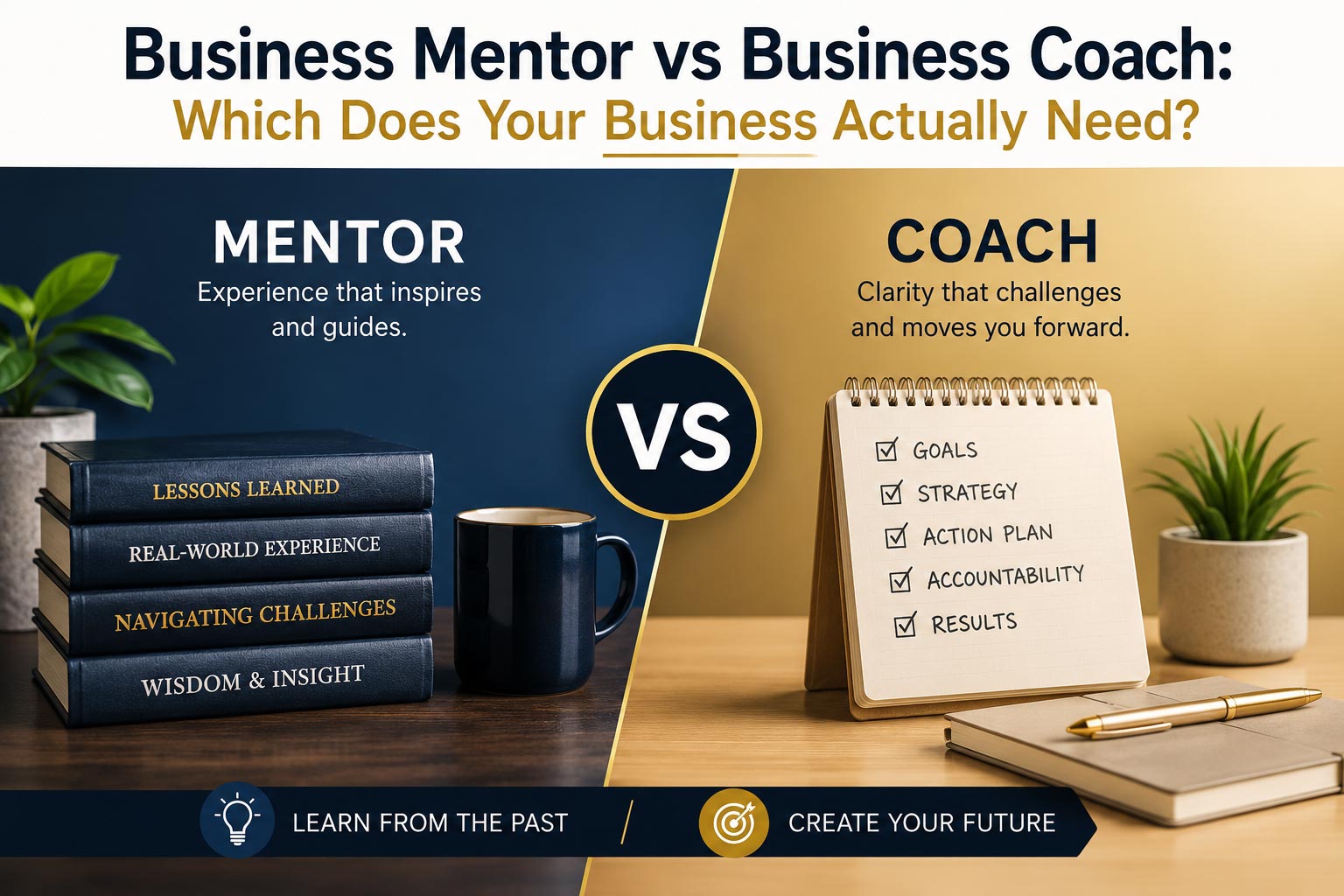
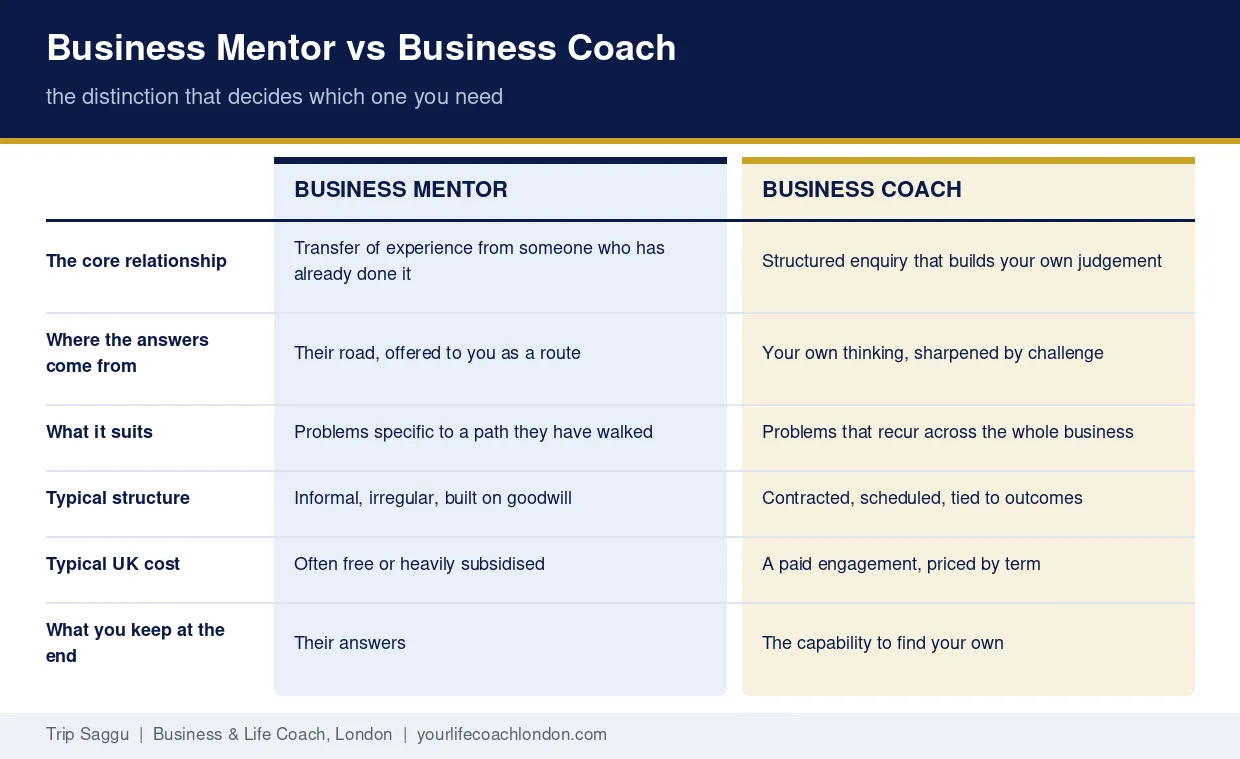
Here is the short version. A business mentor gives you their road. A business coach builds your ability to find your own.
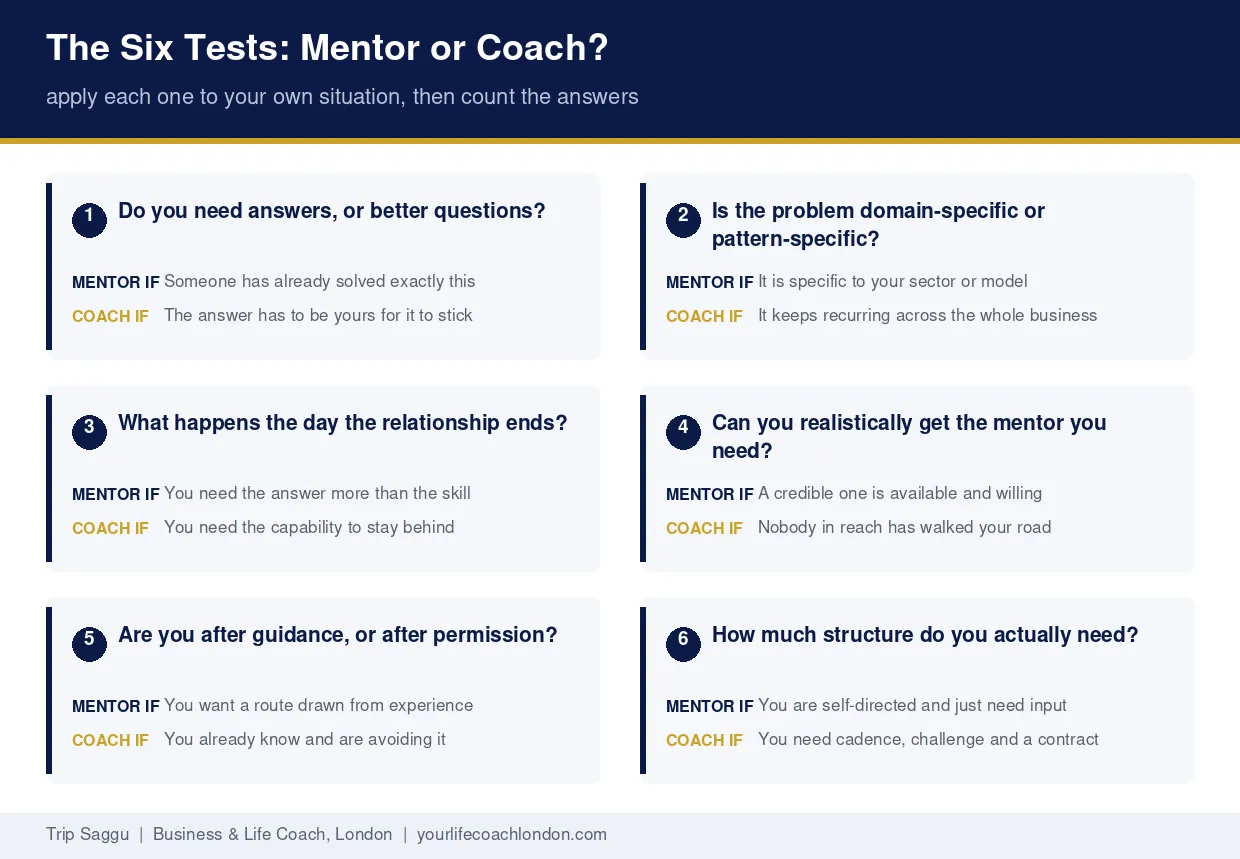
Below are six tests you can apply today, the subsidised UK mentoring routes with current prices and dates, what the research honestly says, and the point at which you should not be paying me at all.
Business Mentor vs Business Coach: The Difference in One Line
The cleanest definitions come from the European Mentoring and Coaching Council, which sets professional standards for both disciplines across Europe.
The EMCC defines mentoring as “a learning partnership through the transfer of skills and knowledge from a more experienced person to a less experienced person”. Coaching, by the same source, is the art of helping someone develop their own professional and personal potential.
Read those twice and the difference jumps out. Mentoring is defined by a transfer, so it only works if the mentor has the thing in the first place. Coaching is defined by development, because the raw material was always yours.
That single distinction drives everything else: who talks more, what you pay, and what is left behind when it ends.
Where the two genuinely overlap
Let me be honest about something the industry glosses over. Almost every good coaching relationship contains moments of mentoring, and the reverse is equally true.
When a client asks me how a pricing model behaves at scale, refusing to answer would be posturing, not professionalism. I answer, then we return to the work. I have covered the neighbouring distinction in my guide to business coach versus consultant.
The useful question is therefore not which of these two people you are hiring. It is which mode your situation needs most of the time, and whether the person opposite you can switch when it does not. Anyone who can only do one of the two is a narrower purchase than they first appear.
A mentor hands you an answer. A coach hands you a method. The answer solves today. The method solves the next decade.
Test 1: Do You Need Answers, or Better Questions?
Think of the thing genuinely bothering you about the business right now. Then ask yourself honestly: if the most experienced person in your sector simply told you what to do, would you be unblocked?
If that is a clean yes, you want a mentor. Paying a coach to draw out an answer someone could hand you in an afternoon is a slow and expensive route.
But this test has a trapdoor. Many owners believe they need answers when they are actually unable to act on the answers they hold.
The tell is repetition. If you have had good advice on this exact issue before and nothing moved, more advice is not the missing ingredient. That is coaching territory, and it is where the signs it is time to hire a business coach start showing up.
Ask which category your problem genuinely falls into before you start shopping for anyone. The shopping is far easier than the honesty, which is exactly why most owners skip straight to it and end up buying the wrong thing extremely well.
Test 2: Is Your Problem Domain-Specific or Pattern-Specific?
Some problems are peculiar to your world: how procurement cycles work in pharmaceuticals, what a retention clause does to construction cash flow, how an acquirer in your niche values recurring revenue.
Those are domain problems with domain answers. No amount of skilful questioning will conjure that knowledge out of a founder who does not have it. Get a mentor from your sector, and one who was operating recently enough that their information has not expired.
Other problems are patterns. They wear a different costume in every industry and behave identically underneath:
- The owner who cannot delegate
- The business that grows revenue and loses margin
- The founder who hires in their own image, then wonders why nobody challenges them
- The strategy that exists as a document nobody has opened since the away day
These recur across manufacturing, agencies, clinics and software with almost no variation. A coach who has never worked in your sector can still be devastatingly useful, because they are pattern matching on people running organisations rather than on your industry. My work on strategic business coaching lives almost entirely here.
The practical rule: if you need ten minutes of industry context to explain the problem, it is domain. If you could explain it in two sentences to anyone who has run anything, it is a pattern.
Domain problems have answers. Pattern problems have causes. Hiring a mentor for a pattern problem gets you an excellent answer to a question that was never the real one.
Test 3: What Happens the Day It Ends?
Picture the last session. What are you left holding?
With mentoring you keep their answers: better decisions, a few contacts, a sense of what they would do in your position. For a specific stretch of road, that can be the highest-return relationship in your business life.
With coaching you keep a capability: a way of interrogating decisions, a review rhythm that survives without the coach, and the habit of noticing your own avoidance.
So the real question is how often the problem will recur. A genuine one-off fork in the road? Buy the answer. Something structural that returns every time the business gains a layer? Buying answers is renting, and you will be back in six months.
There is an economics point buried in that. Paying to build capability for a decision you will make exactly once is poor value. Paying repeatedly for answers to a problem that returns every eighteen months is worse, because nothing compounds and the meter simply starts again each time.
Test 4: Can You Realistically Get the Mentor You Need?
This is the test almost every article skips, and it decides the outcome most often.
The ideal mentor is a demanding specification: someone who built something close to your business, recently enough to be current, willing to give real time, honest rather than flattering, with no financial interest in the advice. That person exists. They are also extremely busy.
The most common failure is not choosing wrongly. It is choosing mentoring and then quietly never finding a mentor.
Where to find a business mentor in the UK
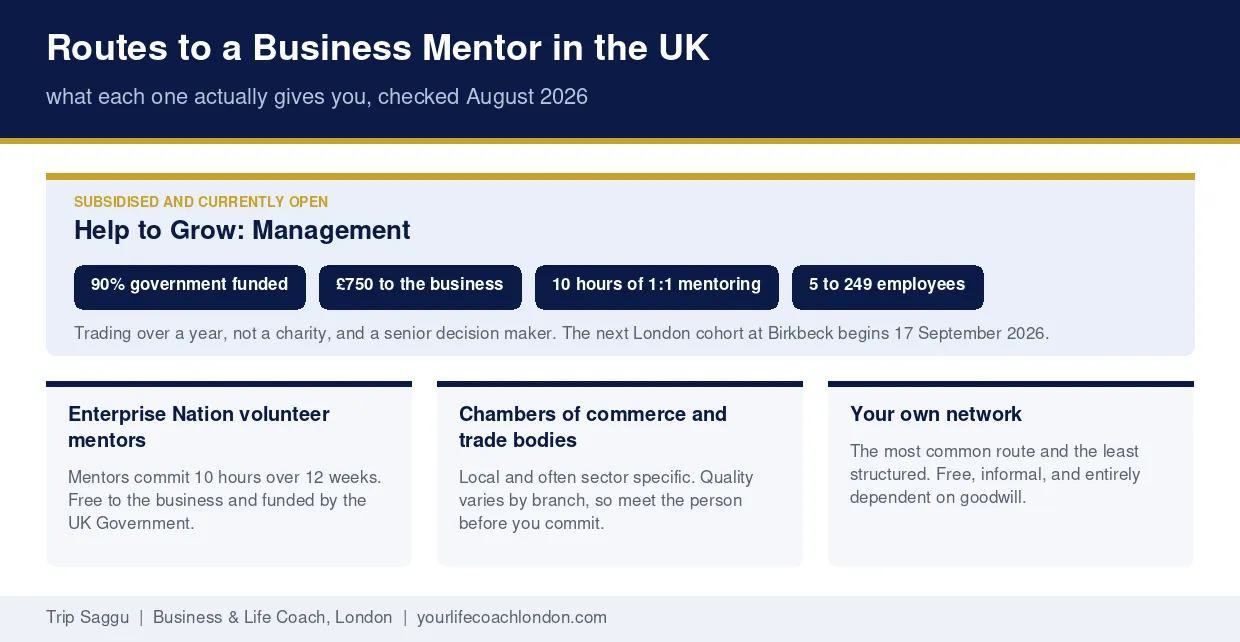
The best-funded route is the government-backed Help to Grow: Management programme, and it is better value than most owners realise.
- Help to Grow: Management. 90 per cent government funded, leaving the business £750. Twelve weeks, twelve modules, eight hours of peer sessions and ten hours of one-to-one mentoring. You need 5 to 249 employees, over a year of trading, and not to be a charity. Birkbeck, University of London runs the London cohort, next starting 17 September 2026.
- Enterprise Nation. Volunteer mentors committing ten hours over twelve weeks, funded by the UK Government.
- Chambers of commerce and trade bodies. Local and often sector specific. Quality varies by branch, so meet the person first.
- Your own network. The most common route and the least structured.
I have just pointed you at help that competes with what I sell, so let me be even-handed. Free mentoring is often excellent. It is not costless.
- Priority. Goodwill time moves when their quarter gets difficult, and a two-month gap can undo a quarter of momentum.
- Candour. Someone giving freely finds it harder to say the blunt thing, because the relationship runs on warmth and blunt feedback threatens warmth.
- Fit. You get the mentor the scheme has, not the one your situation needs. A mismatched mentor with strong credentials can send you confidently in the wrong direction.
None of that means avoid free mentoring. It means treat availability, honesty and fit as things to check rather than assume.
Test 5: Are You After Guidance, or After Permission?
This one is uncomfortable, so I will be direct.
A meaningful share of people who tell me they want a mentor already know what to do. They know the underperforming hire has to go. They know the flagship client is unprofitable. They know the second location was a mistake.
What they want is a respected outsider to say it out loud, so the decision feels less like theirs. That impulse is human. It is also expensive, because permission-seeking scales badly.
The diagnostic is simple. Notice how you react when someone contradicts your plan. If you find yourself explaining why their suggestion will not work in your case, you were seeking agreement, not guidance.
A good coach will decline to hand you the permission. That tends to irritate people for roughly a fortnight, and then it changes how they make decisions, because they stop outsourcing the part of the job that was always theirs to carry.
If you already know the answer and want someone to agree with it, you do not need advice. You need accountability, and the two cost about the same.
Test 6: How Much Structure Do You Actually Need?
Be honest about how you operate when nobody is watching.
Some owners are genuinely self-directed. They set a plan and work it, and what they lack is occasional high-quality input at the decision points. Mentoring suits them perfectly, because its loose shape is a match rather than a weakness.
Most owners are not that person, and the evidence sits in their own diary. If important work reliably loses to urgent work, and you have abandoned three operating rhythms in two years, the missing ingredient is cadence rather than counsel.
That is what coaching supplies: a fixed rhythm, a contract that makes cancelling awkward, and someone who asks what happened to last month’s commitment. It is the same layer underneath my framework for building a scalable business model.
What the Evidence Actually Says About Mentoring
You have probably seen the claim that mentored businesses survive twice as long. I will not repeat it, because when you follow it back the sourcing falls apart.
Here is the honest position instead. Reviewing the research, the Innovation Growth Lab notes the What Works Centre for Local Economic Growth found the evidence base on business mentors “quite weak”. The controlled trials that do hold up are narrower than the marketing suggests:
- Kenyan microenterprise owners receiving mentoring saw profits rise around 20 per cent on average, sustained among those who continued
- US students assigned entrepreneur mentors were roughly 20 per cent more likely to pursue an entrepreneurial career within two years
- Chilean micro-entrepreneurs visited by successful alumni saw income gains comparable to paid consulting, at far lower cost
Those are real effects from microenterprises and students rather than established British companies. My reading after two decades on both sides: the mechanism is sound and the measurement is immature.
So weigh that whenever anyone quotes you a confident figure, and weigh it when I tell you what coaching can do. An industry that cannot yet prove its returns precisely is not necessarily a poor investment. It is one where you should judge the individual in front of you rather than the category they belong to.
Any coach or mentor who quotes a precise return without naming the study is selling, not advising. Weigh that when I tell you what coaching can do, too.
What a Business Mentor and a Business Coach Cost in the UK
Mentoring occupies a strange market. Much of it is free or subsidised, while senior private mentors command professional fees, with very little in between and almost no published rate card.
Coaching has a more legible market: sold as a programme with a defined term, priced on experience and depth of access, with London consistently above the national average. I keep current ranges in my guide to business coaching costs in the UK.
| Consideration | Business Mentor | Business Coach |
|---|---|---|
| How it is priced | Often free or subsidised; senior private mentors charge professional fees | A programme with a defined term, rarely an hourly rate |
| What you are buying | Access to specific experience | Structure, challenge and cadence |
| Commitment from you | Low and flexible; you set the pace | High; the rhythm is the product |
| Main risk | Availability, currency of experience, and fit | Paying for structure you would have built anyway |
| Best first move | Check Help to Grow eligibility before paying anyone | Ask what happens if the engagement is not working |
When You Need Both, and In What Order
Plenty of businesses need both, and the order matters more than the choice.
Coaching first, mentoring second. Coaching establishes what you are building and what rhythm the business runs on. Mentoring then becomes far more efficient, because you arrive with a precise question rather than a general unease. At senior level that first stage is usually executive coaching in London rather than general business coaching.
Go the other way and you collect excellent advice you cannot sequence. Advice without a strategy is just a longer list of things you are not doing.
The costly version is hiring both at once from people who do not know about each other. If you run both, make it deliberate: the coach owns direction and rhythm, the mentor owns domain questions. Some engagements hold both by design, which is how my complete transformation programme is built.
Coaching decides where you are going. Mentoring shortens a stretch of the journey. Buy the mentoring second and you will need less of it.
How My 90-Day Business Mentoring Programme Works
Since I have asked you to be honest, let me be specific rather than vague about my own work.
My 90-day one-to-one business mentoring programme runs twelve weeks with twelve weekly sessions of three hours. Weeks one and two cover a full business audit, goal setting and the KPIs we will actually track. Weeks three to six move into strategy and systems.
The commitment is deliberately high. Expect five to ten hours of focused work each week between sessions. Most clients begin with one-to-one personal coaching before progressing into mentoring, which is exactly the sequence I recommended above.
That order is not a sales device. Coaching surfaces the questions actually worth taking to a mentor. Without it, people tend to spend their mentoring hours on whatever felt most urgent that week rather than on the handful of things that decide the year.
What I will not do is promise a number. A programme gives you structure, challenge and someone who has seen the pattern before. What it converts into depends on the hours I am not there. Any business coach in London who tells you otherwise is describing a product that does not exist.
Frequently Asked Questions
Is a business mentor better than a business coach?
Neither is better. A mentor wins when your obstacle is missing information someone else holds, particularly sector-specific information. A coach wins when the obstacle is a recurring pattern, an avoided decision, or an absence of structure.
Can the same person be both?
Yes, and the best relationships move between both modes. What matters is that they can tell which mode the moment calls for. Ask any candidate how they decide when to advise and when to ask. The quality of that answer tells you plenty.
How much does a business mentor cost in the UK?
Anything from nothing to professional-service rates. Help to Grow: Management puts ten hours of dedicated one-to-one mentoring inside a course costing the business £750, with 90 per cent funded by government. Check the subsidised routes before you pay anyone.
How do I find a business mentor in London?
Start with Help to Grow if you have 5 to 249 employees and over a year of trading, since Birkbeck runs the London cohort from 17 September 2026. Then Enterprise Nation, your chamber of commerce, and your own network. Ask for one conversation about one question rather than for ongoing mentorship.
Does my mentor need to be from my industry?
For domain problems, yes, and recency matters as much as seniority. For pattern problems, no. An outsider is sometimes better, because they will not accept the assumptions your sector treats as fixed.
What should I ask before committing to either?
Four questions. What does success look like and how will we know? What happens between sessions? What happens if this is not working? And what kind of client do you turn away? The last is the most revealing.
Is paid coaching worth it when mentoring is available free?
If your problem is genuinely a domain question and a free mentor is available, use the free mentor. That is the honest answer. Paid coaching earns its fee when the problem is structural rather than informational, when you need a cadence that will not slip, and when you need someone contractually obliged to say the uncomfortable thing.
Business Mentor vs Business Coach: Key Takeaways
A business mentor transfers experience. A business coach develops capability. Run the six tests and count the answers:
- Do you need answers, or better questions?
- Is the problem domain-specific or pattern-specific?
- What do you want to be holding when it ends?
- Can you realistically get the mentor you need?
- Are you after guidance, or after permission?
- How much structure do you genuinely need?
Check your eligibility for subsidised mentoring before paying anyone. Treat confident statistics with scepticism. And if you need both, take the coaching first.
| Your situation | Where to start |
|---|---|
| You need information a specific sector holds | A mentor, ideally one still operating in it |
| The same problem keeps returning in new clothes | A coach |
| You have 5 to 249 employees and a year of trading | Check Help to Grow before paying anyone |
| You already know the answer and are avoiding it | A coach, for accountability rather than advice |
| Your diary keeps beating your intentions | A coach, for cadence rather than counsel |
| You genuinely need both | Coaching first, mentoring second |
Still Not Sure Which One You Need?
That is a better place to be than committing to the wrong one because the label sounded right. If the six tests left you undecided, the ambiguity itself is usually diagnostic.
I offer a complimentary call for exactly this. We look at what is actually in your way, and I will tell you plainly if what you need is a sector mentor, a subsidised scheme, or nothing at all right now.
Explore business coaching in London, see how the 90-day mentoring programme is structured, or book a complimentary call and let us work out which conversation you should be having.

Last updated: 10 September 2026 by Trip Saggu