

Let me explain something that stops most business owners from ever building the company they actually imagined.
You started your business with a clear vision: freedom, growth, impact. But somewhere along the way, the business stopped working for you and started working because of you. Every decision, every client issue, every operational hiccup lands squarely on your shoulders. Sound familiar?
Here is the truth that most business advice skips over entirely: the problem is rarely your product or your market. It is your business model. And specifically, whether that model is built to scale or built to keep you permanently busy.
I am Trip Saggu, your business coach in London, and over two decades of entrepreneurial experience across multiple businesses have shown me that this pattern repeats itself hundreds of times. The good news? A scalable business model is not something you either have or you do not. It is something you deliberately build. And that is exactly what this guide will show you how to do.
Are you ready to stop being the bottleneck in your own business?

What Does ‘Scalable’ Actually Mean? (And What It Doesn’t)
Let me clear up the single biggest misconception in business growth. When most entrepreneurs say they want to scale, what they mean is: they want more revenue. But scaling is not simply about making more money. It is about making more money without proportionally increasing your costs, your hours, or your stress.
A truly scalable business model is one where your revenue can grow faster than your expenses. Where systems do the heavy lifting rather than people, and crucially, rather than you. Where a doubling of clients does not mean a doubling of your workload.
Scalability is not about working harder. It is about designing a business where growth creates leverage, not just more demands on your time.
What scalability is not: getting busier, hiring more people to do the same manual work, or increasing revenue whilst your profit margins quietly shrink. All three are common traps, and all three are symptoms of a business model that was never designed to scale.
The question every UK entrepreneur should be asking is not simply “how do I grow?” but “how do I grow in a way that gives me more freedom, not less?”
5 Signs Your Business Is Ready to Scale But Not Built For It
Before we talk strategy, let us do a quick diagnostic. If several of these resonate, your business model needs a structural rethink, not just a marketing push or a new hire.
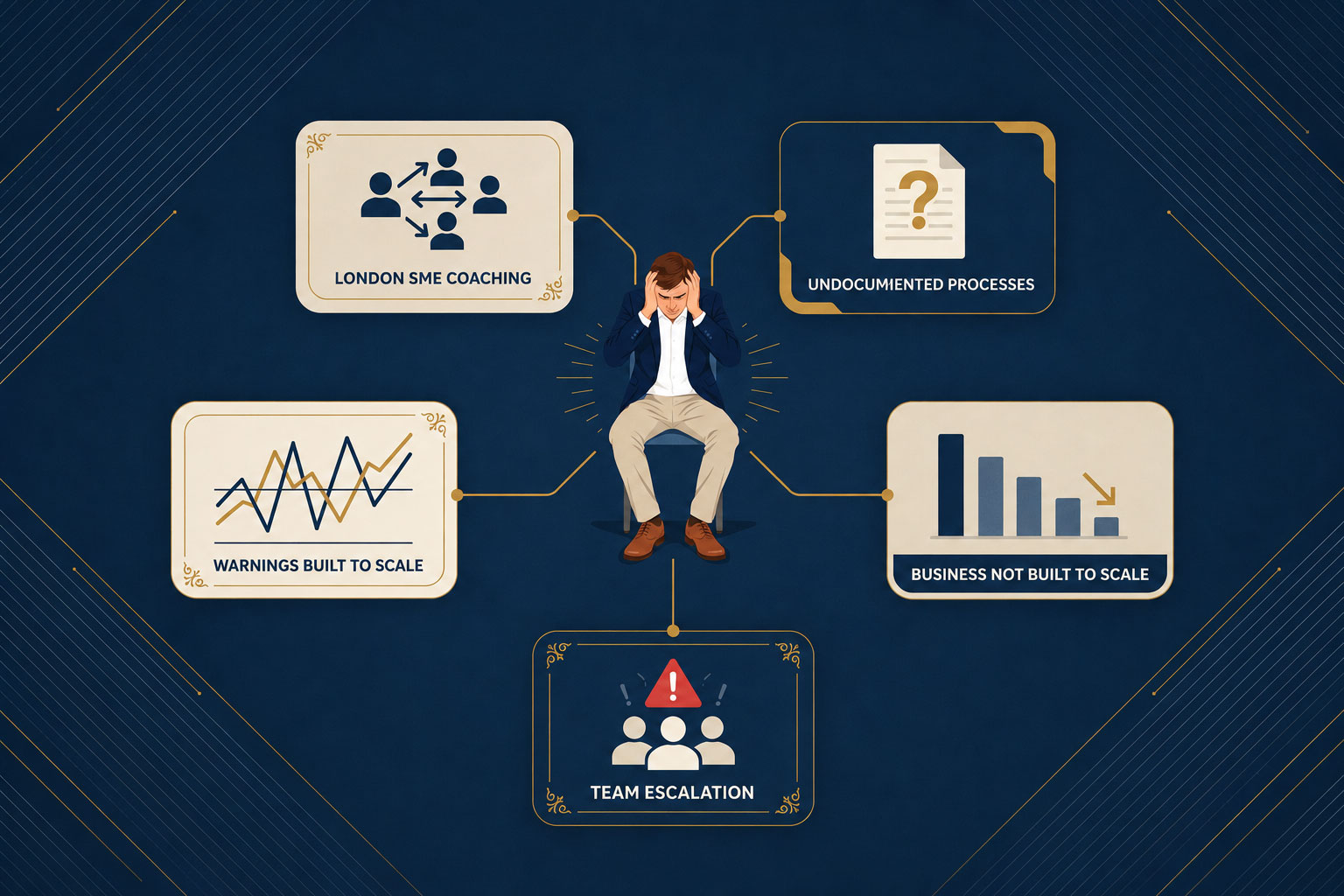
Here are the five warning signs I see most often in my business coaching services London sessions:
- Everything depends on you. You are the decision-maker, the problem-solver, the client-relations manager, and often the delivery engine, all at once. If you step away for a fortnight, the business slows or stops.
- You have no documented processes. Your team relies on tribal knowledge, informal conversations, and their own interpretation of how things should be done. Nothing is written down. Nothing is repeatable.
- Revenue is inconsistent. Some months are brilliant, others are worrying. There is no predictable, recurring income base. Every new pound of revenue feels like starting from scratch.
- Your profit margins shrink as you grow. You take on more clients, hire more staff, and somehow end each month with less left over. This is the clearest signal that your model is not scaling: it is just expanding its costs.
- Your team is reactive, not proactive. They wait to be told what to do rather than operating within a clear framework. They escalate rather than resolve. This is not a people problem: it is a systems problem.
Sound familiar? Do not be discouraged. The early warning signs you need a business coach often overlap with these structural gaps, and recognising them is the first and most important step.
The 4 Pillars of a Scalable Business Model
Over the course of my entrepreneurial career and my work as a business growth coach in London, I have distilled what separates businesses that scale successfully from those that plateau or collapse under their own weight. It comes down to four foundational pillars. Get all four right, and growth becomes structural rather than accidental.
| Pillar | What It Covers | Why It Matters |
|---|---|---|
| 1. Systems & Processes | SOPs, automation, repeatable workflows | Removes owner dependency; enables consistent delivery |
| 2. People & Delegation | Hiring, role clarity, empowerment | Builds capacity that grows with the business |
| 3. Revenue Architecture | Recurring income, pricing, multiple streams | Creates predictable, profitable growth |
| 4. Leadership Mindset | Owner identity shift, CEO thinking | The invisible foundation everything else rests on |

Understand this: all four pillars must be in place for your model to be genuinely scalable. Businesses that focus only on revenue and ignore systems will burn out. Businesses that build great systems but neglect leadership mindset will find the owner becomes the bottleneck in a different way. This is a holistic framework, not a pick-and-choose checklist.
Pillar 1: How to Build Business Systems That Work Without You
The most powerful shift you can make in your business is moving from being the system to building the system. Right now, if knowledge lives in your head, you are the system. And systems that depend on one person cannot scale.
Here is where most business owners make the mistake: they try to document everything all at once and immediately feel overwhelmed. The smarter approach is to systematise your highest-volume, most repeatable processes first.
Where to Start With Business Systems and SOPs
Begin by identifying the five processes in your business that happen most frequently. These are your highest-leverage starting points for documentation. Then, for each one, create a Standard Operating Procedure (SOP), a step-by-step written guide that anyone on your team could follow without asking you a single question.
Your SOP does not need to be a 40-page manual. A one-page process map, a short Loom video, or even a bullet-point checklist in Notion will do the job. What matters is that the knowledge leaves your head and enters a system.

The Three Categories of Scalable Business Systems
To keep things practical, I recommend organising your systems into three categories:
- Delivery systems: How your product or service is created and delivered to clients. This is your core operational IP.
- Client systems: How you attract, onboard, communicate with, and retain clients. This includes your sales process, onboarding sequence, and follow-up cadence.
- Internal systems: How your team operates, communicates, reports, and makes decisions. This is the infrastructure that holds everything else together.
Once your systems are documented, you can begin automating the repetitive parts and delegating the rest. It also becomes significantly easier to identify what tasks to delegate as a business owner, because the process is visible rather than invisible.
Pillar 2: Building the Right Team to Scale Your Business
A scalable business model is only as strong as the people executing it. And yet, most SME owners make two critical errors when it comes to building their teams: they either hire too late and in desperation, or they hire the wrong roles in the wrong order.
Let me be direct with you. Your team should be expanding your capacity, not just covering your weaknesses. There is an important distinction here. Hiring someone to cover a gap in your knowledge is reactive. Hiring someone to own and grow a function of your business is strategic. The latter is what scalable businesses do.
Hiring Strategically, Not Desperately
The question of how London startups can scale successfully almost always circles back to hiring timing. My answer is always the same: hire before you are drowning, not after. When you hire from a position of desperation, you make poor decisions under pressure, and those decisions cost you time, money, and momentum.
Here is a straightforward framework for thinking about your next hire:
| Hiring Question | What to Assess |
|---|---|
| What is consuming the most of my time? | Your highest-volume, lower-leverage tasks, these should be your first delegation targets |
| What am I doing that someone else could do to 80% of my standard? | Tasks where quality does not need to be perfect, delegate these immediately |
| What is not getting done because I am too busy? | Growth-critical activities being neglected, these define your most urgent hire |
| What would I do more of if I had the time? | Your highest-value activities, protect these and hire to support them |
Role Clarity Is Non-Negotiable in a Scalable Team
One of the most consistent issues I see in SMEs is what I call role blur, where team members are not entirely clear on what they own, what authority they have, and what success looks like in their position. Role blur creates dependency on the owner because the team has no framework to operate within independently.
Every role in your business should have three things clearly defined: their responsibilities, their decision-making authority, and their success metrics. Write these down. Review them quarterly. These three things will reduce your management overhead dramatically.
Pillar 3: Designing a Revenue Model That Scales
This is the pillar that most business owners find most exciting, and most confronting. Because designing a scalable revenue model often means challenging the way you have been pricing and packaging your services since day one.
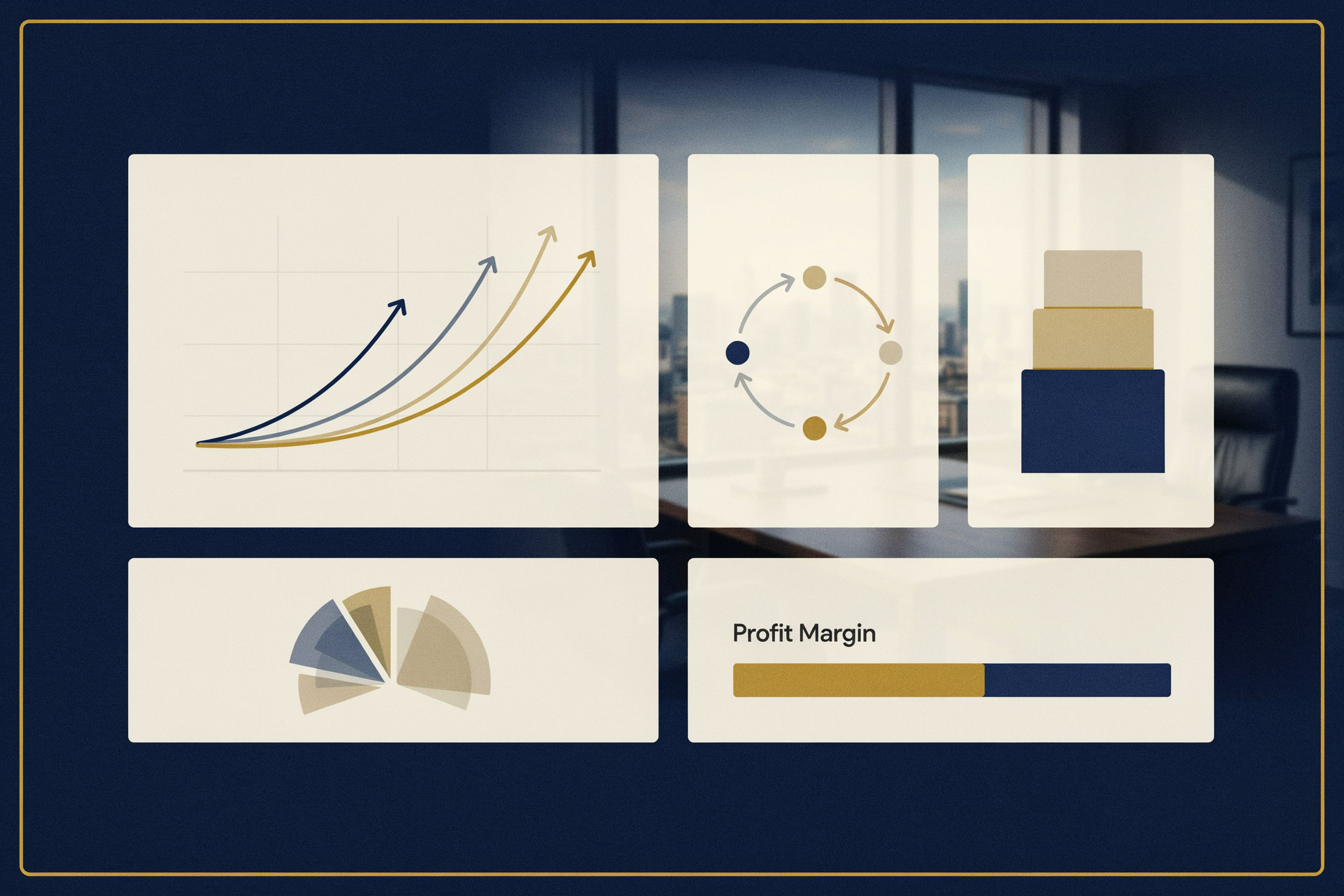
Let me ask you a direct question: how much of your revenue is genuinely predictable? Not hoped-for, not projected: genuinely predictable, coming in every month regardless of whether you win a new client or not. If the answer is “not much,” your revenue model has a scalability problem.
The Case for Recurring Revenue in Your Business Model
The single most powerful shift you can make to your revenue model is building recurring, predictable income. This might look different depending on your industry: retainer agreements, subscription services, maintenance contracts, membership models, or annualised service packages. But the principle is the same: every recurring pound reduces your business’s dependence on constantly chasing new revenue. This is the foundation that allows everything else to scale.
Pricing for Business Growth, Not Survival
I have worked with business owners across London who have been chronically undercharging for years, not because their work is not worth more, but because they have never deliberately reviewed their pricing strategy through a growth lens. Here are the key pricing principles for a scalable model:
- Price based on value delivered, not hours worked. Time-based pricing caps your revenue at the hours available. Value-based pricing has no ceiling.
- Create tiered service levels. Not every client needs your most comprehensive offering. Tiered packages increase your market reach and allow natural upselling.
- Reduce single-client dependency. If one client accounts for more than 25% of your revenue, you do not have a scalable business: you have a very risky arrangement.
- Review pricing annually. As your expertise, reputation, and systems improve, your prices should reflect that.
Pillar 4: The Mindset Shift Every Business Owner Must Make to Scale
Here is what most business model articles leave out entirely. And I believe it is the most important factor of all.
You cannot scale a business if your identity is still that of an operator. The skills that got your business to its current level are not the same skills that will take it to the next level. The entrepreneur who does everything is invaluable in the early stages. But in a scaling business, that same person becomes the biggest obstacle to growth.
Your business will never outgrow your mindset. The ceiling of your company is, almost always, the ceiling of your thinking as its leader.
The transition from operator to CEO is not simply about delegating tasks, and it is the transition I spend most of my executive coaching London time on. It is a fundamental shift in how you see your role, your value, and your relationship with the business. Understanding how to create an entrepreneurial mindset is foundational work here, and it is precisely where professional coaching accelerates what would otherwise take years of painful trial and error.
From Operator to CEO: What Changes in Your Thinking
| Operator Thinking | CEO Thinking |
|---|---|
| I need to be involved in everything | I need the right people and systems in place |
| I am the best at this, so I should do it | My time is worth protecting for high-leverage activities |
| If I delegate, quality will drop | If I document and train properly, quality is maintained |
| I cannot afford to slow down | I need to slow down now to speed up sustainably later |
| My value is in what I produce | My value is in the direction, culture, and systems I create |

This mindset shift does not happen overnight, and it rarely happens without support. The most successful business growth strategy in London I have witnessed always begins with the owner shifting their thinking first. When high-pressure decisions need to be made during periods of growth, and they always do, the ability to define your entrepreneurial goals with clarity matters enormously.
Common Mistakes That Kill Scalability in UK Businesses
Even with the right intentions, there are several mistakes I see business owners make repeatedly when attempting to build a scalable business model. Here are the most costly, and how to avoid every single one.
Mistake 1: Scaling Too Early
There is a difference between a business that is ready to scale and a business that is eager to grow. Scaling before your systems, team, and revenue model are in place does not accelerate your success: it accelerates your problems. Every weakness in your foundation becomes amplified under the pressure of growth.
The test: can your business deliver its current service or product consistently, at quality, without your direct involvement? If not, you are not ready to scale. You are ready to consolidate first.
Mistake 2: Ignoring Cash Flow During Growth
Growth consumes cash. This is a reality that catches many scaling businesses completely off guard. You can be profitable on paper and still run out of money if your cash flow is not actively managed. I have seen businesses with outstanding growth trajectories brought to a halt by poor cash management. Understanding how startups can scale successfully always includes a firm grip on cash flow fundamentals.
Mistake 3: Hiring Quickly Without Clarity
When growth is happening and you are stretched, the temptation is to hire anyone who seems capable and available. This is one of the most expensive mistakes an SME can make. The wrong hire in a key role can set you back six to twelve months in time, morale, and money.
Hire slowly, with clear role definitions and cultural alignment in mind. A smaller, highly aligned team that operates within strong systems will always outperform a larger team operating in ambiguity. If you are working on your time management as an entrepreneur, this principle applies equally to how you manage the hiring process itself.
Mistake 4: Operating Without Feedback Loops
Scaling businesses need data. Not just financial data: operational data, client satisfaction data, team performance data. Without feedback loops, you are managing by instinct rather than information. Build regular review rhythms into your business: weekly check-ins, monthly performance reviews, and quarterly strategic assessments. These are not optional extras for a serious scaling business.
How a Business Coach Accelerates Your Scaling Journey
Let me be transparent with you here. I have spent over two decades building and scaling businesses, and I have also made most of the mistakes described in this article, often more than once. The difference between the business owners who scale effectively and those who stay stuck is rarely intelligence or work ethic. It is perspective, accountability, and access to frameworks that work.
That is precisely what a skilled business coach provides. My role in a scaling engagement is not to tell you what to do. It is to help you see your business clearly, identify the specific constraints holding your model back, and give you both the framework and the accountability to act on what you know needs to change.
The most successful scaling journeys I have witnessed have one thing in common: the business owner stopped trying to figure everything out alone. External perspective changes everything.
Research from the International Coach Federation shows that executives who receive coaching see a 70% improvement in work performance and a 57% improvement in team effectiveness. Those are not small margins in a competitive market like London.
Many business owners also have questions about the investment involved. You can explore my business coaching services in London to understand the different levels of support available and what to expect at each stage of the journey.
Frequently Asked Questions About Building a Scalable Business Model
What is a scalable business model, exactly?
A scalable business model is one where revenue can grow significantly without a proportional increase in costs, time, or resources. It relies on systems, processes, and people that operate effectively without the owner being the central dependency. The goal is leverage: more output from the same or lower input as you grow.
How long does it take to build a scalable business model in the UK?
A realistic timeframe for an established SME to make meaningful structural progress is six to twelve months of focused, deliberate work. Quick wins in systems and delegation are possible within weeks, but the deeper shifts, particularly in revenue architecture and leadership mindset, take sustained effort. Professional coaching significantly accelerates this timeline.
Can any business become scalable, or only certain types?
Almost any business can become more scalable with the right structural changes. Service businesses, which are often seen as inherently time-dependent, can achieve scalability through productised offerings, retainer models, and team-based delivery. The four-pillar framework in this article applies across sectors and business sizes.
What is the biggest barrier to building a scalable business in the UK?
In my experience coaching business owners across London and the wider UK, the single biggest barrier is owner mindset, specifically the reluctance to let go of operational control and trust in systems and people. It is a deeply understandable reluctance, but it is the bottleneck above all others.
Should I focus on scaling up or on improving profitability first?
Improve profitability first. Scaling an unprofitable or barely profitable business simply creates bigger losses at a greater pace. Ensure your unit economics are sound, that each client or sale generates a healthy margin, before investing in growth infrastructure. Profitable businesses scale. Unprofitable ones collapse under the pressure of it.
How do I know if my current business model is scalable?
Ask yourself three questions: Can my business deliver its core offering without my direct involvement? Is my revenue predictable from month to month? Do my profit margins stay the same or improve as I take on more clients? If the answer to any of these is no, there is structural work to be done before scaling.
Is a business coach necessary to build a scalable model?
Necessary? No. Significantly faster and less costly in terms of mistakes avoided? Absolutely yes. The value of an experienced business coach in a scaling context is the combination of external perspective, proven frameworks, and structured accountability. Most business owners who attempt this journey alone find it takes two to three times longer and involves far more costly errors.
Your Blueprint for a Business That Scales: Key Takeaways
Let me bring this together with absolute clarity. Building a scalable business model is not about working more hours, hiring more people, or spending more on marketing. It is about deliberately redesigning the way your business operates so that growth creates leverage rather than more demands on you.
Here is your four-pillar recap:
- Systems and Processes: Document your highest-volume workflows and remove yourself as the central dependency.
- People and Delegation: Hire strategically, define roles clearly, and build a team that operates within frameworks, not through you.
- Revenue Architecture: Build predictable, recurring income and price for the value you deliver, not the hours you work.
- Leadership Mindset: Make the shift from operator to CEO. This is the invisible pillar everything else rests on.
If you recognise yourself in the challenges described here, the most valuable next step is a direct, honest conversation about your specific situation. I work with entrepreneurs and business owners across London and the UK who are ready to build something that genuinely scales, and I would be glad to be part of your journey.
Ready to Build a Business That Scales?
If you are serious about building a scalable business model in the UK and want expert guidance to get there faster, I am here to help.
As London’s leading business coach, I have helped entrepreneurs at every stage move from overwhelmed operator to confident CEO. Whether you need help with systems, team structure, revenue architecture, or the mindset shift that makes everything else possible, we can build the right plan together.
Book your complimentary strategy session with Trip Saggu today.
Together, we will assess where your business model currently stands, identify the structural gaps holding you back from scaling, and create a clear, practical roadmap for sustainable growth.
Your business has the potential to scale. Let us make sure it is built to do exactly that.