Strategic business coaching is work on the direction of your business, not the delivery of it. Strategic business coaching is the discipline of deciding what you are building, what you are deliberately not building, and how those decisions get made when the pressure is on. Ordinary coaching asks how you can execute your plan better. Strategic coaching asks whether the plan deserves your next three years.
After two decades of building businesses in this city, I can tell you that most owners who feel stuck are not lazy, disorganised or short of ideas. They are executing brilliantly in a direction that stopped serving them about eighteen months ago. Does that sound uncomfortably familiar?
Strategic Business Coaching, Defined Without the Jargon
Strategic business coaching is a structured working relationship in which a coach helps you make better decisions about the direction, shape and future of your business. Not your task list. Your trajectory.
In practice, that means working on a small number of questions that most owners never get a clear hour to think about:
- What business are you actually in, as opposed to the one you started?
- Which customers, products or services genuinely deserve your capacity, and which are quietly consuming it?
- What has to be true in three years for this to have been worth it?
- Where are you the constraint, and what would it take to stop being one?
- Which decisions are you avoiding, and what are they costing you every month you avoid them?
The output is not motivation. It is clarity you can act on, a sequence you can follow, and a way of making the next hundred decisions without needing me in the room.
I should be straight with you about one thing. Strategy is not a document. I have watched owners pay handsomely for beautiful strategy decks that changed nothing, because nobody addressed how decisions actually get made inside the business, or who has to stop doing what. That gap between the plan and the behaviour is where strategic coaching earns its money.
Strategic Coaching vs Business Coaching vs Consulting vs Mentoring
These four get used interchangeably, and the confusion costs people thousands. Here is the honest distinction.
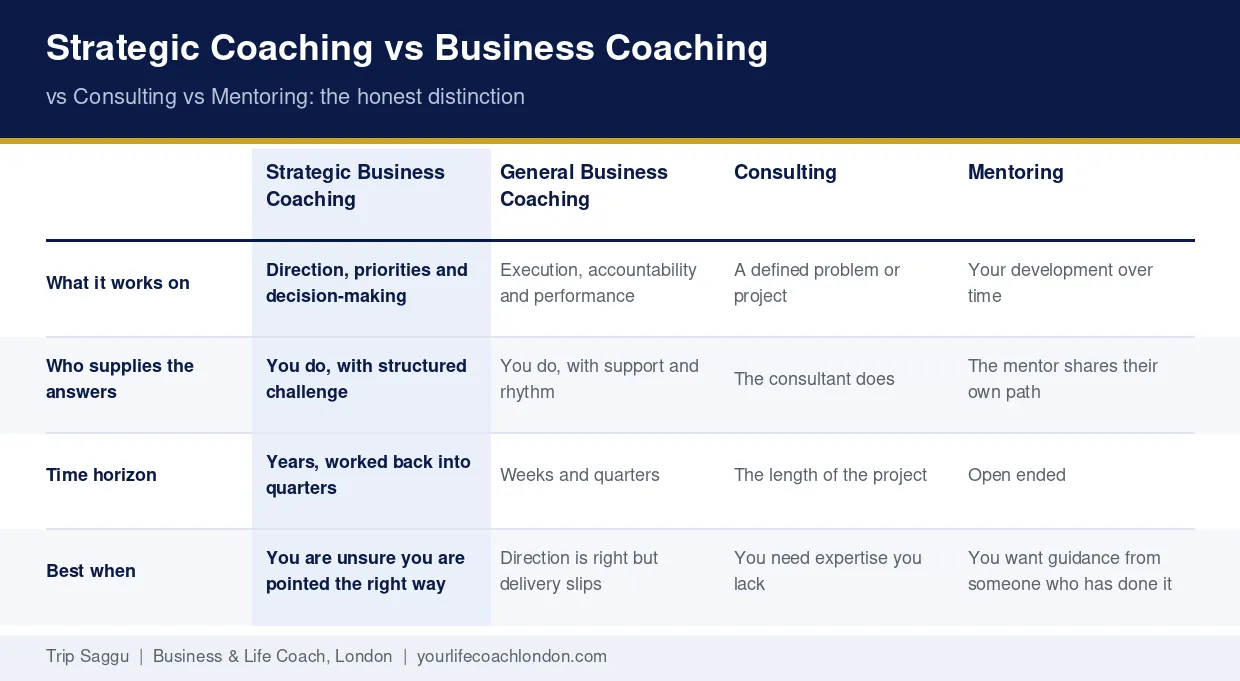
| Approach | What It Works On | Who Supplies the Answers | Best When |
|---|---|---|---|
| Strategic business coaching | Direction, priorities, decision-making | You do, with structured challenge | You are unsure you are pointed the right way |
| General business coaching | Execution, accountability, performance | You do, with support and rhythm | The direction is right but delivery slips |
| Consulting | A defined problem or project | The consultant does | You need expertise or capacity you lack |
| Mentoring | Your development, drawn from experience | The mentor shares their path | You want guidance from someone who has done it |
The practical difference between the first two is time horizon. General coaching works in weeks and quarters, strategic coaching works in years, then reverse-engineers the quarters. The difference from consulting is ownership: a consultant hands you a recommendation, whereas coaching builds the capability so the improvement compounds after the engagement ends. I have set out that distinction more fully in my guide to business coach versus consultant, and if you are earlier in the journey, what a business coach actually does is the better starting point.
In reality most serious engagements blend them, and strategic business coaching often sits at the centre of that mix. My own work as a business coach in London draws on all four depending on what the business in front of me needs that quarter.
5 Signs Your Business Needs Strategy, Not More Effort
Effort is rarely the problem. Direction usually is. These are the five signals I see most often.
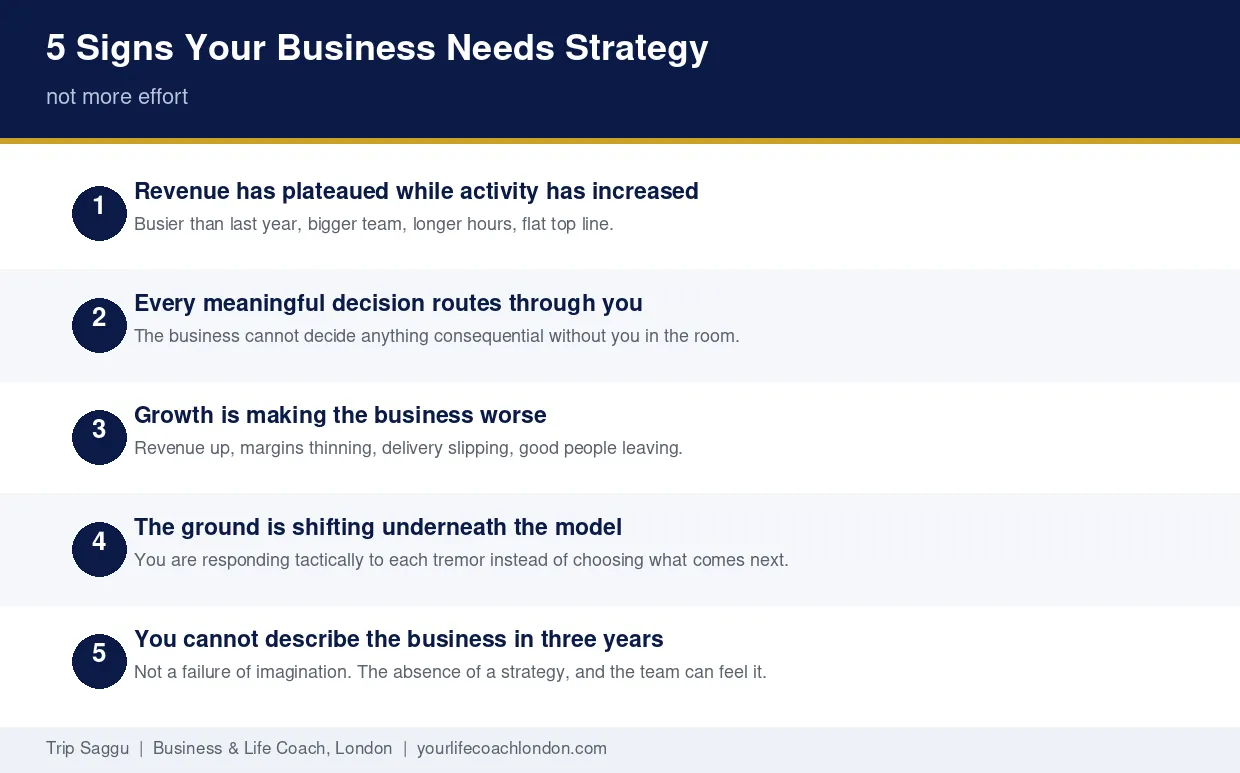
1. Revenue has plateaued while activity has increased
You are busier than last year, the team is bigger, the hours are longer, and the top line has barely moved. That is almost never a work-rate problem. It is a sign the model has reached the ceiling of what effort alone can lift.
2. Every meaningful decision routes through you
If the business cannot make a consequential decision without you in the room, you do not have a company yet, you have a very demanding job. This is the constraint I meet most often, and it is structural, not personal.
3. Growth is making the business worse
Revenue is up and everything else is deteriorating: margins thinning, delivery slipping, good people leaving, you enjoying it less. Growth in the wrong shape is more dangerous than no growth at all, because it consumes cash and goodwill while looking like success.
4. The ground is shifting underneath the model
Your market, your channel, your pricing power or your technology is changing, and you are responding tactically to each tremor instead of deciding what the business becomes next. Strategic work turns that into a choice rather than a reaction.
5. You cannot describe the business in three years
Ask yourself right now: what does this look like in three years, and who is running which part of it? If the honest answer is vague, that is not a failure of imagination. It is the absence of a strategy, and everyone in your business can feel it even if they cannot name it.
If several of those landed, you may also want to read the twelve clear signs it is time to hire a business coach, which covers the timing question in more depth.
How Strategic Business Coaching Actually Works
Here is my process. I am setting it out plainly because “strategic coaching” is a phrase people hide behind, and you deserve to know what you would actually be buying.
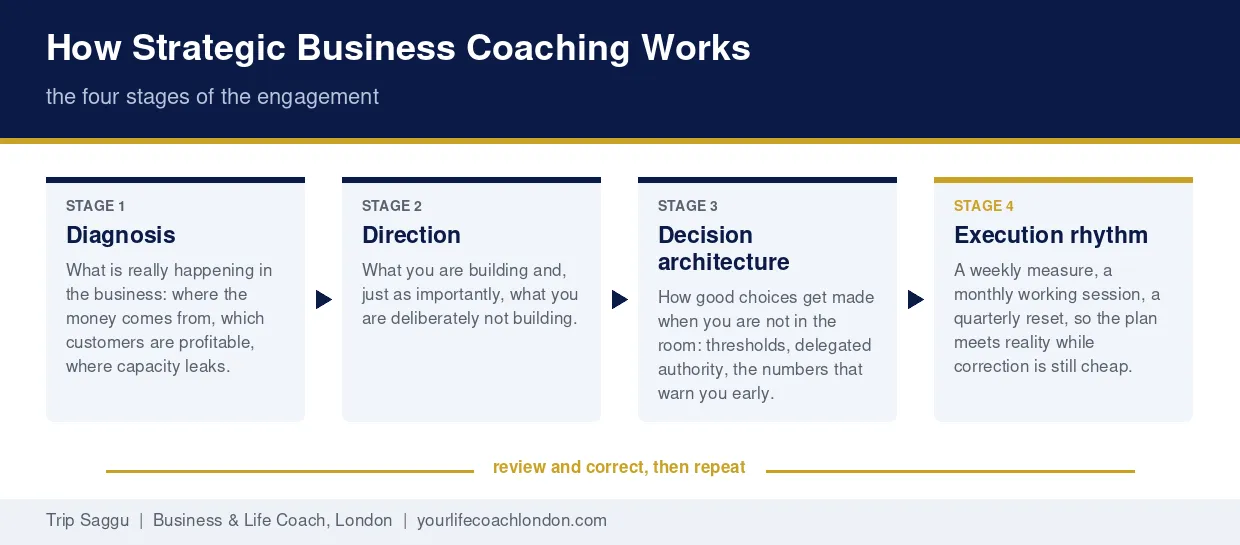
Diagnosis: what is really happening in the business
We start with truth, not ambition. Where the money genuinely comes from, which customers are profitable once your time is priced in, where capacity leaks, and what the numbers say versus what you believe. Most owners are surprised by at least one finding in this stage, and it is usually an expensive one.
Direction: choosing what you are building and what you are not
Strategy is subtraction before it is addition. We define what this business is for, who it serves best, what it will deliberately stop doing, and what “won” looks like in three years in terms you can measure. The decision not to pursue something is usually worth more than the decision to pursue.
Decision architecture: how choices get made when you are not there
This is the stage almost everyone skips, and it is why so many strategies die quietly. We build the rules, thresholds and delegated authority that let good decisions happen without you. What can a manager approve alone? What triggers a conversation? What are the two or three numbers that tell you the strategy is working before the annual accounts do?
Execution rhythm and review
Strategy without cadence is a wish. We set a rhythm of review, usually a tight weekly measure, a monthly working session and a quarterly reset, so the plan meets reality often enough to be corrected while correction is still cheap. If your operating discipline needs rebuilding first, my framework for building a scalable business model covers the systems layer that sits beneath all of this.
Strategic Coaching Through Growth Stages
The strategic question changes as the business grows. Recognising which stage you are in matters more than most owners realise, because strategic business coaching looks different at each one.
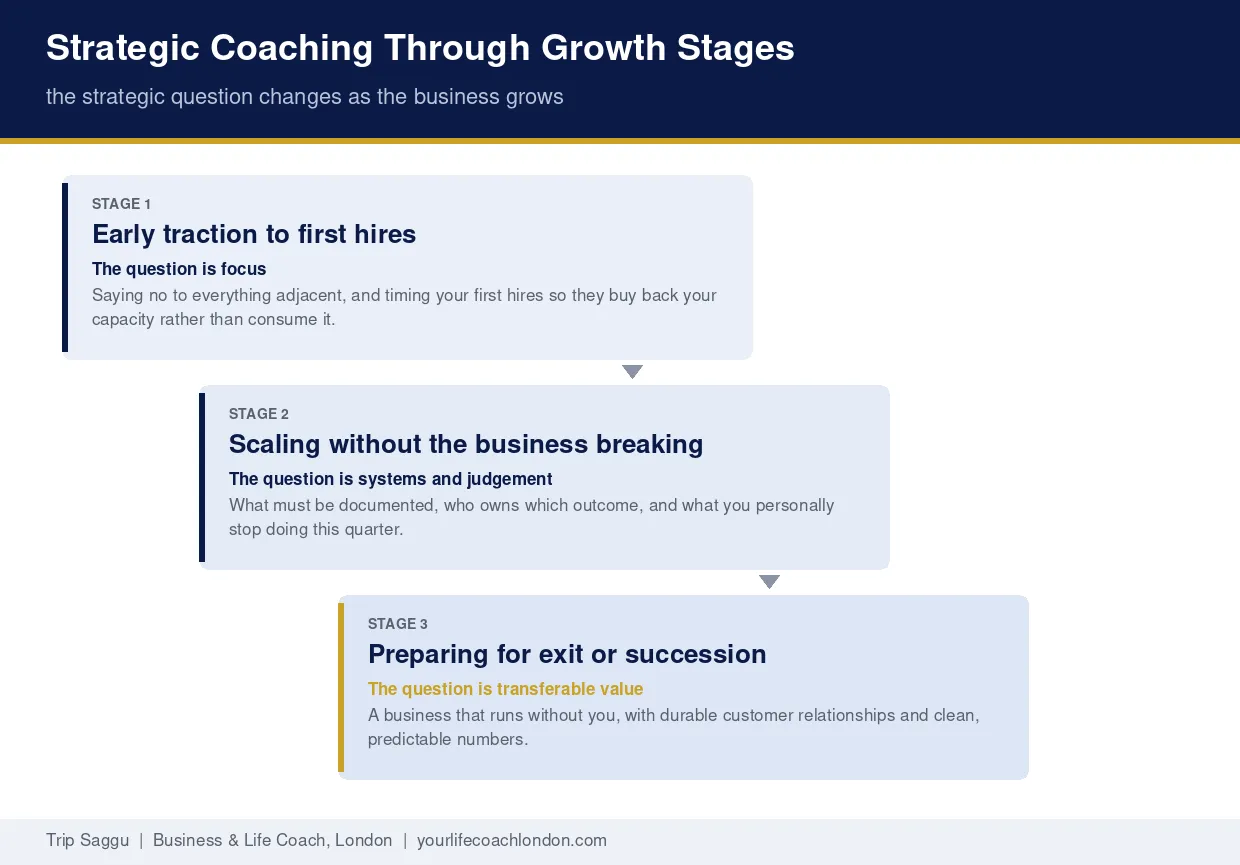
Early traction to first hires
The question is focus. You have proof that something works and infinite temptation to chase everything adjacent to it. Strategic work here is mostly about saying no, and about timing your first hires so they buy back your capacity rather than consume it.
Scaling without the business breaking
Between roughly a handful of people and a proper management layer, the constraint moves from selling to systems and from your effort to your team’s judgement. The strategic questions become: what must be documented, who owns which outcome, and what are you personally going to stop doing this quarter? This is the stage where owners most often need a genuine sounding board, and where expert business coaching in London tends to pay for itself fastest.
Preparing for exit or succession
If there is any chance you will sell or step back, the strategy should be built backwards from that day, and ideally years before it. That work sits close to executive coaching for founders, because by then the constraint is usually the owner rather than the model. Buyers pay for businesses that run without the founder, have durable customer relationships and can show clean, predictable numbers. Nearly every decision that makes a business valuable to a buyer also makes it more pleasant to own in the meantime, which is a happy coincidence worth exploiting early.
What Strategic Business Coaching Costs
I will not quote you a single figure, because anyone who does without understanding your situation is selling rather than advising. What I can tell you honestly is how engagements are usually shaped.
Strategic work tends to be structured as a programme rather than sold by the hour, because the value sits in the sequence and the follow-through, not in the session. Expect a defined term, typically a quarter to six months, a regular one-to-one rhythm with access between sessions, and clear outcomes agreed at the start. Rates in the UK vary widely with the coach’s experience and the depth of the engagement, and London tends to sit above the national average. I have set out the honest market ranges in my guide to business coaching costs in the UK rather than repeating them here.
The more useful question is not the fee. It is this: what is the current direction costing you every quarter you stay on it?
When You Do Not Need a Strategic Business Coach
I would rather turn work away than take money for the wrong thing, so here is the honest disqualifier.
You probably do not need strategic business coaching if your direction is sound and your problem is execution. If you know exactly where you are going, the model works, and the gap is discipline, follow-through or accountability, then general business coaching will serve you better and cost you less.
You also do not need it if you are looking for someone to hand you a plan. That is a consultant, and there is nothing wrong with hiring one. And if the business is in genuine financial distress with weeks of runway, strategy is not the first call. Stabilise the cash position first: my guide to cash flow warning signs is the more useful read today.
Why London Changes the Strategic Picture
Running a business here is not the same as running one elsewhere in the UK, and pretending otherwise produces generic advice.
Operating costs, premises and salaries compress margins in a way that punishes an unclear strategy faster. The talent market is deep but fiercely competitive, so people decisions carry more weight and more cost. On the other hand, the density of professional networks and sector clusters means a well-chosen position can compound remarkably quickly, because the right rooms are within a few miles of each other. Strategy in London is largely about choosing a narrow enough position to be findable in a very crowded market, then being unambiguous about it.
Frequently Asked Questions
What should I expect to pay for a growth strategy coaching programme?
Programmes are usually priced by term rather than by session, and vary considerably with the coach’s experience and the depth of support. Ask what is included between sessions, what outcomes are agreed at the outset, and what happens if the engagement is not working. My UK cost guide sets out the current market ranges honestly.
Can strategic coaching help me scale from a few million to something much larger?
That kind of step-change is rarely a sales problem, which is why strategic business coaching tends to be the right tool for it. It is usually a question of business model, management layer and decision-making capacity, which is precisely the territory strategic coaching works in. The work focuses on what has to become true structurally before that growth is survivable.
Is strategic coaching useful if I am planning a founder exit?
It is arguably where it earns the most. Exit value is built years in advance through customer concentration, documented process, management depth and clean numbers. Starting the strategic work twelve months before a sale is usually too late to change the price.
What is the difference between a strategic coach and a business strategist?
A strategist is typically engaged to produce a strategy and hand it over. A strategic coach builds your capacity to set direction, make the decisions and hold the course, so the capability stays with you and your team afterwards.
Do I still need this if I already have a business plan?
Often yes, because a business plan describes intentions while strategy governs trade-offs. If your plan does not say what you will stop doing, who decides what without you, and which numbers would tell you it is going wrong, it is a forecast rather than a strategy.
Can we do this remotely, or does it need to be in person?
Both work. I coach clients across London in person and across the UK online, with the same structure and rhythm either way.
Key Takeaways
Strategic business coaching works on direction, priorities and decision-making, not on effort or task management. You most likely need it when revenue has plateaued despite more activity, when every decision routes through you, when growth is making the business worse, when your market is shifting, or when you cannot describe the business in three years. Good strategic work moves through diagnosis, direction, decision architecture and a review rhythm, and it changes shape as you move from early traction to scaling to eventual exit. If your direction is already sound and execution is the gap, save your money and take the general coaching route instead.
Ready to Work On the Business Instead of In It?
If reading this has surfaced a question you have been avoiding, that question is the conversation. I offer a complimentary call in which we look honestly at where the business is pointed and whether strategic work is the right next step, including when it is not.
Learn more about business coaching in London, see how my 90-day one-to-one business mentoring programme is structured, or book a complimentary call and we will find out together.