

Search this subject and you will find a great deal of encouragement and very few numbers. The encouragement is not the problem. The missing numbers are, because they change what you should buy.
I went looking for the evidence before writing this, and one government report reorganised the whole piece. Not because of what it found. Because of what it never measured, and nobody selling coaching to women mentions that either.
I am a business coach London business owners call when something is stuck, and I am not a woman. That matters for one finding below, and I will come back to it rather than quietly skip it.
If you want the day-to-day mechanics rather than the evidence behind them, what a business coach does covers that ground. This piece is the part nobody publishes.
The UK Number That Nobody Actually Has
The Growth Vouchers Programme was the UK government’s randomised trial of subsidised business advice. Thousands of small firms were allocated vouchers at random. If you wanted to know whether business advice lands differently for women in Britain, this is the one place a real answer could have come from.
It did not come from there. The evaluation did not analyse impact by gender at all. Take-up across the scheme was also thin: only a third of Cohort 1 businesses purchased advice with their vouchers, which the report itself says makes the more detailed questions hard to answer.
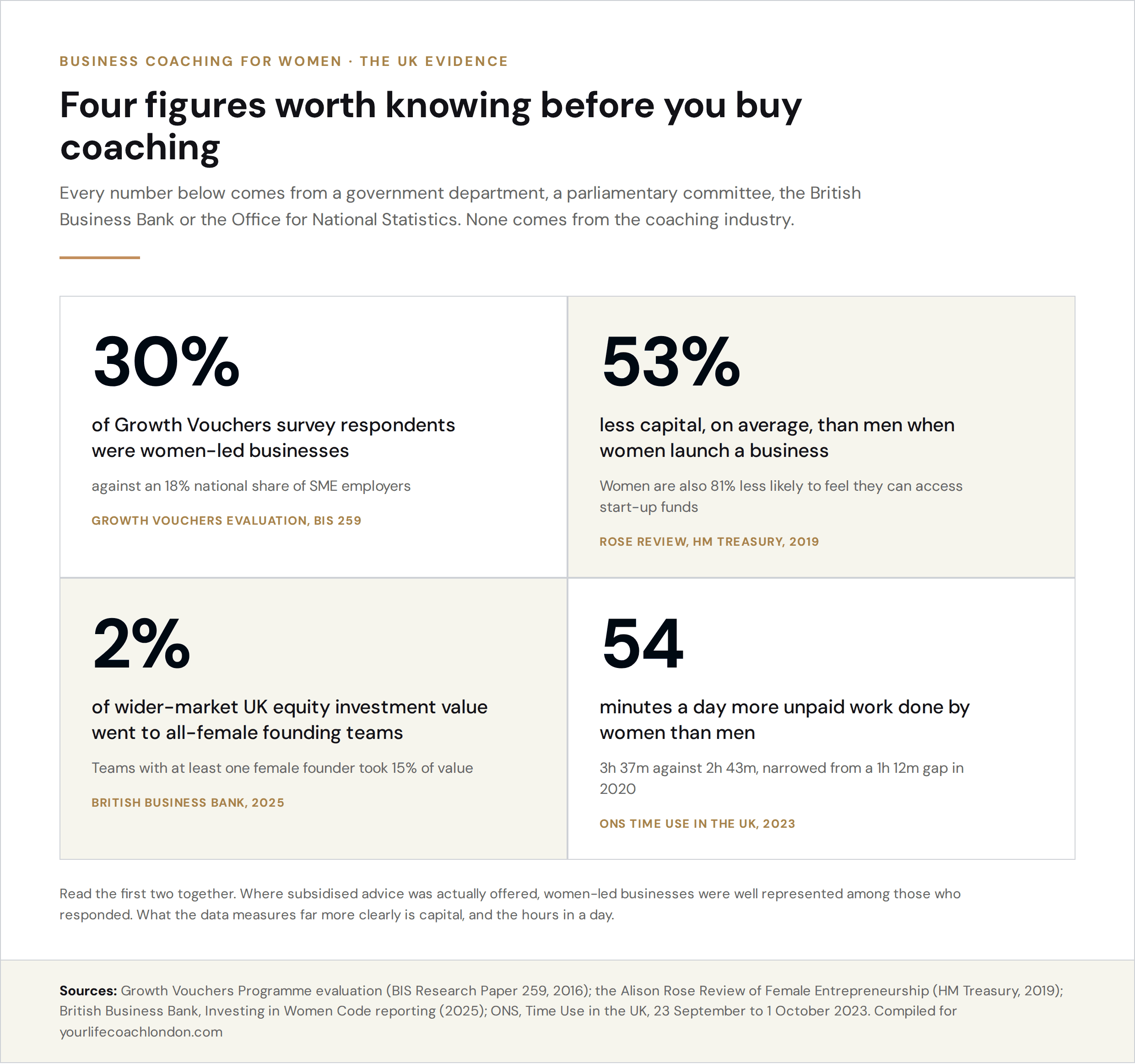
There is exactly one gender observation in it, and it is narrower than it looks. Eighteen per cent of SME employers were majority-led by women, against 30 per cent of survey respondents, which the report reads as suggesting “that the scheme has been accessible to women-led businesses”. Accessible to the women who applied. Not a measure of how much advice women went on to buy, and not a measure of what it did for them.
Britain’s one randomised trial of subsidised business advice cannot tell you whether that advice works differently for women. Nobody ever analysed it that way.
Hold on to that, because it is the test for everything else in this field. When somebody tells you women need encouragement to ask for help, or that women get more out of coaching, or less, the fair question is which trial says so.
That absence sits beside the separate question of why businesses fail, which is not mainly a story about advice either.
What the Data Says Is Genuinely Different
The Rose Review of Female Entrepreneurship, published by HM Treasury in 2019, remains the most serious UK work on this. Its headline is widely misquoted, so here it is exactly: up to £250 billion of new value could be added to the UK economy if women started and scaled new businesses at the same rate as UK men.
That is a conditional projection of value that does not exist yet. It is not what women’s businesses contribute today, and any site telling you otherwise has misread its own source. Rose also ran a more modest scenario: simply matching the best-performing peer countries, rather than closing the gap with UK men altogether, would add £200 billion.
Capital is the gap the data measures most clearly
Rose found that women launch businesses with 53 per cent less capital on average than men, are 81 per cent less likely to feel they can access the necessary start-up funds, and typically estimate they need 40 per cent less funding to launch in the first place.
Sit with the third one, because it is the least discussed and possibly the most consequential. A smaller ask, made with less confidence, met with less capital. Each of those three compounds the other two.
Rose measured what women were given and what they felt able to ask for. It did not measure what they could do, and it is worth noticing which of those things the coaching industry usually offers to fix.
At the growth end the picture is starker still, and it is where the single most quoted statistic in this field lives.
The 2 per cent everybody quotes and almost nobody explains
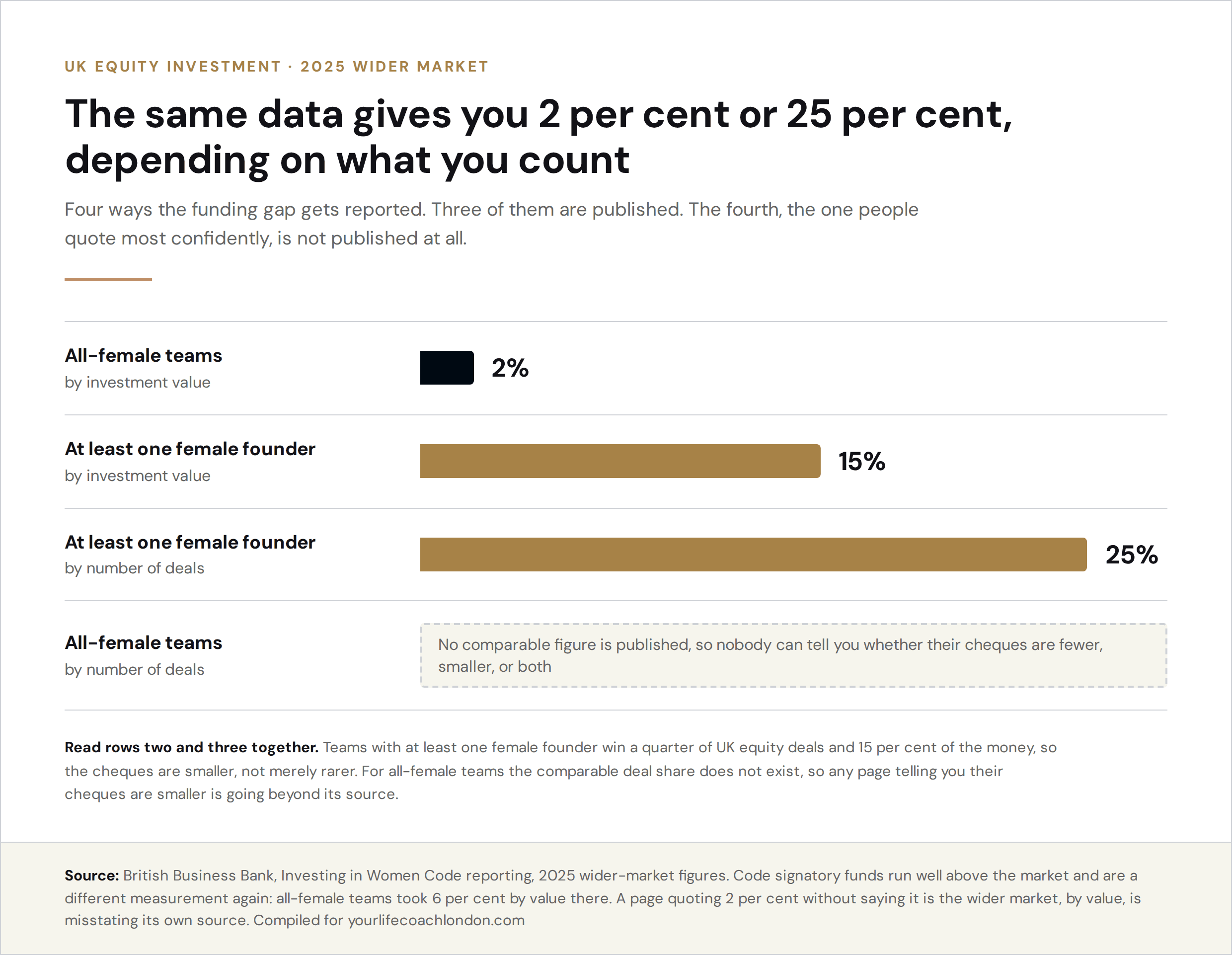
In 2025, founding teams with no male founder received 2 per cent of total UK equity investment by value across the wider market. That figure is real, it comes from British Business Bank reporting, and it is almost always used wrongly.
Three published numbers circulate as “the funding gap”, they measure three different things, and a fourth number that everyone assumes exists does not.
British Business Bank, Investing in Women Code reporting, 2025 wider-market figures. Signatory funds run well above the market and are a different measurement again: all-female teams took 6 per cent by value there. A page quoting 2 per cent without saying it is the wider market, by value, is misstating its own source.
Notice what the middle two rows do together. Teams with at least one female founder win a quarter of UK equity deals. Their share of the money is 15 per cent. The cheques are smaller, not merely rarer. For all-female teams the comparable deal share is not published, so the honest answer on their cheque size is that nobody has shown it either way.
That pattern shows up most sharply where the money is newest. The Women and Equalities Committee reported that over the last year the average deal for male-led AI start-ups was £5.3 million, against £800,000 for female-led AI firms. The male-led average was about 6.6 times as large, a difference of £4.5 million on a single deal.
Time is the constraint nobody coaches away
The Office for National Statistics measured how British adults spend their days in late 2023. Women averaged 3 hours 37 minutes a day on unpaid work, against 2 hours 43 minutes for men. A gap of 54 minutes, every day.
To its credit the gap is narrowing. It was 1 hour 12 minutes in 2020. It is still close to a working day every week.
The Women and Equalities Committee found that female entrepreneurs spend twice as much time on caregiving as male counterparts and are 17 per cent more likely to struggle balancing business demands and family responsibilities. The same committee was blunt about the programmes built to address all this: “[n]umerous programmes and initiatives have been established to address these impacts but they have been insufficient in scale and ambition”.
That last one is not a coaching problem, and pretending otherwise would be dishonest.
The Sector Gap Sitting Underneath the Funding Gap
Capital and time are the two constraints everybody names. There is a third one in the Rose data that gets far less attention, and it quietly shapes both of the others.
Rose puts it plainly. Women are “significantly more likely than men to start businesses in certain lower productivity sectors”, and thinly represented in the sectors where the money moves.
Rose Review, HM Treasury, 2019. High value sectors are Rose’s own term for financial services, IT and manufacturing. The review reports these findings alongside one another. It does not calculate how much of the funding gap sector composition explains, so nobody quoting it can tell you either.
Now put that next to the equity table further up. Investment concentrates in a handful of sectors, and so does the shortfall. Part of the 2 per cent is about who gets backed inside a given sector, and part of it is about which sectors women’s businesses are in. Those are different problems with different remedies.
Sector is also the one item on this list that is partly a decision rather than a circumstance, which is precisely where coaching has something to say. Not “move into fintech”, which is glib and usually wrong. Where you sit inside your own market, what you charge, which customers you chase and whether you go up-market are live decisions, and that planning layer is what strategic business coaching is for.
So which of these, honestly, does a weekly coaching call move?
What a Coach Can Reach, and What No Coach Can
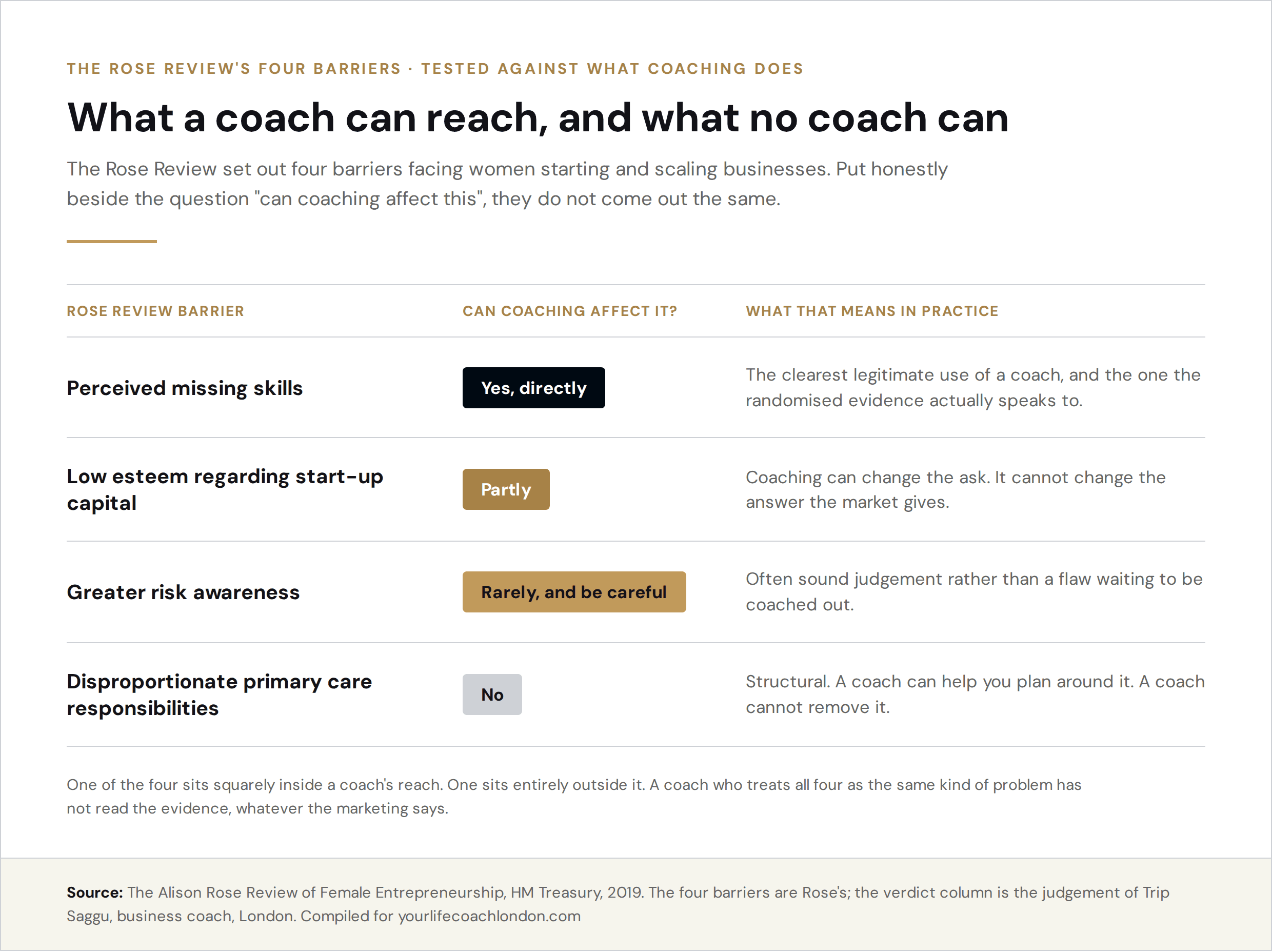
Rose set out four barriers. Putting them next to the honest question, can a coach affect this, is the most useful table here.
The four barriers span finance, risk assessment, perceived skills and care responsibilities. Rose does not class three of the four as financial, and I am not going to pretend the list is tidier than it is.
A coach can change how you ask for money. A coach cannot change how the market answers. Anyone selling you the second thing is selling something they do not have.
I would rather say that and lose the sale.
Does Coaching Actually Work for Women? The Honest Answer
Here is where most articles on this subject quote a return-on-investment figure and move on. I will not, because the honest position is more interesting and considerably more useful to you.
The What Works Centre for Local Economic Growth reviewed the evidence on business mentoring and found only four studies that met its standards, noting that “none of the studies comes from the UK” and that the evidence base is “quite weak”. That review does not establish that no UK randomised trial of any coaching intervention exists anywhere. It does tell you that when serious reviewers went looking for mentoring evidence, almost nothing qualified and none of it was British.
So the rigorous evidence comes from elsewhere, and the single most relevant study is worth setting out in full rather than as a percentage.
The one randomised trial that is actually about women
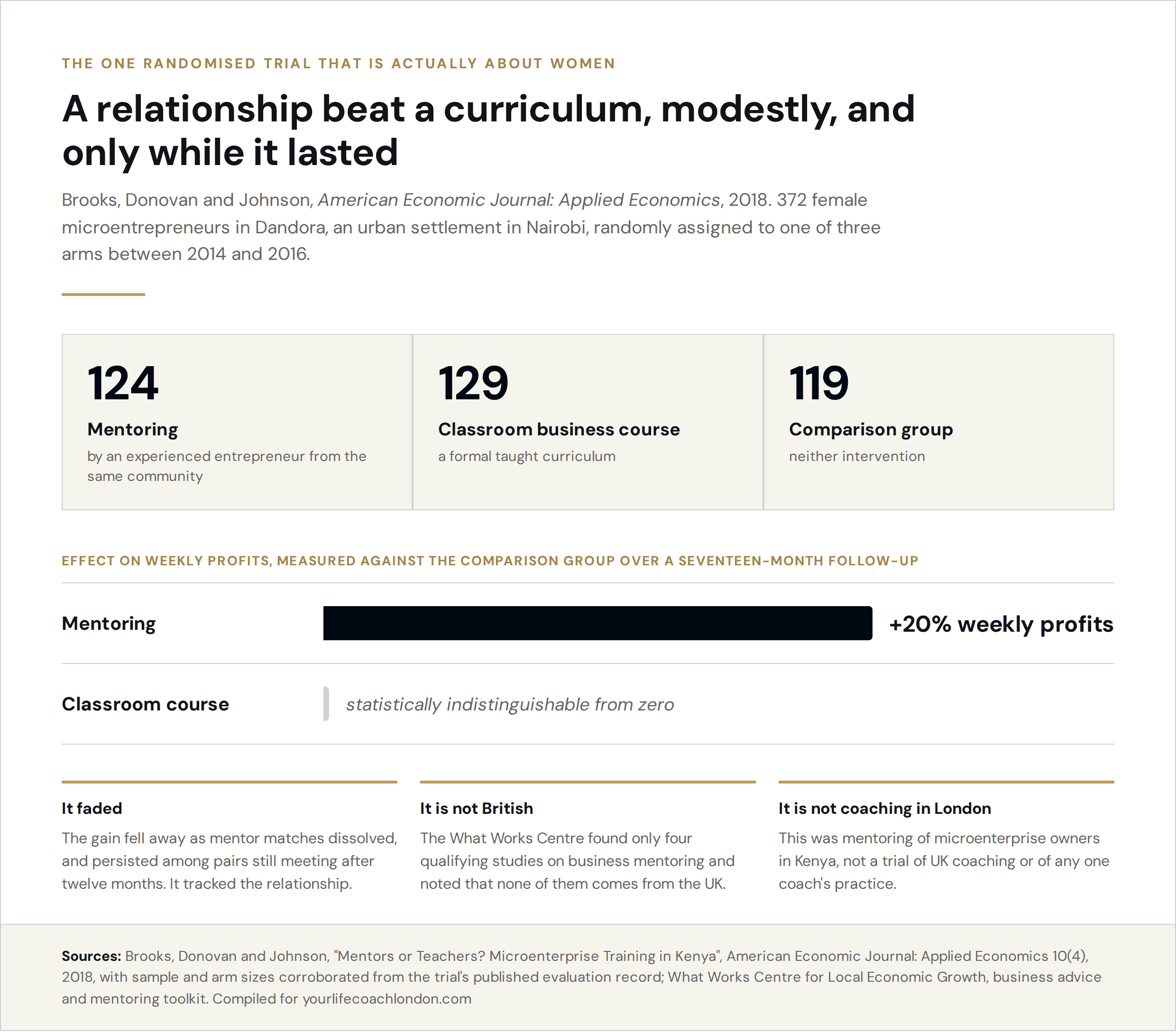
In Brooks, Donovan and Johnson, published in the American Economic Journal: Applied Economics in 2018, 372 female microentrepreneurs in Dandora, an urban settlement in Nairobi, were randomly assigned to one of three arms between 2014 and 2016: mentorship by an experienced entrepreneur from the same community (124 people), a formal business course (129), or a comparison group receiving neither (119).
Over a seventeen-month follow-up, mentees reported weekly profits about 20 per cent higher than the comparison group. The business course produced an estimate statistically indistinguishable from zero, despite measurably changing how people said they ran their businesses.
Three qualifications belong with that figure, and they matter more than the figure does.
- This was mentoring in Kenya, not a trial of my coaching or of UK coaching generally
- The subjects were microenterprise owners, not established UK firms
- The authors report the gain fading as mentor matches dissolved, though it persisted among pairs still meeting after twelve months
What survives all three caveats is the comparison inside the trial. Two interventions, same population, same measurement. The relationship worked and the curriculum did not.
The useful ingredient was not general business knowledge. It was specific, applied knowledge from somebody who had actually done it. That is an argument for a relationship over a syllabus, and it was measured on women.
That distinction is close to the one between a business mentor and a business coach, which I have set out separately.
What that honestly adds up to
Put the two together and you get a thin, specific, defensible claim, which is all anybody should be offering you here.
- The rigorous evidence base on mentoring is small and not British
- Where it has been tested against a classroom alternative, the relationship outperformed the course
- The measured effect was modest, and it tracked the relationship, fading as matches dissolved and holding where they continued
- None of it was measured on UK businesses of the size most readers here are running
Anyone quoting you a large percentage for coaching without naming the study, the sample and the comparison group is selling rather than informing. That includes percentages that flatter my own industry.
Does the Coach Need to Be a Woman?
This is the question I am asked most and the one I have the least comfortable answer to.
There is one suggestive study, summarised in the World Bank’s review of what works in supporting women-led businesses. In a trial of mentoring delivered by video call, the effect was positive for female entrepreneurs matched with a female mentor, and not when matched with a male mentor. One study is not a settled finding and I am not going to inflate it into one.
But it is the only causal evidence pointing at the question, it points one way, and I am a man. So here is my position, plainly: if what you need is somebody who has personally raised capital while being read as less credible for it, I am not that person, and there are excellent women in this market who are.
What I can offer is the part the evidence actually supports: specific, applied, relationship-based work with somebody who has built and run businesses. If you want the London-specific version of that, I have written separately about business coaching for female entrepreneurs in London.
The most useful thing a coach can tell you is when not to hire them. That sentence costs me work every year and I have never once regretted writing it.
Buying Against the Constraint Rather Than the Label
If “for women” is a marketing label applied to a standard programme, it is worth nothing. If it means the coach has actually thought about where the binding constraint sits, it is worth a great deal. The difference shows up in the first conversation.
Rose’s four barriers are not interchangeable, and the table further up shows how differently a coach stands in relation to each one. One sits squarely inside a coach’s reach. One sits entirely outside it. A coach who treats all four as the same kind of problem has not read the evidence, whatever the marketing says.
So the useful question is not whether something is coaching for women. It is which of those four is binding on you this year, and whether the person opposite you knows the difference. On when coaching is the wrong purchase altogether, I set that out on my business coaching London page rather than here.
The label tells you who the marketing is aimed at. The method tells you what you are buying. Only one of those two shows up in your accounts at the end of the year.
In the Kenya trial the gain held where the pairing held and faded where it dissolved, which says something about what you are actually buying. Not a stock of knowledge, but a working relationship. My own engagements carry a ninety-day checkpoint, and stopping there means a pro rata refund for the sessions you have not used.
Where This Sits Alongside the Rest of My Work
This piece is deliberately national and about the evidence. Several neighbouring questions have their own homes, and sending you there is faster than half-answering them here.
- On choosing between coaches and what to ask in a first call, see how to choose the right coach
- On fees, see my breakdown of business coaching costs in the UK
- If you are pre-revenue and still testing the idea, that is entrepreneur coaching rather than this
- If you lead inside a larger organisation, that is executive coaching
Complete Transformation is a six-month coaching programme.
Frequently Asked Questions
Is coaching women different from coaching anyone else?
The work is largely the same. What should differ is which constraints the coach takes seriously. A coach who treats a capital gap as a confidence problem is doing the job badly, whoever is sitting opposite.
What does the data identify as the main barriers?
Capital, sector concentration, risk assessment, perceived skills and care responsibilities. Rose puts four of those in its own list. These sources measure money, minutes and caregiving on different scales, so they cannot rank one as the single biggest.
Is confidence really the issue?
Less than the marketing suggests. Rose lists low esteem about start-up capital as a barrier, but it sits alongside risk awareness, which is often sound judgement, and care responsibilities, which are structural. Treating all three as confidence is the commonest error in this field.
Does business coaching for women in the UK have proof it works?
Not of the kind you should accept uncritically. The nearest rigorous evidence is a Kenyan randomised trial on female microenterprise owners, where mentoring beat a classroom course, the effect was modest and it faded. No British trial of comparable rigour appeared in the What Works review.
How long should an engagement run?
Long enough for a change to survive a normal quarter. Six months is a reasonable default for structural work, with a genuine checkpoint at ninety days.
Should I work with a female coach?
If the specific thing you need is lived experience of raising capital as a woman, yes, and I will say so. The single study that exists on mentor matching points that way. For applied operating experience, judge the person rather than the category.
What should I do if capital is the binding constraint?
Buy the instrument that addresses it. Coaching can sharpen how you present a business and what you ask for. It cannot change what investors decide, and a 53 per cent capital gap at launch is not a coaching problem.
Key Points
- The Growth Vouchers Programme, Britain’s only randomised test of subsidised business advice, never analysed its results by gender, and only a third of its first cohort bought advice at all. Women-led businesses were 30 per cent among respondents against an 18 per cent national share, which the report reads as accessibility and nothing more.
- Rose measured a 53 per cent capital gap at launch. In 2025, teams including a female founder won a quarter of UK equity deals but only 15 per cent by value, and teams with no male founder took 2 per cent by value.
- Women do 54 minutes a day more unpaid work, and female entrepreneurs spend twice as long on caregiving.
- Of Rose’s four barriers, one sits squarely inside a coach’s reach and one sits entirely outside it.
- The best relevant trial found mentoring beat a classroom course on women, modestly, and the gain faded when the relationship ended.
- Buy against the constraint that is actually binding, not against the label.
If you run a business and you already know which of these is your binding constraint, the first conversation is free and there is nothing to prepare.

Book a complimentary consultation about the 90-day business mentoring programme with Trip Saggu. No pressure, no obligation.
Last updated: 13 September 2026 by Trip Saggu