

There is a particular kind of quiet that arrives with seniority. The more senior you become, the fewer people tell you the truth, and the more expensive it becomes when nobody does.
Your board wants confidence. Your team wants certainty. Your investors want the number. Somewhere in the middle sits a person making decisions worth millions with nobody to think out loud in front of.
That gap is what executive coaching exists to fill. Not motivation, not training, and certainly not a consultant handing you a deck. Something narrower and considerably more useful.
Below I set out what an executive coach does across five domains of the job, how to check whether the one in front of you is genuinely senior, what executive coaching costs in London this year, and the point at which you should keep your money.
The Short Answer, Before the Detail
An executive coach works on the quality of your thinking, your judgement and your impact as a leader, rather than on the operations of the business beneath you.
That is the line separating it from everything adjacent. A business coach works largely on the business, and I have set out what that involves in practice elsewhere. An executive coach works on the person running it, on the assumption that at senior level the two have become the same constraint.
The unit of work is a decision, a relationship or a behaviour. Not a spreadsheet. If you leave a session with a revised financial model, you were with a consultant. If you leave having changed how you will handle Thursday’s board meeting, you were with an executive coach.
Executive coach and leadership coach are used more or less interchangeably in the UK market. Where a distinction exists, executive coaching attaches to a role and its stakeholders, while leadership coaching attaches to a capability that can be developed at any level.
It is bought by two quite different buyers. Organisations commission it for leaders they are investing in, or for ones they are worried about. Founders and owners buy it for themselves, and almost always later than they should.
The Five Domains an Executive Coach Works On
Strip away the language and executive coaching covers five domains. Any coach worth their fee moves between all five, because at senior level they are rarely separable.
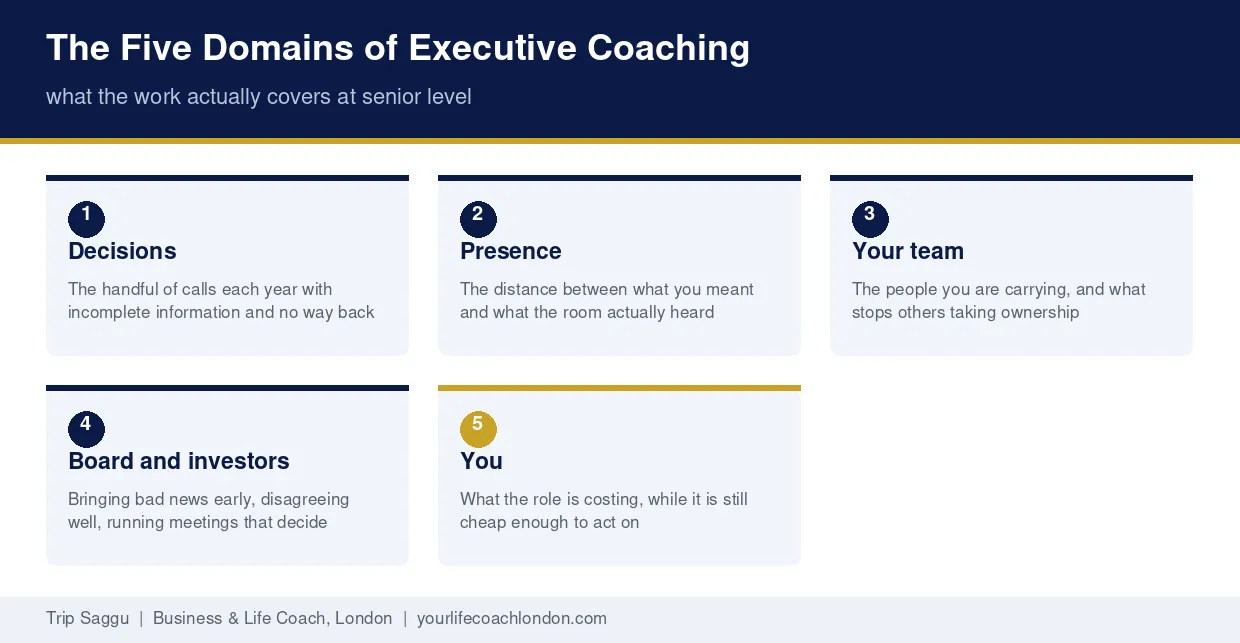
1. The decisions only you can make
Every senior role narrows to a handful of choices a year that genuinely matter, and they are almost always the ones with incomplete information and irreversible consequences.
A coach builds the structure around those decisions: what would have to be true, whose view you need and who is not in the room, what you are optimising for, and what you would advise a peer facing exactly this. In my experience the missing view usually belongs to whoever will have to deliver the decision.
2. How you land in the room
Executive presence is a much-abused phrase, but the thing underneath it is real. It is the gap between what you intended to communicate and what people actually took away.
At senior level that gap compounds. A throwaway remark becomes a directive and a raised eyebrow becomes a strategy shift. The work here is mostly accurate feedback, which is precisely what your position has stopped supplying. In my experience it takes about three months into an engagement before anyone around you risks saying something genuinely unflattering.
3. The team directly beneath you
Your leadership team is the highest-leverage asset you have and usually the least examined. In my experience most senior leaders are quietly carrying one or two people, and have been for longer than they would admit.
We work on the calls you have been deferring: who is genuinely capable of the next stage, who was right for the last one, and what you personally do that stops good people taking real ownership. In my experience the person being carried is often the second or third hire, and you have usually known it for about a year.
4. The relationships above and around you
Board members, investors, non-executives, co-founders and peer executives. These relationships are political in the neutral sense, and most technically brilliant leaders manage them worse than they believe they do.
The work is unglamorous and high-return: how to bring bad news early, how to disagree with a chair without spending capital you will need later, and how to run a board meeting that produces a decision instead of a performance.
5. What the job is doing to you
This is the domain people skip, and it is the one that ends careers. Senior roles extract a price, and the leaders who last are the ones who notice the cost early enough to change something.
A good coach asks about sleep, about the relationships outside work, and about whether you still want the thing you are organising your life around. Not out of sentiment, but because a depleted leader makes worse decisions and everyone around them pays for it.
Seniority removes the two things that made you good: honest feedback and time to think. Executive coaching is the deliberate reconstruction of both.
Executive Coaching vs Business Coaching: Where the Line Sits
These overlap far more than either camp admits, and the honest distinction is about the unit of work rather than about seniority or price. Neither is the senior version of the other.
| Dimension | Executive Coaching | Business Coaching |
|---|---|---|
| Unit of work | A decision, a relationship, a behaviour | A number, a system, a process |
| Who is in the frame | You, your team and your stakeholders | The business and its operations |
| Who usually pays | The organisation, as development spend | The owner, often personally |
| Typical trigger | A promotion, a transition, a stalled leader | A plateau, a growth target, an operational mess |
| Success looks like | Better judgement under pressure | Better numbers and less owner dependency |
In a founder-led company the two collapse into one job, which is why I rarely sell them separately. That combined work is what my executive coaching in London is built around. If you want the neighbouring distinctions properly examined, I have written about mentoring versus coaching and about coaching versus consulting elsewhere.
Founder to CEO: The Transition Nobody Prepares You For
The most common reason a founder comes to me is not growth. It is the dawning realisation that the job they are doing is no longer the job the company needs.
Founding rewards speed, personal judgement and being across everything. Running a company of any scale rewards something close to the opposite: delegation, deliberate pace on the big calls, and building people who decide without you.
Nobody announces this transition and there is no date. You simply notice, in my experience at around thirty to forty employees, that the behaviours which built the thing have started to constrain it.
The awkward part is that none of those behaviours were wrong. They were correct for a company of eight and are actively harmful in a company of eighty, which is considerably harder to accept than simply having been mistaken.

What tends to break first
Three things, and in my experience almost always in this order:
- The information flow. You stop hearing bad news early, because the organisation has learned what you react badly to.
- The hiring bar. You promote loyalty over capability at exactly the moment capability starts to matter more.
- Your own identity. A founder who no longer does the founding work has to answer a genuinely hard question about who they now are.
The structural side of this sits alongside my framework for building a scalable business model, and the directional side sits in my piece on strategic business coaching. The personal side is the part only executive coaching reaches, and it is the work people are usually describing when they say they want a CEO coach rather than a business coach.
Most founders do not fail at the CEO transition because they lack the skill. They fail because nobody told them a transition was happening.
How to Check an Executive Coach Is Actually Senior
Executive coaching in the UK is unregulated. Anyone can call themselves an executive coach tomorrow morning, and the difference between an experienced practitioner and a well-packaged one is not visible on a website.
There is, however, a published standard you can check against. The European Mentoring and Coaching Council operates a four-level individual accreditation, and the thresholds are specific.
| EMCC level | Minimum years practising | Minimum client hours | Minimum clients |
|---|---|---|---|
| Foundation | 1 | 50 | 5 |
| Practitioner | 3 | 100 | 10 |
| Senior Practitioner | 5 | 250 | 20 |
| Master Practitioner | 7 | 500 | 40 |
Every level also requires current EMCC membership, alignment with the Global Code of Ethics, and evidence of continuing professional development, reflective learning and ongoing one-to-one supervision. Master Practitioner additionally requires a demonstrated contribution to the profession. All of this comes directly from EMCC Global.
I should be straight with you, since this article is built on the question of credentials. I hold no accreditation from either the EMCC or the ICF. My background is two decades of building businesses and a property portfolio, plus formal training in leadership and management, in coaching and mentoring, and in NLP. That NLP practitioner qualification is unrelated to the EMCC Practitioner level in the table above. Some of the best coaches I know are accredited and some are not, but you should know which you are buying.
The five questions that separate real from packaged
- Who supervises you, and how often? Supervision is the strongest signal of a serious practice and the least likely to be faked.
- What kind of client do you turn away? Anyone who helps everybody has not thought about who they help best.
- Tell me about an engagement that did not work. A real practitioner has several and will discuss them.
- What happens to what I say in the room? Especially where the organisation is paying and you are not.
- How do we end this? The answer tells you whether they are building your capability or your dependence.
Question four matters more than most people realise. If your employer commissions the coaching, establish at the outset exactly what gets reported back and in what form, before you say anything you would not put in an email.
What a Six-Month Engagement Actually Looks Like
Engagement length varies with the brief. The commercial guides describe anything from a short block around a single transition to a year or more of retained work. What the time is spent on matters far more than the frequency, because a promise to meet fortnightly tells you almost nothing about what you are buying.
Weeks one to four: establishing what is true
The opening stretch is diagnostic and often uncomfortable. What are you genuinely optimising for, what does your team say when you are not in the room, and which of your beliefs about this business have not been tested in two years?
In many engagements we gather structured feedback from the people around you at this point. It is the most valuable input available and the one most leaders quietly resist, usually because they already suspect what it will say.
Months two to four: the working middle
This is where change actually happens and where the discomfort lives. You will be asked to do things between sessions, and each session opens with what happened when you did, or did not, do them.
Expect at least one session in which you defend a position you have held for years and find you cannot support. In my experience that is the session people still refer back to a year later.
Months five and six: making it survive your coach
The closing stretch is about transfer. Which habits have genuinely taken, what structure persists without a fortnightly appointment, and what your own early warning signal is that you are sliding back into the old pattern?
If the final month of an engagement is not about how you continue without the coach, you are not being coached. You are being maintained.
What Executive Coaching Costs in London
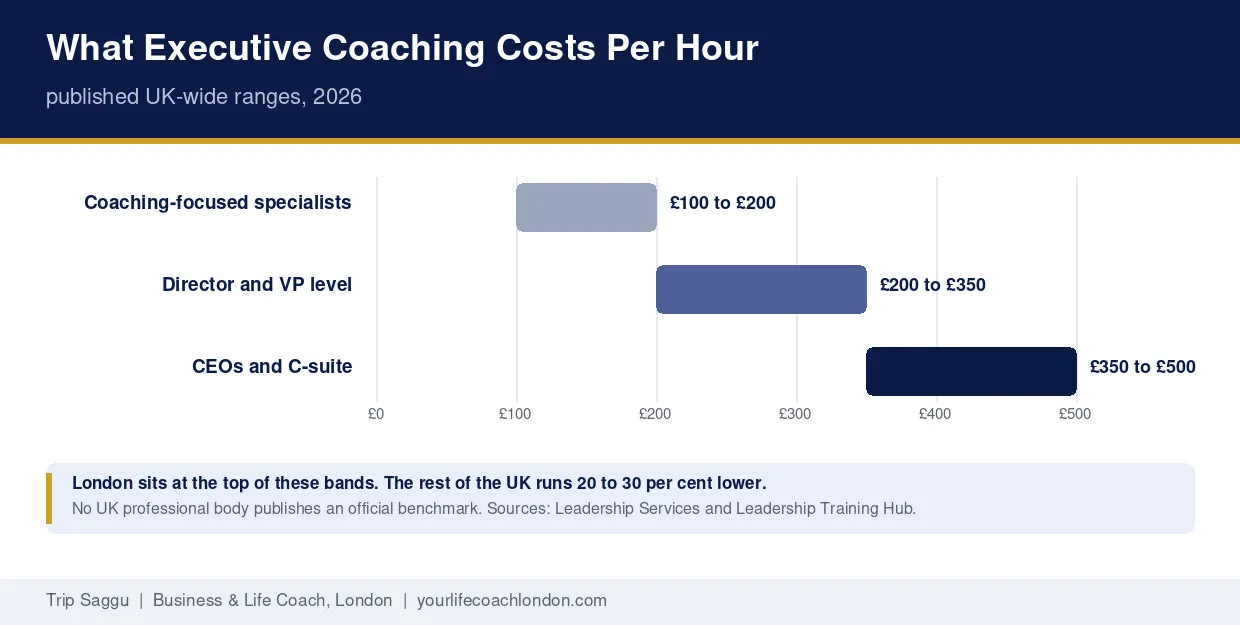
No UK professional body publishes an official rate benchmark, so anyone quoting you a definitive market average is quoting their own price list. What follows comes from two commercial guides, both linked below, and I offer it as market observation rather than as fact. The published bands are UK-wide, and the London picture sits underneath them.
| Engagement (UK-wide ranges) | Published range |
|---|---|
| Coaches working with CEOs and C-suite | £350 to £500 per hour |
| Director and VP level | £200 to £350 per hour |
| Monthly retainer, two sessions plus support | £800 to £2,400 |
| Six-month structured programme, per participant | £4,000 to £12,000 |
| First-time chief executive, annual | £14,400 to £24,000 |
Two caveats before you use those numbers:
- Those bands are UK-wide, and the two guides do not entirely agree on London. Leadership Training Hub gives London starting rates of £200 to £300, rising to £350 to £500 for the most experienced practitioners, with the rest of the UK sitting 20 to 30 per cent lower. Read together, London sits at the top of the national bands rather than above them.
- Somebody else usually pays. Leadership Services, which publishes the bands in the table, notes that executive coaching is normally paid for by the organisation as development spend rather than by the individual.
If you are a business owner paying for yourself, the comparison you actually want is my guide to business coaching costs in the UK, which covers the owner-funded end of the market properly.
No UK body publishes an official executive coaching benchmark, so every published average is somebody’s price list. Judge the practitioner in front of you, not the number.
When You Do Not Need an Executive Coach
I would rather turn work away than take a fee for the wrong thing. These are the honest disqualifiers, and in my experience at least one of them applies to a fair share of the people who enquire.
- You need a specific skill. Financial modelling, employment law, a technical capability. Buy training or expertise, not coaching.
- Your organisation is the problem and it is not going to change. Coaching cannot repair a structurally broken environment, and it is sometimes used to imply an individual is at fault when they are not.
- You are being sent, not choosing. Coaching commissioned as a last step before an exit is a performance process wearing a friendlier coat.
- You are experiencing genuine mental health difficulties. That deserves a qualified clinician. A responsible coach will say so and help you find one.
- Your problem is the business, not you. If the model is broken, start with business coaching in London instead.
And if you are simply unsure whether the timing is right at all, the signs it is time to bring someone in cover that question in detail.
Coaching commissioned to fix a person when the problem is the structure is not development. It is documentation. Establish which one you are in before you engage.
How I Work with Senior Leaders and Founders
I came to coaching from operating, not from a training course. Two decades building multiple businesses and a property portfolio, and a long stretch on the other side of the table as somebody else’s client.
Over the past decade I have put more than £50,000 into my own development, including Tony Robbins’s Business Mastery University and Date With Destiny, and earlier structured coaching with ActionCOACH. My formal training covers leadership and management, coaching and mentoring, and NLP to practitioner level.
In practice most senior clients start with focused one-to-one work, then move into the 90-day mentoring programme once the direction is settled and the constraint becomes execution. Where the personal and professional are genuinely entangled, which at founder level they usually are, the six-month complete transformation holds both.
I also work with a small number of senior clients at any one time, which is a constraint rather than a marketing line. The structure and the price of my executive coaching engagements are set out in full. Work of this kind does not scale well, and a coach carrying thirty senior clients is not giving any of them much thought between sessions.
What I will not promise is a number. As a business coach in London I can give you structure, challenge and the pattern I have seen before. What it converts into depends on the hours I am not in the room.
Frequently Asked Questions
What does an executive coach do in a session?
They ask what is genuinely in front of you, then work through it properly rather than sympathetically. Expect to be asked what you are avoiding, what evidence would change your mind, and what you would tell a peer in the same position. You should leave with a decision or a changed behaviour, not a summary.
Is executive coaching confidential if my employer is paying?
It should be, but confidentiality is contracted rather than automatic. Agree in writing what is reported back, whether that is attendance only, themes, or progress against objectives. Establish it before the first session, not after you have said something you would not want summarised.
Do I need an executive coach with experience in my industry?
Usually not. The material of executive coaching is judgement, relationships and behaviour, and those transfer across sectors. Industry knowledge matters when you need answers, which is a mentoring need rather than a coaching one.
Can executive coaching help with a founder-to-CEO transition?
It is arguably where it earns most. The transition is not a skills gap but a change in what the job rewards, and it usually surfaces as an identity question rather than a capability one. Starting before the discomfort becomes obvious is considerably cheaper than starting after.
Key Takeaways
An executive coach works on your judgement, presence and impact, not on the operations beneath you. Before you engage one:
- Know which of the five domains you need: decisions, presence, your team, your stakeholders, or the toll of the job
- Check any credential against the published EMCC levels, and ask the coach who supervises them
- Treat published rate ranges as market observation rather than as a benchmark, and expect London to sit at the top of the UK bands
- Settle confidentiality in writing before the first session if your employer is paying
- Walk away if what you need is a specific skill, a qualified clinician, or an organisational change nobody above you intends to make
Ready to Think Out Loud with Someone?
If any of this landed, the useful next step is not a proposal. It is one honest conversation about what is actually in front of you.
I offer a complimentary call in which we look at whether executive coaching is the right instrument, including when it is not. If what you need is a sector mentor, a clinician, or simply a fortnight off, I will tell you.
Explore business coaching in London, read more about my background, or book a complimentary call and we will work out what you actually need.

Last updated: 10 September 2026 by Trip Saggu