

You have been drafting the resignation email in your head for about eight months. Never in a document. Just often enough that you know how the second paragraph goes.
Something in you has already decided and the rest of you has not caught up. That gap is where most career changes stall, because the deciding part and the doing part run on different timetables and neither waits.
I am a business coach London professionals come to when the next move has stopped being obvious. Career change is the version of that conversation I have most often, and it almost never opens with a question about jobs. It opens with somebody describing a Tuesday.
This piece is for people who are employed and quietly wondering whether the profession itself is wrong. If your question is really about your age rather than about the work, career coaching for mid-career professionals is the closer fit, and if you want to go further inside your current field rather than leave it, that is career development coaching.
Everything below sits under career coaching in London, and before any of the five checks there is one thing you should know about the ground you are standing on, because it changes how much weight to put on everything you have read so far.
Nobody in the UK Measures Career Change
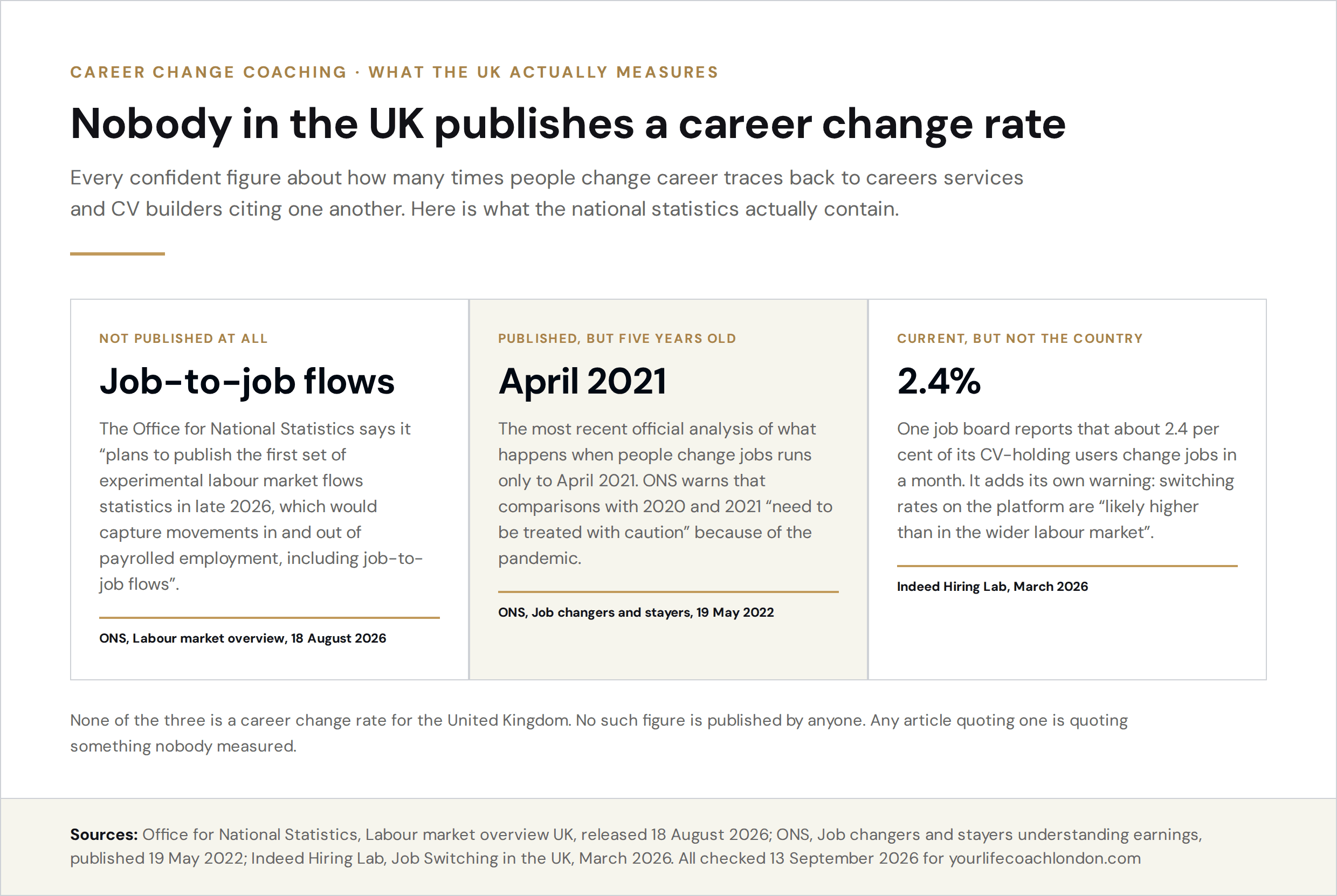
You have read that the average person changes career five times in a lifetime, or seven, or twelve. The number varies by article and it is always delivered with great confidence. Not one version of it comes from an institution that measures anything.
I went looking on 13 September 2026 and followed the citations backwards. The entire first page of results was careers services, CV builders and content farms quoting each other in a circle. No government source, no survey, no stated method, no sample.
Those numbers do real work in people’s heads. “Everyone changes career five times” makes a reckless move feel normal and a considered one feel slow. Here is what the United Kingdom publishes instead.
The Office for National Statistics said in its labour market overview of 18 August 2026 that it “plans to publish the first set of experimental labour market flows statistics in late 2026, which would capture movements in and out of payrolled employment, including job-to-job flows”.
That series does not exist yet. When it arrives, built on the Linked Employer and Employee Dataset, it will be the first proper UK measure of movements in and out of payrolled employment. Until then there is no official flows series, and there has never been an official career change rate at all. What does exist is partial, and the two best pieces of it are below.
The closest official answer is five years old
The last ONS analysis of what happens when people change jobs is Job changers and stayers, understanding earnings, published on 19 May 2022 and running to April 2021.
It matched employees surveyed in consecutive years, so roughly a third of the sample dropped out annually, and its last year was distorted by the pandemic. ONS says so plainly: comparisons with 2020 and 2021 “need to be treated with caution”. With all that against it, it remains the best official evidence we have.
The only current number belongs to a job board
Indeed’s Hiring Lab published UK switching figures in March 2026, built from job histories on user CVs. About 2.4 per cent of its users change jobs in a month, roughly one in 42, and about 63 per cent of those movers go into a different occupation.
To Indeed’s credit it flags the problem itself: “job-switching rates observed on Indeed are likely higher than in the wider labour market.” A job site sees the people who are looking. Somebody settled in a role for eleven years is not refreshing their CV on it. The figure is real, but it describes a particular group.
You are making one of the largest decisions of your working life in a country that does not measure it. That is not a reason to freeze. It is a reason to stop outsourcing the decision to statistics that were invented by somebody selling CV templates.
So the five checks below are not built on a career change statistic, because there is not one. They rest on what the country does measure, and on what decides these conversations in the room.
Check 1: Are You Leaving the Job, or the Career?
Almost nobody separates the two properly before handing in notice. They produce identical symptoms and demand different solutions, which is an unusually bad combination.
A bad manager, a restructure that removed the interesting half of your role, a commute that eats your evenings, a salary that stopped moving three years ago: all excellent reasons to change job. Not one is evidence about your career. They are facts about an employer.
The CIPD Good Work Index 2025, published on 9 June 2025 from 5,017 UK working adults surveyed that January and February, found the split plainly. Among workers who say work damages their mental health, 34 per cent planned to quit voluntarily within twelve months, against 14 per cent of everyone else.
That measures how work currently feels, not whether the profession was ever wrong. The expensive version of confusing them is a full retrain when a different employer in the same field would have fixed it in a month.
The test I actually use
Picture the same role and profession. New organisation, good manager, fair pay, reasonable hours.
- If that fixes it, you have a job problem. Changing career is the expensive answer to a cheaper question.
- If you read that and felt nothing, you have a career problem. No employer in that field is going to reach it.
- If you cannot tell, that is genuinely useful information, and it is the most common answer I get.
The third answer is not indecision, and I would rather hear it than a confident wrong one. It usually means the job has been bad long enough that you can no longer feel the difference between disliking the work and disliking the conditions. Untangle that first, because every decision after it inherits the error.
Nobody quits a good job in a wrong career, and nobody quits a bad job in a right one. The two get muddled precisely because they feel identical from the inside on a Sunday evening.
Check 2: Does the Move Change Your Occupation, or Just Your Employer?
Here the official data earns its place. The common assumption is that the safe move pays and the bold one costs. The ONS numbers point the other way.
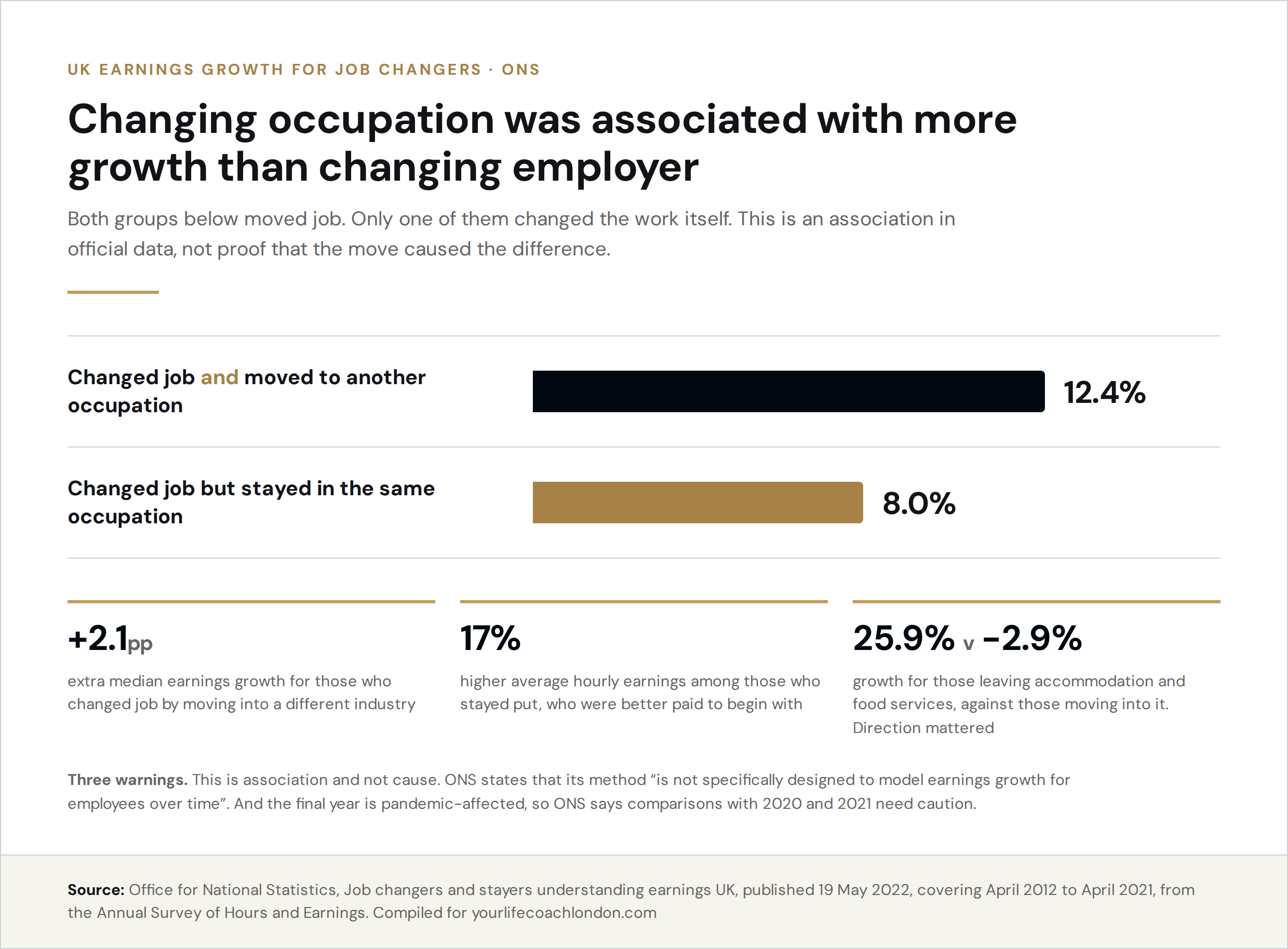
The job changers analysis found that employees who changed job and moved to another occupation had average earnings growth of 12.4 per cent, against 8 per cent for those who changed job but stayed in the same occupation. Both groups moved. Only one of them changed what they actually did all day.
Changing employer was worth something real. Changing the work itself was worth more than half again as much. That is the opposite of how most people price the risk at two in the morning.
Three warnings before you do anything with that table.
1. This is association, not cause. People who change occupation may simply be the people with more to move towards.
2. ONS says the method was not built for this. Its own note is that the Annual Survey of Hours and Earnings “is not specifically designed to model earnings growth for employees over time”.
3. The closing year was distorted by the pandemic, on ONS’s own caution.
Even allowing for all three, the direction of travel is worth knowing. The larger and more frightening move is the one the data associates with the larger change in earnings. That does not make it right for you, but it should stop you assuming the cautious version is automatically the sensible one.
Check 3: Which Direction Are You Moving In?
The same analysis shows something most career advice skips. Direction mattered more than movement.
Workers leaving accommodation and food services for another sector saw earnings growth of 25.9 per cent. Workers moving into that sector saw minus 2.9 per cent.
Same act, opposite outcomes, nearly 29 percentage points apart. Nobody in the second group planned badly. They moved towards a part of the labour market that pays differently from the one they left, and the direction of the arrow did the work.
What this means for the conversation
Most people arrive with a destination already chosen, usually from one friend’s experience or a single good day somebody described at a wedding. None of that is disqualifying. It is untested. The useful work is finding out whether the destination behaves the way you imagine.
- What does this occupation pay at entry, not at the top? You are joining at the bottom of it.
- Who hires into it from outside, and at what level? Some fields have a door for career changers. Some do not.
- What is the smallest real version of the job you could test first? A weekend, a project, a conversation with somebody doing it.
- What would you have to be wrong about for this to be a mistake? If you cannot answer, you have not examined it yet.
A career change is a bet on a destination, not an escape from an origin. Most failed changes were decided entirely by what the person was leaving.
Check 4: What Does the London Market Actually Look Like?
One London fact belongs in the decision, and it is not the one most people would guess. London is usually described as the place with the most opportunity, which is true, and almost never as the place with the most competition for it, which is also true.
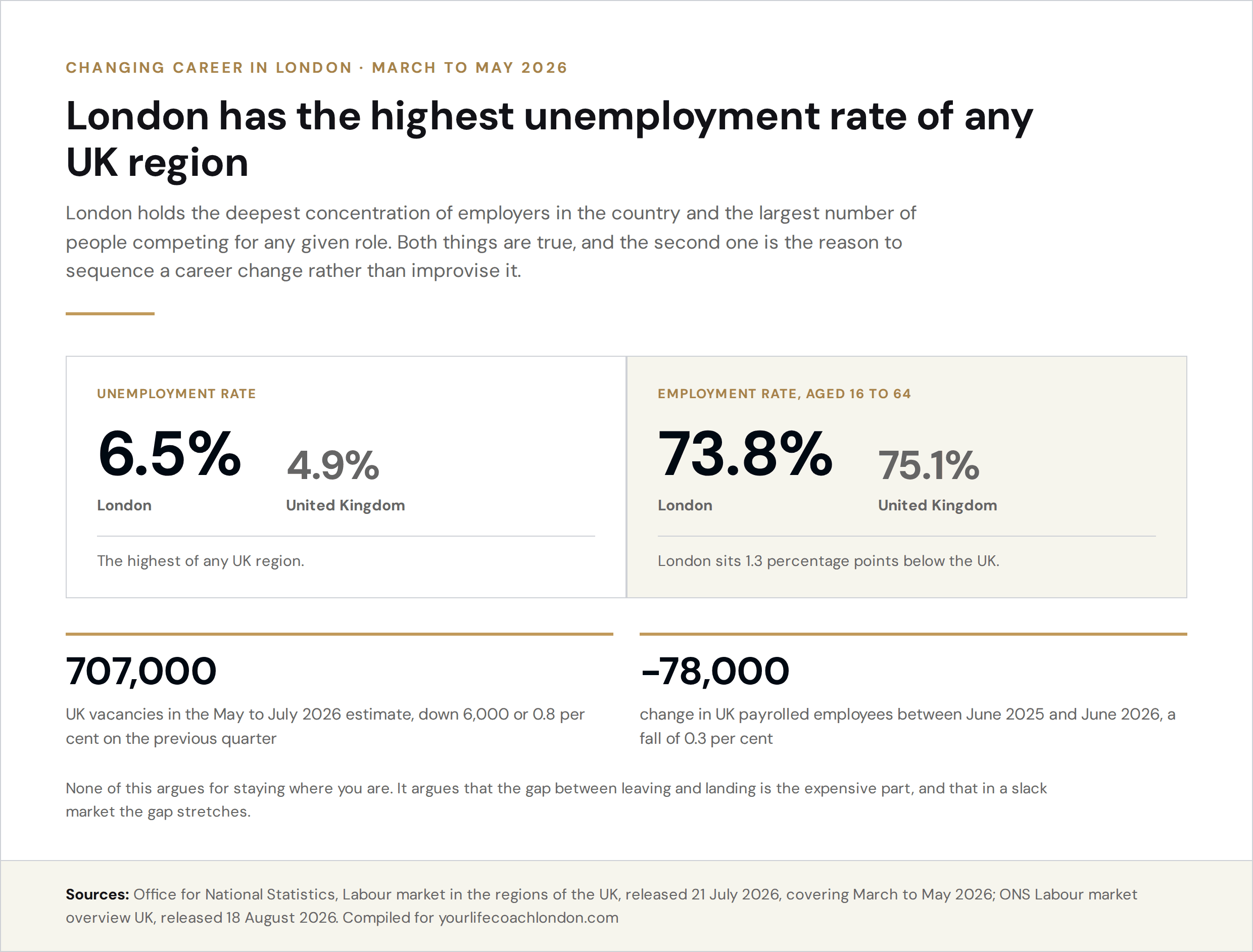
The ONS regional labour market bulletin of 21 July 2026 records that for March to May 2026, London had the highest unemployment rate of any UK region at 6.5 per cent, against 4.9 per cent for the UK. London’s employment rate was 73.8 per cent against a UK figure of 75.1 per cent.
The wider picture is not loose either. Vacancies fell to 707,000 in the May to July estimate, and payrolled employees fell by 78,000 across the year to June 2026.
Why this argues for planning, not for staying put
London holds the deepest concentration of employers in the country, and for most career changes that is decisive. It is also where the most people compete for any given role, which is what 6.5 per cent describes.
That combination does not make a career change in London unwise. It makes an unplanned one expensive. The gap between leaving and landing is the part that hurts, and in a slack market it stretches.
Which is why I will not run this work on a “hand in your notice and we will figure it out” basis, however much better that feels in the week you decide. The sequencing is not the admin around the job. It is the job.
Check 5: What Are You Expecting Coaching to Do?
This is the part most coaching pages leave out, and the part to hold me to hardest. If somebody selling you coaching cannot tell you what the evidence does not show, they either have not read it or would rather you did not.
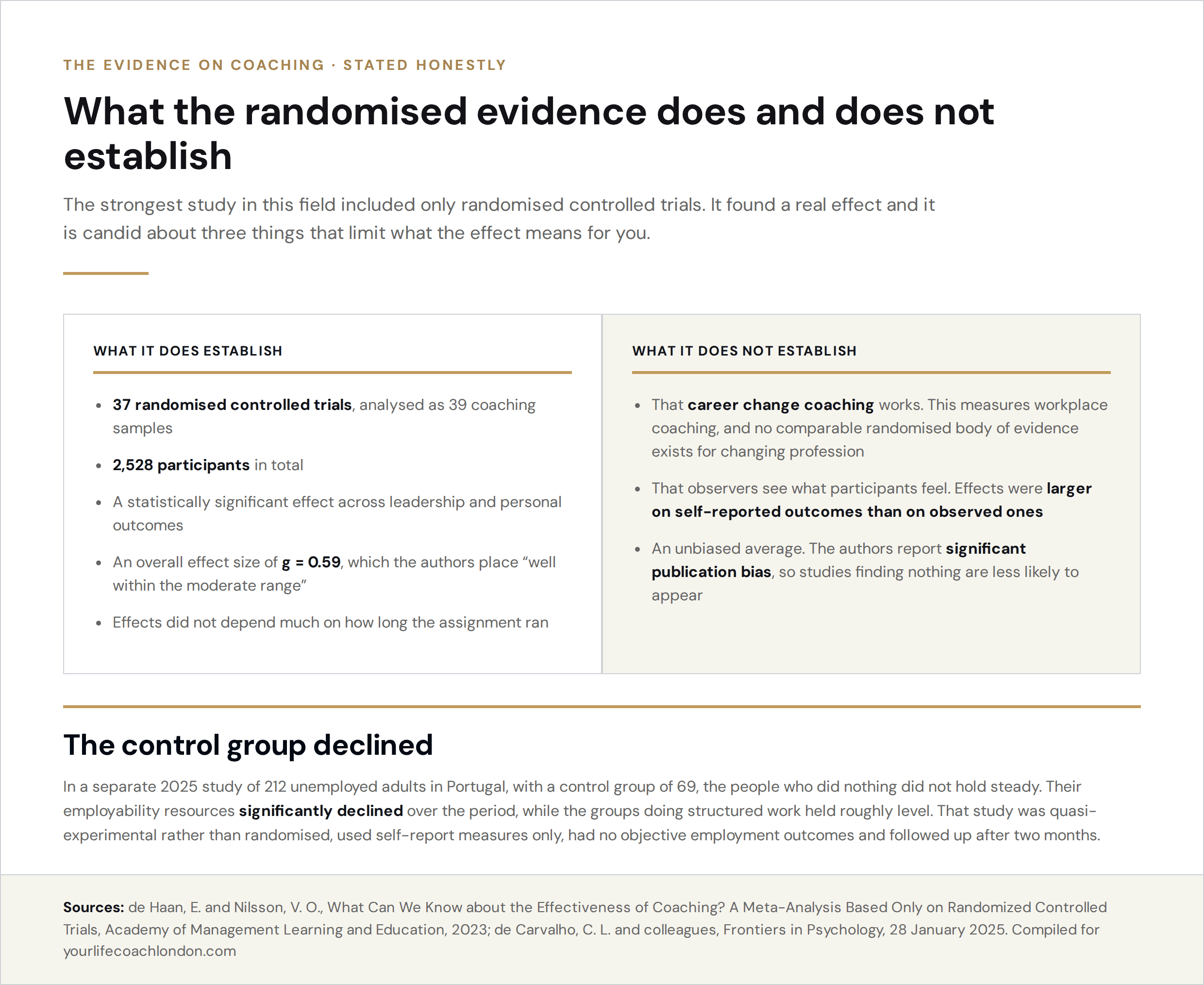
The strongest evidence on coaching is a meta-analysis by Erik de Haan and Viktor Nilsson, published in the Academy of Management Learning and Education in 2023, which is unusual because it included only randomised controlled trials. It covered 37 studies, analysed as 39 samples, with 2,528 participants in total.
It found a statistically significant effect across leadership and personal outcomes, with an overall effect size of g = 0.59, which the authors place “well within the moderate range”. Moderate is a good result for this kind of intervention, and a long way from the language the industry tends to use.
Now the caveats, because they matter more than the headline.
- It measures workplace coaching, not the work described here. No equivalent body of randomised evidence exists for helping somebody change profession.
- Effects were larger on self-reported outcomes than on observed ones. People felt better by more than observers measured them improving.
- The authors report significant publication bias. Studies showing nothing are less likely to be published, which inflates the average.
The finding I think about most
A 2025 study in Frontiers in Psychology by Catarina de Carvalho and colleagues ran a group career intervention with 212 unemployed adults in Portugal, with a control group of 69. It was quasi-experimental rather than randomised, used self-report measures only, had no objective employment outcome data, and followed up after just two months.
That is a weak design and I would rather tell you so than quote it as though it settles anything. But the number worth sitting with is not the intervention group’s at all.
The control group’s employability resources significantly declined over the period. The people who did nothing did not stay where they were; they went backwards. The groups doing structured work on it held roughly steady instead.
In that study the people who did nothing went backwards, and the groups doing structured work did not. That is a two-month, self-reported result from a non-randomised Portuguese trial of a group programme for unemployed adults. It is not evidence about one-to-one coaching, and I am not going to dress it up as though it were.
What This Work Actually Involves
Stripped of the industry language, it is four things done in a particular order, and the order carries most of the value. Out of sequence, each step undermines the one before it, which is how people end up retraining for a destination they never tested.
1. Separating the job problem from the career problem, which is Check 1 and usually takes longer than people expect.
2. Building a real picture of two or three destinations, including what they pay at entry and who hires into them from outside.
3. Designing the smallest test that could disprove your plan, before it costs you a salary.
4. Sequencing the move, so the gap between leaving and landing is as short as you can make it.
Being clear about the limits saves us both time. This is coaching, not recruitment, not CV writing, not therapy, and not a way around a qualification your destination genuinely requires. If what is actually happening is burnout or something clinical, coaching is the wrong instrument and I will say so in the first session.
Where This Sits Alongside the Rest of My Work
Career change is one of several conversations that look alike from outside. Work out which one you are in before booking anything; the wrong starting point costs sessions.
The two nearest neighbours are named in the opening: the mid-career piece if your question is framed by age, and the development piece if you want to go further inside your field rather than leave it. Everything below is a different question again.
If you already run a business, your career question is a different shape entirely, and I have written about career coaching for founders separately. Senior leaders weighing a move within leadership rather than out of it are usually looking at executive coaching instead.
For people who are not sure whether their question is about work at all, the honest comparison is in life coach versus business coach. And if you are shopping around, read the mistakes people make when hiring a career coach before you pay anybody, including me.
If the shape of your question is still unclear, a single focused session is one place to start, and the full range of work is on the coaching programmes page.
Frequently Asked Questions
How long does a career change actually take?
Longer than the internet suggests and shorter than fear suggests. The decision itself often takes a handful of sessions. The move, including retraining and the search, is measured in quarters rather than weeks. Anyone giving you a fixed number without knowing your destination is guessing.
Can I do this while still employed?
Yes, and with London unemployment at 6.5 per cent it is usually the sensible sequence. Almost everyone I work with does the deciding, the testing and most of the searching before they resign.
What qualifications do you hold?
A Diploma in Leadership and Management, a separate qualification in Coaching and Mentoring Skills, NLP to practitioner level, and Train the Trainer. I hold no ICF or EMCC accreditation and I do not claim one. Coaching is not a regulated profession in the UK: there is no statutory licence and no register, and accreditation is voluntary. Ask this of anyone you consider, including me.
Does the evidence show this kind of coaching works?
Not in the form you should accept without question. The randomised evidence covers workplace coaching in general, not this specifically, and the effect it finds is moderate and larger on self-reported outcomes. No UK randomised trial of the practice exists, and I am not going to invent one out of adjacent research.
Do I have to be in London to work with you?
I am based in London, and the labour market facts above matter to you because of where you intend to work rather than where you happen to sit during a session. Check the current delivery options with me before you book.
Is a single session enough?
A single 60-minute session exists and is one place to start. What I will not tell you is that an hour reliably settles Check 1, because nothing in the evidence above establishes that. What an hour does is put the question in front of somebody whose job is to ask it properly. If the answer turns out to be structural, we would talk about a longer piece of work then.
Key Points
- The UK publishes no job-to-job flow statistics. ONS says the first experimental set is planned for late 2026, so every confident career change percentage you have read was not measured by anyone.
- The last official analysis of job changers ran to April 2021 and its final year is pandemic-affected, on ONS’s own caution.
- ONS found 12.4 per cent average earnings growth for people who changed job and occupation, against 8 per cent for those who changed job alone. Association rather than cause, but the larger move is the one associated with the larger change.
- Direction mattered more than movement. Leaving accommodation and food services was associated with 25.9 per cent growth; entering it with minus 2.9 per cent.
- London had the highest unemployment rate of any UK region at 6.5 per cent in March to May 2026, against 4.9 per cent nationally. That argues for sequencing, not for staying put.
- The randomised evidence on coaching is moderate, larger on self-reported than observed outcomes, and carries acknowledged publication bias. Treat any percentage in this field with suspicion, mine included.
- The first question is always whether you are leaving the job or the career. Get that one wrong and everything after it is expensive.
If you have been rehearsing that resignation email for months, the useful next step is not another evening of research. Career change coaching in London is, at its most basic, one honest hour with somebody whose job is to ask you the question you have been carefully walking around.

Book a 60-minute breakthrough coaching session with Trip Saggu to get clarity on your next step. No pressure, no obligation.
Last updated: 13 September 2026 by Trip Saggu