



Most founders who get in touch with me do not ask for founder coaching by name. They ask for help with one of three things: growth has stopped being clean, every decision lands on their desk, or they are running out of road personally. A few sessions in, it turns out the three were never separate.
That is the whole case for founder coaching as its own discipline. A business coach looks at the business. An executive coach looks at the leader of an organisation. A founder coach deals with the one person the business cannot yet run without, which is a different job.
I am a business coach London founders tend to find when the growth plan and the diary have stopped agreeing with each other. This article sets out what founder coaching involves, who it is for, what the evidence supports, and what the first ninety days look like. If you have an idea and no business yet, the entrepreneur coaching London page is the better starting point.
Every external research figure below comes from the Office for National Statistics, the Department for Business and Trade, or a randomised trial with a named sample. None comes from coaching-industry marketing.
The Short Answer, Before the Detail
Founder coaching is one-to-one work for the person who started and still runs the business, on the three things only that person can change: how the business grows without them in every decision, how their own decisions get made, and whether they have the capacity to keep doing both.
The work is for owner-operators, not salaried chief executives. Most of the founders I work with run firms of one to forty-nine people, the small band in the government’s statistical classification, and the business is still a direct expression of how they spend a week.
Is that you? Then the useful question is which conversation you are in, because the four coaching services on this site answer four different questions.
The last row is where the other three overlap, and that overlap is the founder coaching brief. If you can cleanly separate the business problem from the personal one, you probably do not need this kind of coaching. Most founders cannot, and that is what founding a business does to a person.
Why “Founder” Is a Different Brief from “Business Owner”
The Department for Business and Trade’s Business Population Estimates, published on 2 October 2025, counted 5.7 million private sector businesses in the UK at the start of 2025. Of those, 1.4 million had employees and 4.3 million did not employ anyone aside from the owners. Small businesses with 0 to 49 employees numbered 5.64 million, 99.18 per cent of the whole population, while London had 1.042 million private-sector businesses in total.
Now set a growth ambition against that. The Office for National Statistics Business Demography release of 20 November 2025 counts a business as high growth when its employment has grown by more than 20 per cent a year on average over three years, among businesses with 10 or more employees. In 2024 there were 14,330 such businesses in the UK, 4.9 per cent of the 292,000 with 10 or more employees.
Read the two together. Almost every UK business is small, and of the ones large enough to be measured, under 5 per cent sustain the growth founders routinely write into a plan. A 30 per cent annual growth target, on headcount, would put you in a club smaller than 5 per cent of eligible firms. In my experience, hitting it is a founder problem before it is a market problem.
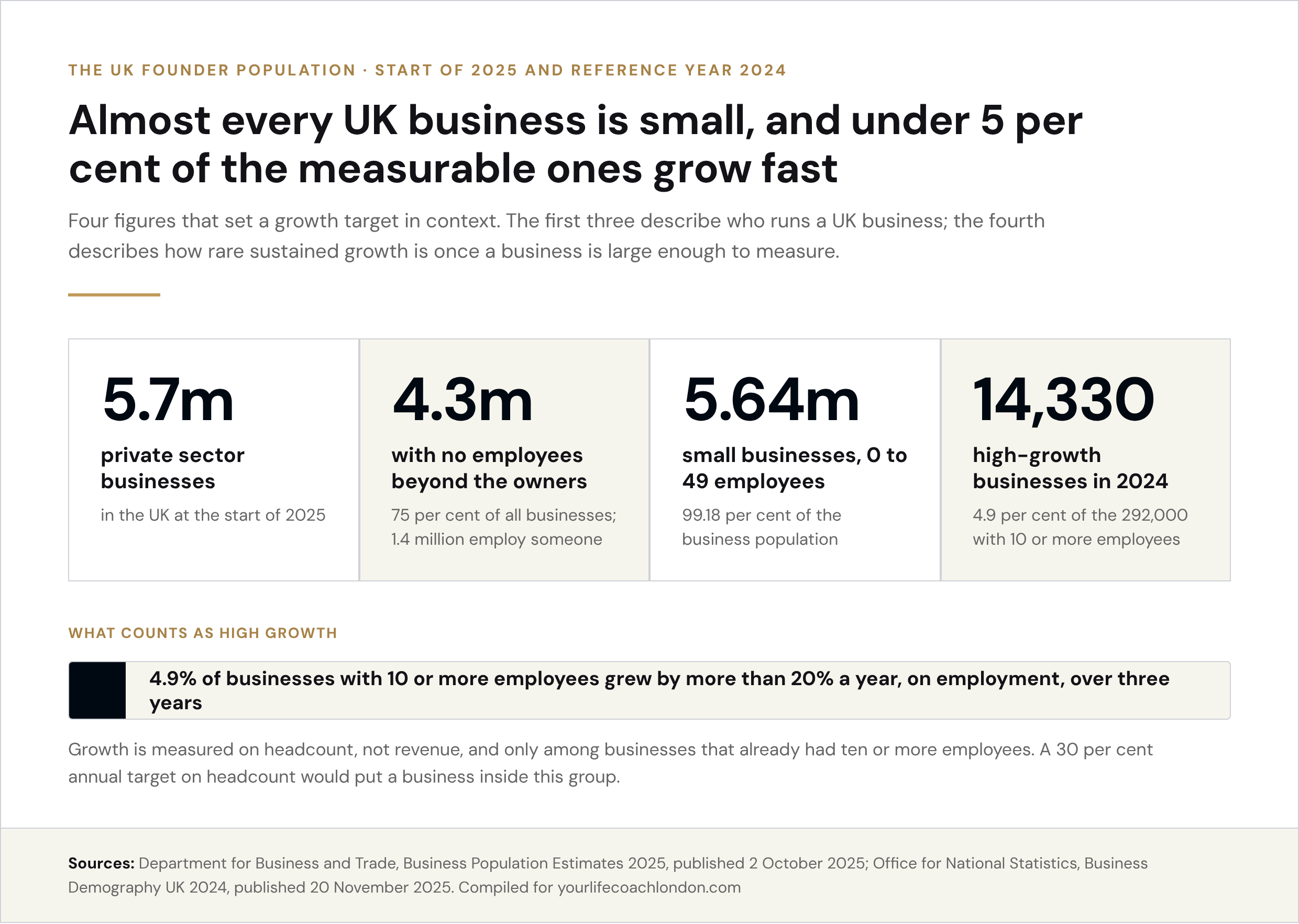
Fewer than one in twenty eligible UK businesses grows at 20 per cent a year for three years. The ONS figures do not show what constrains firms from joining that group. In my work, one recurring constraint is how much of the business still runs through one person.
The ambition is real. In the Longitudinal Small Business Survey 2024, published by the same department on 25 September 2025 from 8,419 SME employers, 71 per cent aimed to grow sales over the next three years. The major obstacles they named were taxation at 61 per cent, energy prices at 50 per cent, regulation at 44 per cent and competition at 40 per cent. Nobody names themselves.
Strand 1: Scaling Without the Business Breaking Around You
The first strand is the one people think they are buying: growth. What makes it founder work rather than business work is where the attention goes. The mechanics of scaling a London startup, from premature scaling to funding, are in my piece on how London startups can scale successfully, and I will not repeat them here.
Founder coaching looks at a narrower thing: which parts of the business still exist only inside your head. Growth stalls in founder-led firms when the business has outgrown what one person can hold, and the person has not noticed, because they are still holding it.
The founder bottleneck test
The diagnostic I run in the first fortnight is simple. For two weeks, every time something waits for you, write it down. Not the task, the wait: who was blocked, on what, for how long.
At the end of the fortnight the list sorts itself into three piles:
- Decisions that really do need you. A major contract, a senior hire, the one pitch only you can give. This pile is almost always smaller than the founder expected.
- Decisions that need someone, and that someone is you only by habit. Pricing within a known band, a supplier swap, a customer escalation. These are the growth you are not getting.
- Things that waited for you and did not need a decision at all. Approvals that exist because you built the business alone and never removed them.
The second and third piles are the scaling plan: not a new strategy, just the work of taking yourself out of the places where you are the queue. When a first hire is the answer, the hiring and the employment law sit in when to hire your first employee.
What would your week look like if the business grew 30 per cent and nothing in the way you worked changed? For most founders, today with a third more of everything, and the week does not have a third more in it. If the commercial engine is the constraint, the coaching strategies that help entrepreneurs close more deals are written up separately. If the founder is the constraint, no amount of pipeline fixes it.
Growth in a founder-led business is capped by how much of the business still runs through the founder. Everything else can be bought. That cannot.
Strand 2: Decisions, and the Cadence That Makes Them
The second strand is the one founders rarely ask for and nearly always need. It is not about making better decisions, which is a skill. It is about the rhythm in which decisions get made at all, which is a system. Frameworks for the decision itself are in mastering business decisions under pressure. How decisions get made in the business when you are not in the room is the domain of strategic business coaching. Founder coaching sits between the two, on the founder’s own decision cadence.
Your business makes decisions whether you schedule them or not. The only question is whether they happen deliberately, at a time you chose, or by default at eleven at night because you were the only one who could answer. Every instant answer you give trains the people around you to bring you the next one, which is exactly the queue the first strand found.
The three-layer cadence
The fix I install with every founder is a fixed rhythm for the decisions only they can make. It has three layers and nothing more.
Does your calendar have those three slots in it now? If not, every one of those decisions is still being made. Just not by you, and not well.
The cadence also teaches the team which decisions wait for Tuesday and which ones they are trusted to make themselves. That second category is where the capacity to scale lives, and it is why strand two feeds strand one rather than competing with it.
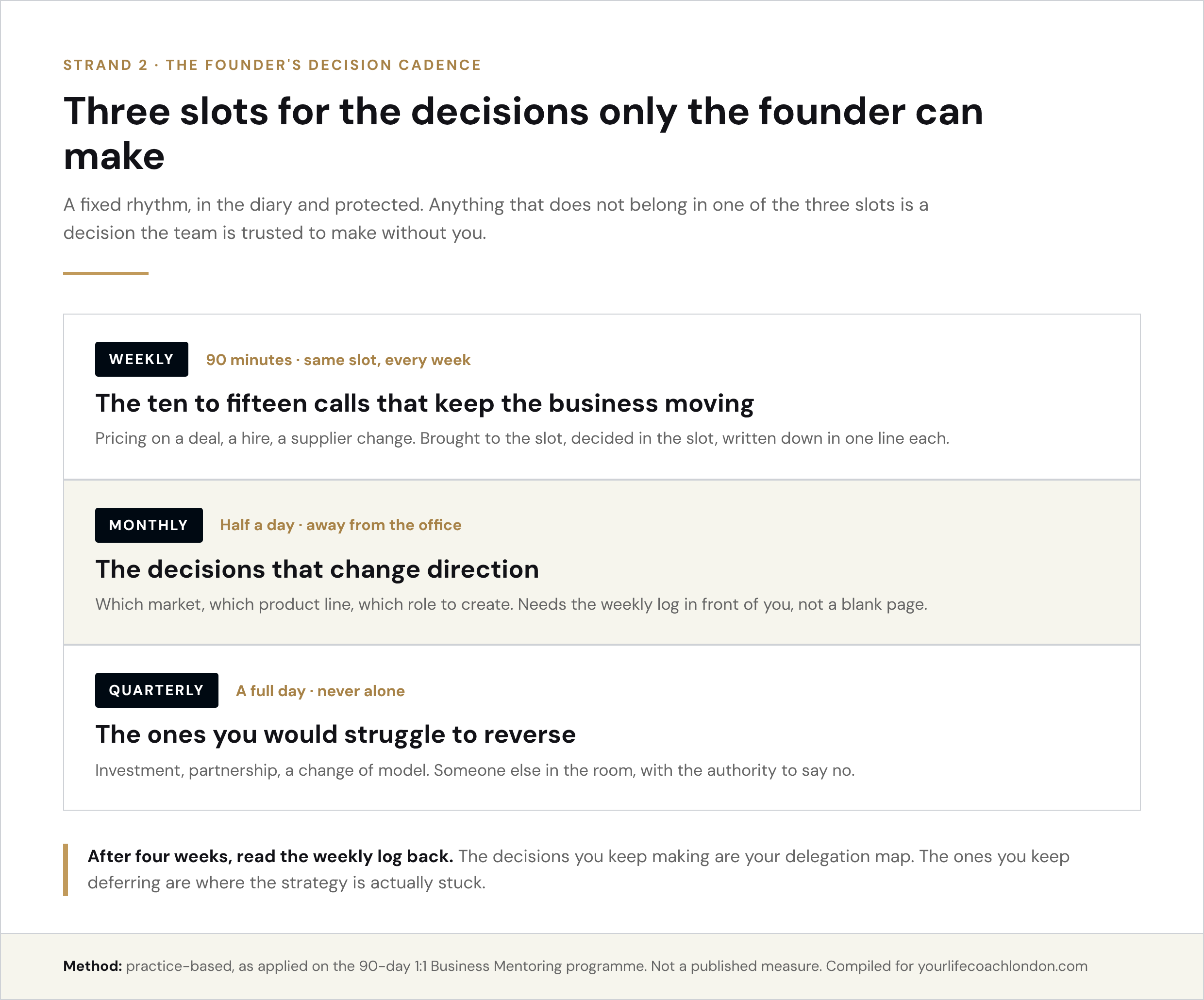
A founder with no decision cadence is making every decision in the worst possible conditions. Tired, interrupted, and without the information a scheduled slot would have gathered.
Strand 3: Wellbeing as an Operating Constraint
The third strand is the one founders are most likely to leave out of the brief, and the one I am least willing to leave out. The word wellbeing invites a kind of coaching I do not do. Founder wellbeing in this work is not a feelings conversation that sits beside the business. It is an operating constraint, exactly like cash. Run out of either and the business stops, however good the pipeline looks.
The warning signs of burnout, and the prevention programme for it, are in entrepreneur burnout prevention, and if you recognise yourself there, read it before this. What founder coaching adds is a measurement, so the constraint can be managed before it becomes a crisis.
The three capacity numbers
Before I look at anyone’s growth target, I ask them to track three numbers for thirty days. I know of no published study that measures founder capacity this way. This is practice, not a published measure, and it is offered as that.
- Hours that only you can do. Not hours worked. Hours on things that would not happen at all without you. Founders guess high and measure low, and the gap is the delegation map from strand one.
- Decisions carried overnight. The open calls you take home and are still turning over at midnight. Above five, consistently, and something is wrong with how decisions reach you, which is strand two.
- Recovery days in the last thirty. A day with no email, no calls and no thinking about the business that you did not choose. Founders tell me they had a few. The diary usually says one.
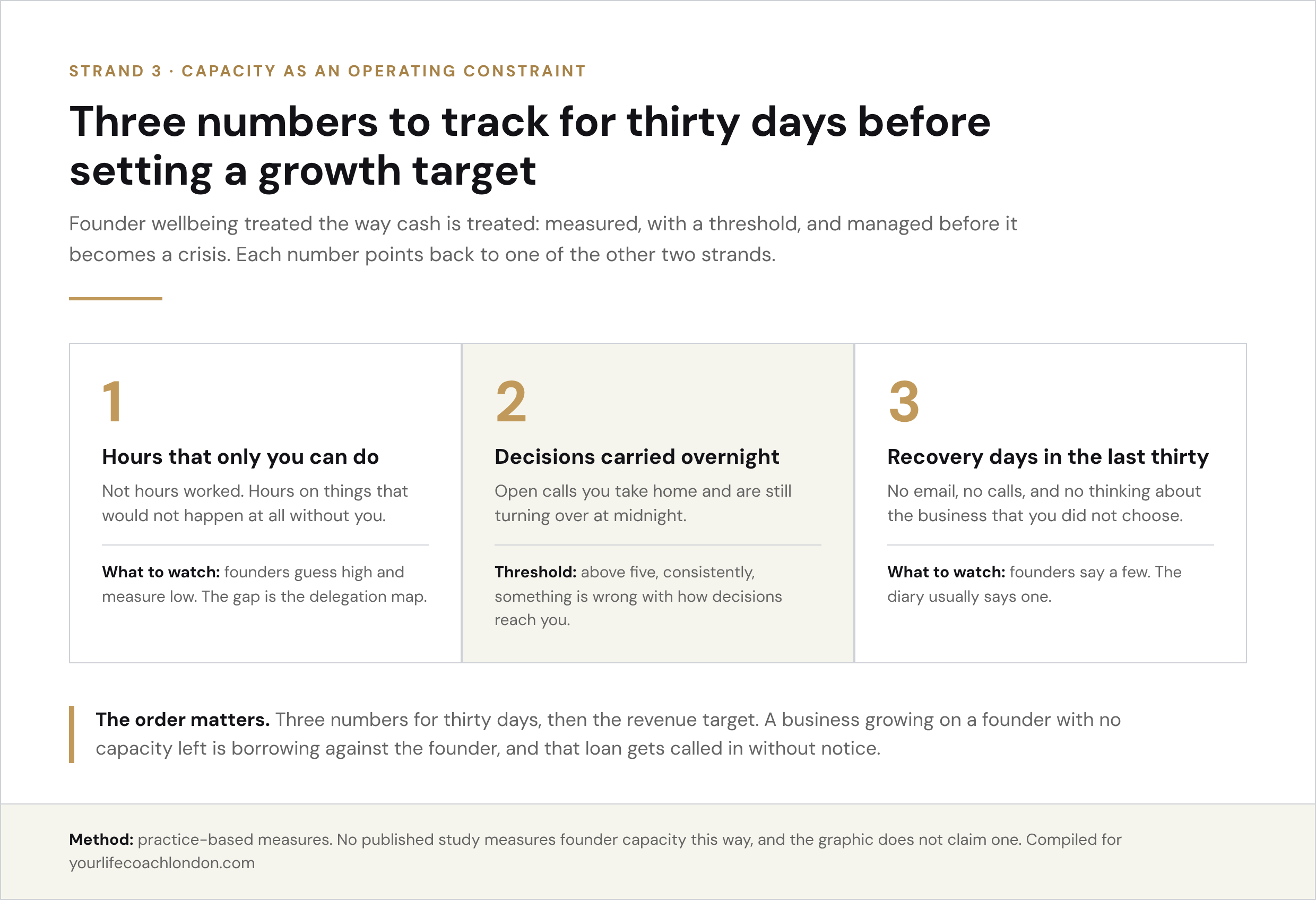
What would change if those three numbers sat on the same dashboard as sales? In my experience the growth target becomes realistic for the first time. A business growing on a founder who works seventy hours, carries six decisions overnight and takes one recovery day a month is not growing. It is borrowing against the founder, and that loan gets called in without notice.
Your capacity is the first constraint on the growth plan, not the last. Three numbers for thirty days, then the target. The order matters.
What the Evidence Says About One-to-One Help for Founders
No randomised trial of founder coaching in the UK exists that I have been able to find. The UK’s own trial of subsidised business advice, and what it did and did not show, is set out in my piece on small business coaching in London. What follows is the research nearest to the founder brief.
Three studies, and what transfers from each
In 2016, Chatterji, Delecourt, Hasan and Koning ran a randomised field experiment with 100 high-growth technology startups in India. Founders were paired at random at a three-day retreat and advised each other on managing people and growing the business. Two years later, founders paired with a peer who took an active approach to managing people had grown 28 per cent larger by headcount and were 10 percentage points less likely to have failed.
The advice came from peers, not coaches, and the setting was Indian technology firms. What transfers is narrower than the headline: a structured conversation about how to run the business changed how founders ran it, and the change showed in the numbers two years on.
Bruhn, Karlan and Schoar, in the Journal of Political Economy in 2018, randomised 432 small and medium enterprises in Mexico into a year of subsidised management consulting. The treated firms showed higher productivity and return on assets, and employment and the wage bill were about 50 per cent higher five years after the programme ended. That is consulting, not coaching, and Mexico, not London. What it shows is that a year of consulting changed those particular businesses for years.
For coaching itself, de Haan and Nilsson in 2023 pooled only randomised controlled trials of workplace and executive coaching: 37 studies, 39 samples, 2,528 participants. The overall effect was g = 0.59, which the authors call well within the moderate range. Effects were larger on self-reported than on observed outcomes, with signs of publication bias.
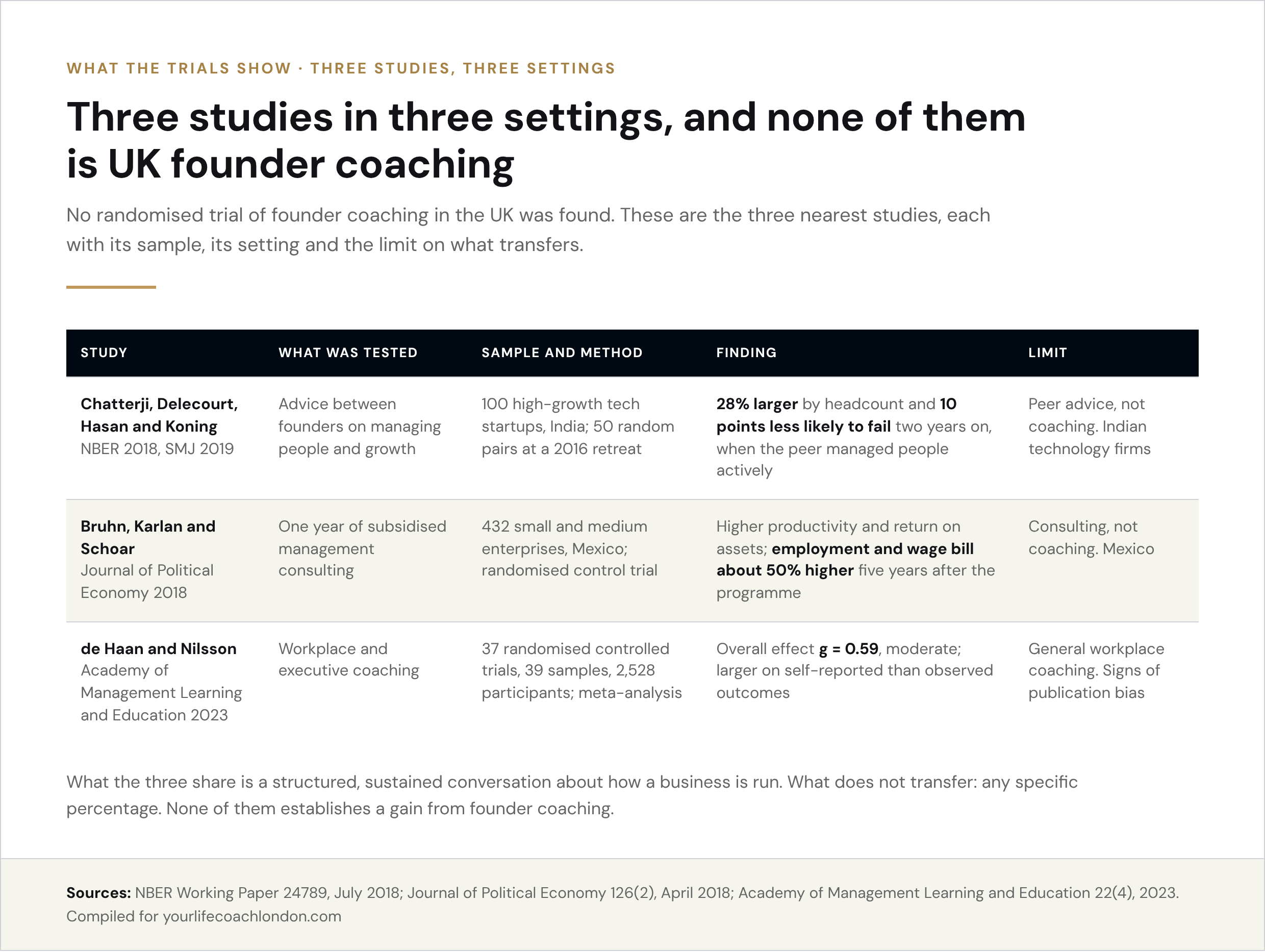
The nearest evidence reports effects in three different settings: active versus passive peer advice for Indian technology founders, consulting for Mexican SMEs, and workplace and executive coaching generally. None establishes a moderate gain from founder coaching, and any coach quoting a return-on-investment figure without a study behind it should be asked for the study.
What the First Ninety Days Look Like
Founder coaching with me runs on the 1:1 Business Mentoring programme, which is ninety days at £4,995 paid in full, and it follows the three strands in order because each one produces the material for the next.
Weeks one to two: measurement before advice
Nothing is prescribed in the first fortnight. You run the bottleneck test and start the three capacity numbers, and we meet to look at what the business actually asks of you. Most founders find this uncomfortable, because the list of things waiting on them is longer than they believed and the list of things only they can do is shorter.
Weeks three to six: installing the cadence
The decision cadence goes into the diary and is protected. The delegation map from the bottleneck test becomes a short list of things that stop coming to you, with the people who now own them told so explicitly. We meet weekly, often in the weekly decision slot, because that is where the decisions are.
Weeks seven to twelve: making it hold without me
The last six weeks test whether the changes survive when nobody is checking. The capacity numbers are reviewed against the growth target, and the target is reset if the numbers say so. By week twelve you should be able to describe the business without being in every sentence.
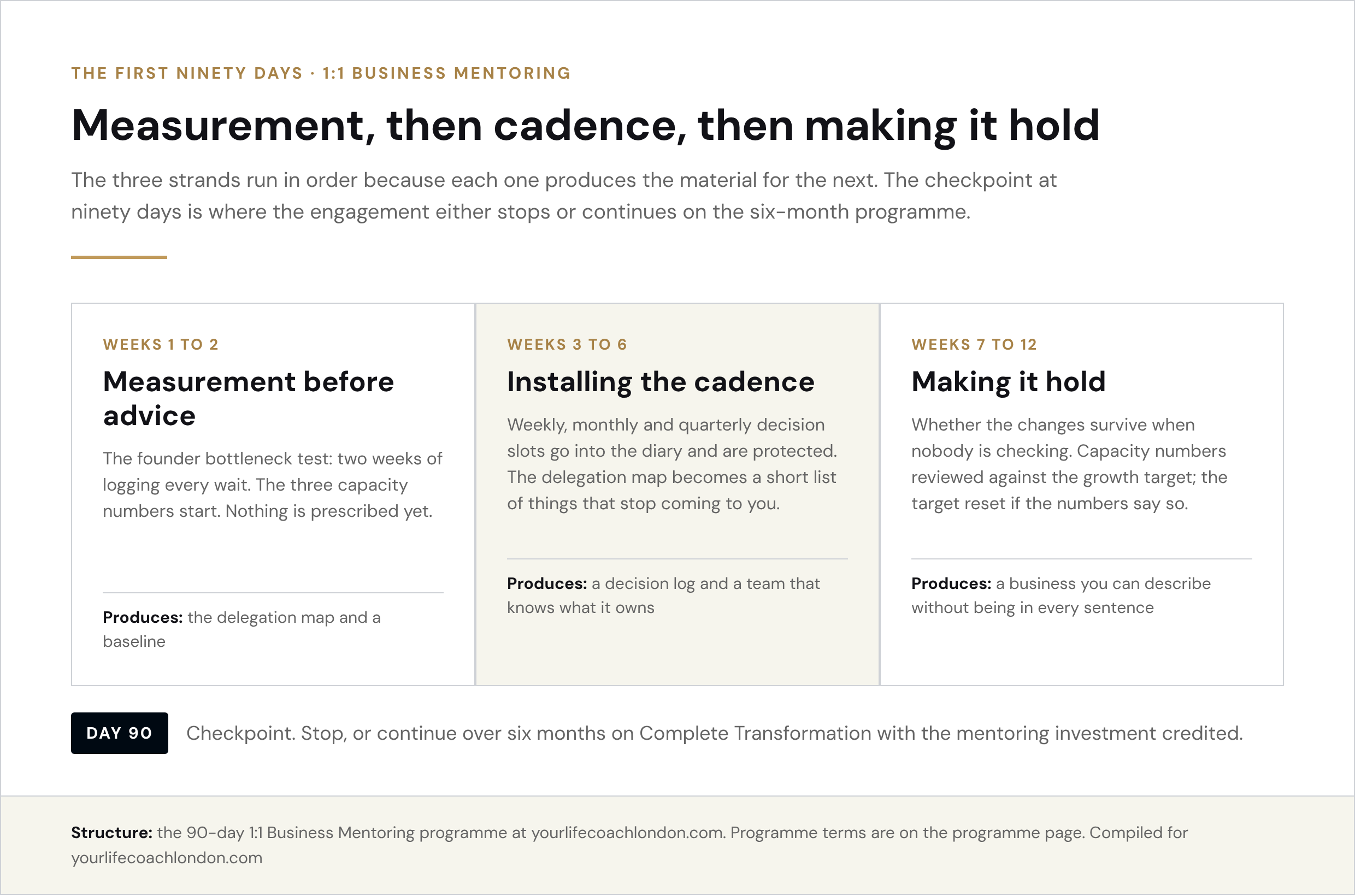
The programme runs for twelve weeks, and the end of it is a checkpoint, not a cliff. Founders who want the work to continue over six months, with in-person sessions, move to Complete Transformation, which is £9,495 paid in full, and the mentoring page sets out how your investment is credited if you upgrade part-way. The terms of each programme, including the refund position, are on its own page.
Where Founder Coaching Stops
Founder coaching has edges, and I would rather you knew them before the first call.
- It does not replace an accountant, a lawyer or a financial adviser.
- It does not fix a business whose product nobody wants. That is a market problem, and no amount of founder capacity solves it.
- It is not the right purchase for everyone who asks. That question is answered on the business coaching page linked in the routing table above, not here.
Coaching in the UK is not a regulated profession. There is no licence and no statutory register. I hold a Diploma in Leadership and Management, a separate qualification in Coaching and Mentoring Skills, NLP to practitioner level, and Train the Trainer. I hold no accreditation from the ICF or the EMCC. How to weigh any coach’s background, including mine, is set out in how to choose the right entrepreneur coach in London.
A founder coach who cannot tell you where the work stops is selling you the work, not doing it. The edges are part of the method.
How I Work with Founders in London
I spent two decades building businesses and a property portfolio before I coached anyone, and the three strands above are the three places I got it wrong myself. The business grew faster than I could hold, the decisions piled up because I answered them all, and I treated my own capacity as free.
If the business already has a senior team and a board, and the question is how you run an organisation rather than how it runs through you, that is the founder-to-chief-executive work on the executive coaching London page.
Frequently Asked Questions
Is a founder coach the same as a business coach?
No. Business coaching is about the business: pricing, pipeline, operations, the plan. Founder coaching is about the person the business still runs through: how it grows without them, how their decisions are made and whether they have the capacity for both.
Does founder coaching combine strategy and mindset work?
Yes, and in founder coaching they are not separable. The decision cadence is a strategy tool and a mindset tool at once: it changes how the business decides and how the founder relates to being asked. What I do not do is mindset work detached from the business.
Can founder coaching help me hit a 30 per cent annual growth target?
It can help you find out what the target asks of you, which is where most targets fail. ONS data show that under 5 per cent of UK businesses with ten or more employees sustain 20 per cent annual headcount growth, so 30 per cent is ambitious by any measure. The founder work is to remove yourself from the places where you are the queue.
Do you coach tech founders and venture-backed founders?
Yes. The three strands do not depend on sector. What changes for a venture-backed founder is the pressure in strand two, because investor decisions arrive with deadlines the cadence has to absorb, and the pace in strand one, because the target is written into the funding.
How is founder coaching different from executive coaching?
Executive coaching is for leaders of organisations that already run without them day to day, including founders who have grown into chief executives. Founder coaching is for the stage before that. If you are the senior team, start here.
What does founder coaching cost?
Founder coaching runs on the ninety-day 1:1 Business Mentoring programme at £4,995 paid in full. The six-month Complete Transformation programme is £9,495 paid in full, and each programme page carries its own terms. How those compare with the wider market is covered in business coach cost UK and not repeated here.
Key Points
- Founder coaching is for the one person the business cannot yet run without, across three strands usually bought separately: scaling, decisions and capacity.
- Almost every UK business is small, and under 5 per cent of those with ten or more employees sustain 20 per cent annual growth. In my work, a growth target is a founder problem before it is a market problem.
- The bottleneck test, the decision cadence and the three capacity numbers are the working tools, and each produces the material for the next.
- The nearest evidence comes from three different settings, none of them UK founder coaching. It establishes no gain from founder coaching, and nothing in it supports a transformation claim.
Ready to Find Out Which of the Three Is Yours?
The first conversation is free, and its only purpose is to work out which strand your business is stuck on. Bring the growth target and the diary, and I will tell you which one it is.

Last updated: 20 October 2026 by Trip Saggu

