
Business content comes in two kinds. One is written for startups, where the question is whether the thing will work at all. The other is written for corporates, where the question is which director gets the budget. Almost nothing is written for the business in between, which is where most of us actually trade.
If you run a firm in London with between one and forty-nine people on the payroll, you are in the largest category of business in the country by number of firms, and among the least likely to have asked anyone outside for advice. My business coaching London page covers the service in general terms. Plenty of people in London sell coaching to firms your size. Very little is written about what the work actually involves once you have paid for it.
I am a business coach London business owners call when something is stuck. This piece sets out what an SME engagement contains, what the constraints usually turn out to be, and what the research shows about paying for business advice. That last part does not flatter my industry, and you should have it before you spend anything.
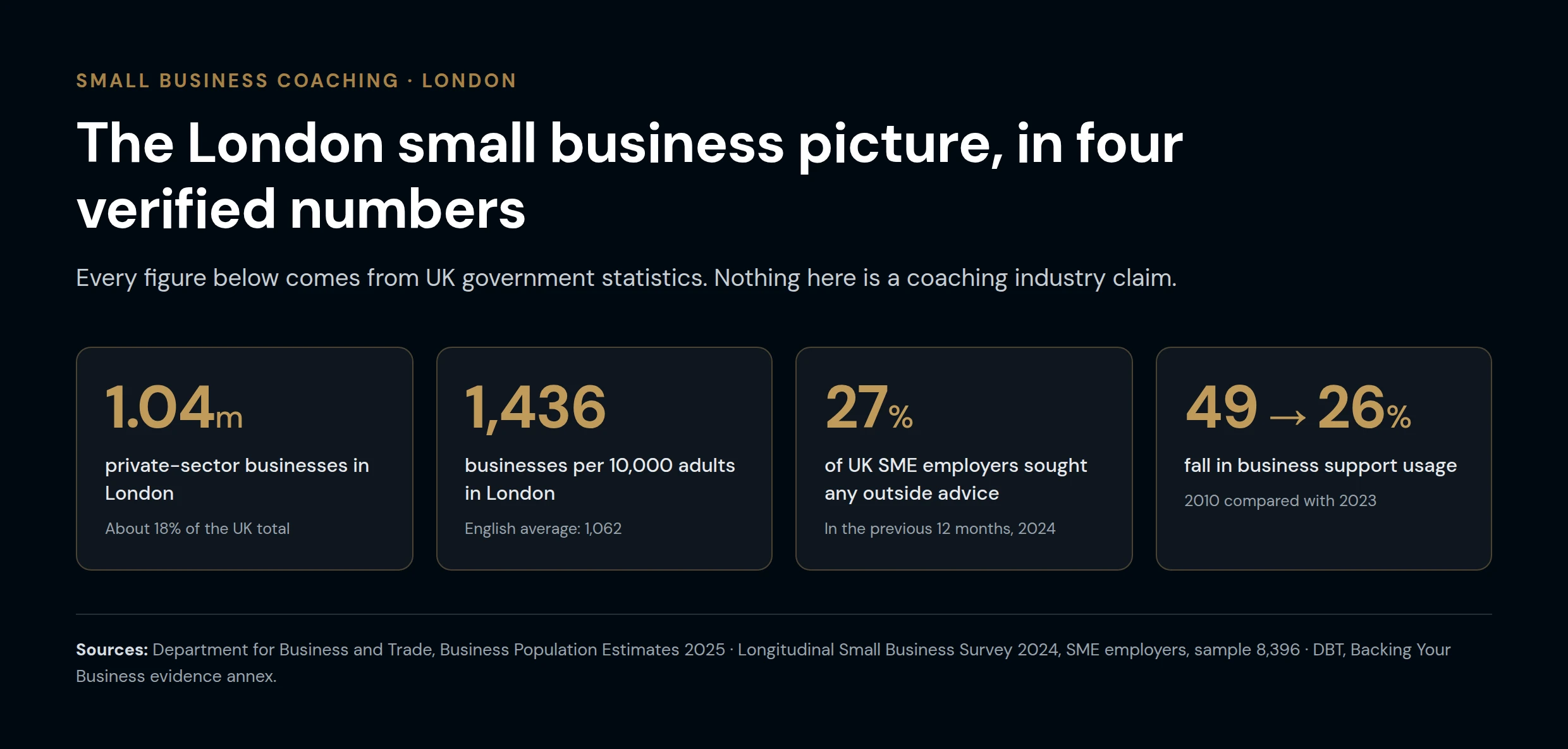
Before any of that, here is the ground you are trading on, in government figures rather than industry ones.
What Counts as a Small Business, and Why the Answer Changes What You Need
The UK has two different definitions of a small business. They do not agree, and you can sit in a different category under each on the same day.
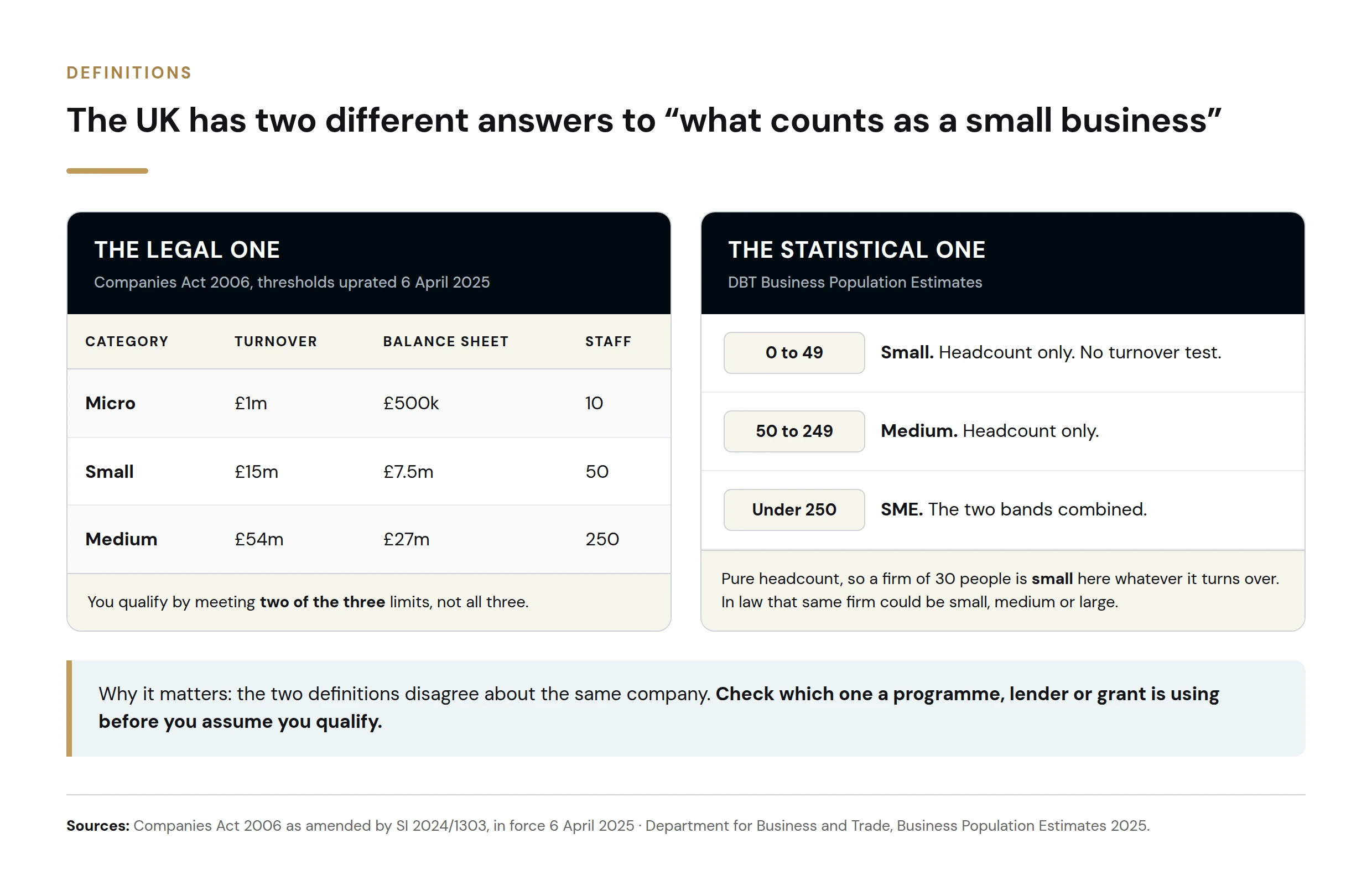
The first is the company-law size test in the Companies Act 2006. It shapes which accounts regime you may use and whether you may qualify for audit exemption, though some companies are excluded from that exemption and shareholders holding a qualifying stake can demand an audit anyway. It is a two-out-of-three test, so you qualify by meeting any two of the three conditions. The thresholds were uprated on 6 April 2025, and a great many accountancy sites still quote the old ones.
Companies Act 2006, sections 382, 384A and 465, as amended with effect from 6 April 2025. Two out of three conditions, not a headcount rule.
The second definition is the statistical one, used in the Department for Business and Trade’s Business Population Estimates. That one is pure headcount: 0 to 49 employees is small, 50 to 249 is medium, and an SME is anything under 250.
Conflating the two is the commonest error in British writing on the subject. Somebody will tell you the Companies Act sets the line at fewer than fifty employees. It does not. That is the statistical rule, and it answers a different question.
Why this matters to you. A four-person consultancy and a forty-five-person manufacturer are both “small”. They have almost nothing in common operationally. The first has a founder doing everything. The second has a management layer that may or may not be working. A small business coach in London worth the fee treats those two as different jobs, because they are.
The two are easier to hold side by side than to read in a paragraph.
Most Small Businesses Never Ask Anyone
This statistic should be on every coaching website in Britain and it is on none of them. I have never seen a competitor publish it, and I understand why.
In 2024, 27 per cent of UK SME employers sought any external information or advice in the previous twelve months. Not coaching specifically. Any advice at all, from anyone, including their own accountant. Roughly three in four asked nobody.
About 73 per cent did not report seeking outside advice at all in the previous twelve months. That is not the same as saying they were working alone, and plenty of them are doing perfectly well without it. I am not going to pretend otherwise.
Take-up has fallen a long way. Government figures show business support usage dropped from 49 per cent in 2010 to 26 per cent in 2023, a fall of 23 percentage points. It has not kept falling: the 2024 figure quoted above is 27 per cent, a single point higher. What matters is the level rather than the last wobble, and the level is around half what it was in 2010.
Among the minority who did ask someone, this is where they went.
- Their accountant, 37 per cent
- A consultant or business adviser, 34 per cent
- A business network or trade association, 22 per cent
- A solicitor, 15 per cent
- Their local council, the internet, GOV.UK or a specialist financial adviser, 5 to 6 per cent each
What to do with that. The accountant is the default, and the accountant is looking backwards at what already happened. That is a perfectly good thing to buy and most owners already buy it. Before you spend on anything else, work out which of the two you are missing: someone to tell you what the numbers did, or someone to work out what you do next. So which of the two are you actually missing? If your last three conversations about the business were all with your accountant, you already know the answer.
What Small Business Coaching London Actually Involves
Almost nobody sets this out, so what follows is the work itself rather than what it promises. What follows sits underneath the wider service described on that page.
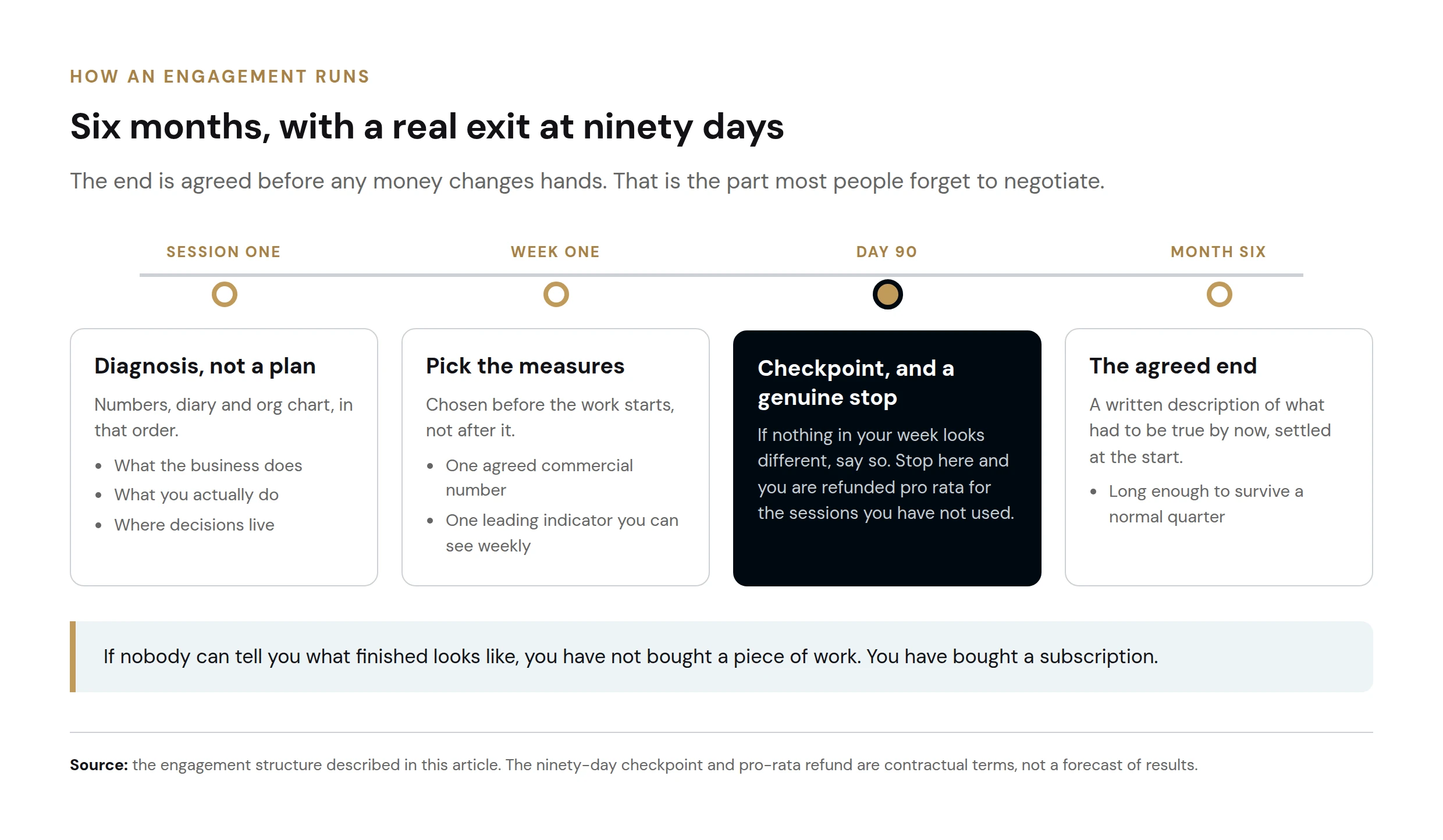
The first session is a diagnosis, not a plan. I want the numbers, the diary and the org chart, in that order. The numbers tell me what the business does. The diary tells me what you actually do, which is usually a different story. The org chart tells me where the decisions live.
Most owners arrive with a stated problem, and it is rarely the real one. Somebody comes in about margins and the actual issue is that nobody will make a pricing decision without them. Somebody comes in about staff turnover and the actual issue is a hiring process someone threw together four years ago and nobody revisited.
The middle is an operating rhythm. What actually happens between the sessions? Coaching that lives entirely inside the session is entertainment. What makes it work is the structure between them: a few things you have committed to, a date on which they are checked, and someone who will notice if they have not happened. That sounds unglamorous because it is.
The end is agreed at the start. A good engagement has an end date and a written description of what has to be true by then. Agree both before any money changes hands, because the time to negotiate an exit is while everyone is still optimistic.
If nobody can tell you what finished looks like, you have not bought a piece of work. You have bought a subscription, and subscriptions are designed to continue.
Laid out end to end, six months looks like this, with the ninety-day point as a real exit rather than a review meeting.
Three kinds of work that get sold as one
Startup coaching, small business coaching and executive coaching get sold interchangeably. They answer three different questions and they suit three different people.
If you are still testing whether there is a market, that is entrepreneur coaching, and how London startups scale and why most startups fail are the more useful reads. If you sit inside a larger organisation, what an executive coach does covers that, and my executive coaching engagements are quoted separately. If the work is really about direction rather than execution, that is strategic business coaching. And if what you want is somebody who has run your kind of business and will tell you what they did, that is mentoring rather than coaching, and the FAQ below points you to the full comparison.
Three Constraints That Show Up in Almost Every London Small Business
These are not reasons businesses fail. I have written about why most small businesses fail separately. These are the things that cap a working business that is not failing at all.
The owner is the bottleneck and cannot see it
Every decision routing through one person is survivable at four staff and fatal at twenty. The tell is not stress. It is the diary. If your week is fully booked with things only you can do, the business has a ceiling and the ceiling is you. How much of last week could genuinely only have been done by you?
London sets your cost base before you price anything
Your rent, your salaries and your suppliers are all priced for London, which you already know from your own bank statement. What I can actually evidence is how crowded the market is. London holds about 1.04 million private-sector businesses, roughly 18 per cent of the UK total, at a density of 1,436 businesses per 10,000 adults against an English average of 1,062, on the Business population estimates for 2025. That density is competition, and it is also cost.
Business population estimates for the UK and regions 2025, Department for Business and Trade, published 2 October 2025.
A London firm that prices as though it were in the Midlands is quietly funding its own decline. Getting the pricing conversation right is often the highest-value thing an outside pair of eyes does.
Recruitment is a fight you are having with everyone
In 2024, 37 per cent of SME employers named staff recruitment and skills as an obstacle, behind taxation at 61 per cent, energy prices at 50 per cent, regulation at 44 per cent and competition at 40 per cent. In London you are bidding for the same people as firms with far deeper pockets. If you are approaching this for the first time, when to hire your first employee covers the mechanics.
Longitudinal Small Business Survey 2024, SME employers with 1 to 249 employees, published by the Department for Business and Trade on 25 September 2025. Achieved sample 8,396.
What the Evidence Actually Says About Paying for Business Advice
One caveat before the numbers: the studies below measure business advice and business support, which is a wider category than coaching. Nobody has run a trial on one-to-one coaching at this scale. Read them as the best available proxy, not as a verdict on coaching itself.
The one large randomised trial
The best causal evidence in the UK comes from the Growth Vouchers Programme, which offered subsidised business advice to 15,207 randomly selected small and medium-sized enterprises. Because allocation was random, it is possible to say what the advice caused rather than what advised firms happened to do.
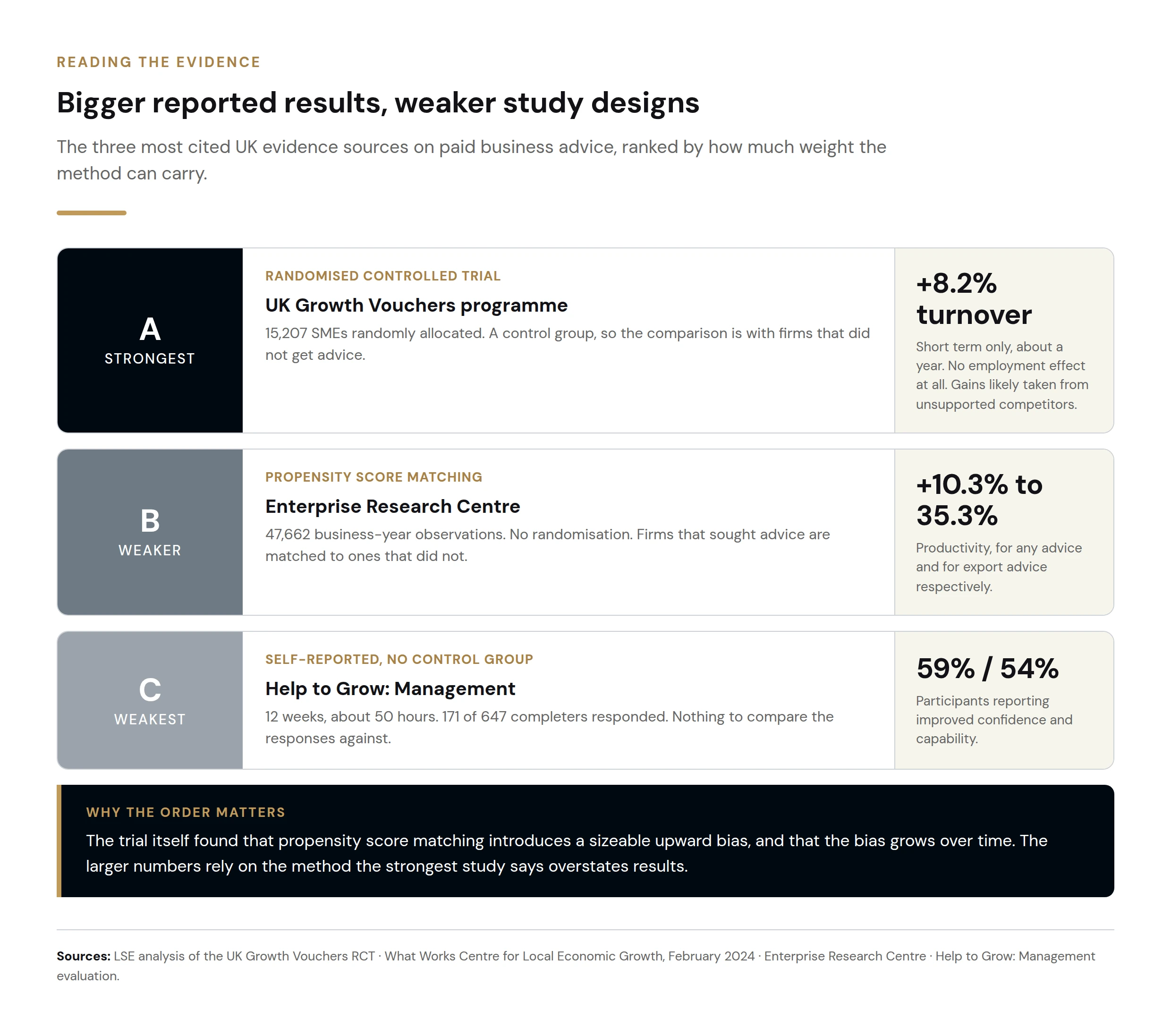
The London School of Economics analysis found that firms which received and used a voucher increased turnover by 8.2 per cent, and only in the short term. The accompanying summary is blunter: no effect on employment at all; a turnover effect lasting about a year; gains appearing only for firms advised on sales and marketing; and, because supported firms mostly served local markets, gains that likely came at the expense of competitors who were not supported.
Among firms that actually used the subsidised advice, turnover rose 8.2 per cent for about a year, employment did not move at all, and the gain may have come from a competitor down the road. That is the strongest study we have on whether paid business advice does anything, and it is the one I would want to see before I spent five figures.
Why the impressive numbers deserve caution
You will find far better figures than 8.2 per cent. A widely cited Enterprise Research Centre paper reports productivity effects of 10.3 per cent for any business advice and 35.3 per cent for advice on exporting, drawn from 47,662 business-year observations.
Read the method. That study uses propensity score matching, which compares advised firms with statistically similar unadvised ones. The randomised trial tested that same method against its own results and found that propensity score matching introduces a sizeable upward bias in estimated effects, and that the bias grows over time.
So the studies producing the most quotable numbers rely on a technique that the strongest study says overstates the result. That does not make them worthless. It does mean anybody quoting 35 per cent at you should tell you where it came from.
What the government’s own programme found
Help to Grow: Management is the closest thing Britain has to a publicly evaluated business coaching intervention: twelve weeks, around fifty hours, plus up to ten hours of one-to-one mentoring. Its first-year evaluation reported that 59 per cent of participants said their skills in leading the business had improved, and that 54 per cent had implemented changes.
Those are real results, and they are also entirely self-reported, from 171 responses out of 647 completers, with no control group. The evaluators warn of optimism bias themselves. No turnover, productivity or employment data was reported at all.
One more finding is worth sitting with. Analysis of the ONS Management and Expectations Survey found an increase of 0.1 points in management scores associated with a 9.6 per cent rise in productivity, and smaller firms scoring worse on management practice than larger ones. Associated, not caused. Firms that manage well may simply be better firms for reasons unrelated to anyone’s advice.
Associated is not caused, and the difference is the whole argument. Well-run firms are more productive and they are also more likely to buy advice. Nobody has shown which way round that runs.
Put the three sources side by side and the pattern is hard to miss.
What This Means for How You Buy Coaching
Choosing between coaches is a separate question, and I have covered it in how to choose the right coach in London. This is about what to buy, not who to buy it from. Take the evidence seriously and four things follow.
- Buy against a specific problem, not a general improvement. The measurable turnover effect in the trial appeared for sales and marketing advice and nowhere else.
- Do not assume the effect will persist. The trial found a turnover effect at twelve months and no statistically significant effect at twenty-four. It did not test why, so this study does not show whether structural change makes a gain last.
- Ask what is being measured, and when. If the only outcome on offer is how you feel about the business, that is legitimate, but it is not a commercial result.
- Treat any percentage claim as a question, including any of mine. Ask which study, what sample size, and whether there was a control group.
On cost, I have set the UK market out properly in my guide to business coaching costs in the UK, and my own six-month Complete Transformation programme is £9,495 paid in full, with instalment options published on that page. Shorter pieces of work are priced against the decision rather than the month.
How to Tell Whether It Is Working
The trial found a turnover effect at twelve months and no statistically significant effect at twenty-four. It did not identify why the effect did not persist, and neither will I. What it does tell you is what to watch: whether anything you can measure is still moving once the engagement has ended.
Pick the number before you start, not after. So which single number would tell you, six months from now, whether any of this worked? Agree one commercial measure in the first session and write it down. Gross margin, average order value, days sales outstanding, revenue per head, hours you personally work. One is enough, and it has to be a number that already exists in the business, because a measure that needs a new system to collect it will quietly never be collected.
Ask what is being measured, and when. How you feel about the business is a legitimate thing to talk about. It is not a thing anybody can check in month six.
Watch the leading indicator, not the lagging one. Revenue is a lagging measure and it moves too slowly to steer by. If the work is about pricing, the leading indicator is how many quotes go out at the new price without an apology attached. If it is about delegation, it is the number of decisions that reached you last week and should not have.
Check at ninety days and be willing to stop. Ninety days is the checkpoint I write into the engagement, not a promise that a particular result will have arrived by then. If nothing has moved, and nothing in your week looks different, say so. Any coach worth paying will either change what they are doing or tell you honestly that this is not the right piece of work. If you stop at ninety days, you are refunded pro rata for the sessions you have not used.
- One agreed commercial number, chosen in week one
- One leading indicator you can see weekly without a report
- A ninety-day checkpoint with permission to stop
- A defined end date and a description of what has to be true by then
I would rather lose a client at ninety days than keep one for a year who cannot tell you what changed.
What This Work Cannot Fix
This is about the limits of the method, not about whether you should buy it. For that second question, business coaching London sets out when it is the wrong purchase.
The method acts on decisions and behaviour, so it stops where decisions stop mattering. That boundary runs straight through the trial figure quoted above: the 8.2 per cent is the effect for firms that received a voucher and actually used one, and only about a third of recipients did. Advice that nobody acts on does nothing, however good it was.
Late payment is the clearest example of the boundary. Coaching can change how you chase invoices, what terms you agree and which customers you take on. It cannot make a customer pay you.
Frequently Asked Questions
What is small business coaching?
Small business coaching is structured one-to-one work with the owner of a trading business, focused on decisions, priorities and the operating rhythm between sessions. It differs from consulting, which delivers a piece of work, and from mentoring, which supplies answers from someone who has done your job.
What is SME business coaching, and is it the same thing?
The same work, described by size band rather than by stage. SME business coaching in London covers anything under 250 employees, and in practice most owners I work with run firms of one to forty-nine people, which is where the owner is still personally inside every important decision.
How is it different from business coaching generally?
Scale changes the problem. A firm of one to forty-nine people usually has one decision-maker, thin management capacity and no head office to absorb mistakes. The work sits closer to the owner’s own diary.
Does it actually work?
The evidence is thinner than my industry implies, and what exists measures business advice rather than coaching specifically. The one large UK randomised trial found a short-lived turnover effect and no employment effect. Self-reported evaluations are more positive but lack control groups. Anyone quoting a percentage without naming the study is selling, and that test applies to me as much as to anyone on your shortlist.
How long should an engagement run?
Long enough for a change to survive contact with a normal quarter. Six months is a reasonable default for structural work. Shorter suits a single decision.
Do I need to be in London?
No. The cost base, recruitment market and competitive density are London-specific, which is why they are covered here. The work itself runs perfectly well remotely.
What if I am not sure I need coaching at all?
Then read when to hire a business coach before you speak to anyone, including me.
Key Points
- The UK has two conflicting definitions of what counts as small. The Companies Act one is a two-out-of-three test; the statistical one is headcount only.
- Roughly three in four UK SME employers sought no external advice at all in 2024, and take-up has fallen since 2010.
- The strongest UK evidence is a randomised trial showing a short-lived 8.2 per cent turnover effect among firms that used the advice, and no employment effect.
- The larger published effects rely on a method that the trial says overstates results.
- London’s cost base and business density are the two constraints that most reliably show up in the room.
- Coaching acts on decisions and behaviour. The evidence below covers business advice broadly rather than one-to-one coaching, so treat that as the aim of the method rather than a measured effect. It does nothing for demand, capital or time that has already run out.
If you run a small business in London and something is stuck that should not be, the first conversation is free and there is nothing to prepare. Bring the numbers, the diary and the thing you have been avoiding.

Book a complimentary consultation about the 90-day business mentoring programme with Trip Saggu. No pressure, no obligation.
Last updated: 13 September 2026 by Trip Saggu