

Nobody has ever given you an appraisal. There is no ladder above you, no manager tracking your development, and no HR department planning what you do next. You built the thing, and the thing became the job.
That is the position most founders are in, and it is a career position, not a business one. It gets very little attention, because almost everything written for founders is about the company.
I am a business coach London owners call when something is stuck, and this particular conversation comes up far more than the search volume suggests. It usually arrives sideways, in the last ten minutes of a session about something else.
This piece is about your career, not your company. If you are still testing an idea rather than running something, that is entrepreneur coaching and a different conversation. This is for people whose business already exists and has quietly become the whole of their working life.
The numbers below come from the Office for National Statistics, the Department for Business and Trade, the Institute for Fiscal Studies and GOV.UK. None of them come from the coaching industry.
The Career Nobody Gave You a Ladder For
An employed career comes with scaffolding you never had to build. Someone tells you when you are ready for more. Someone else writes the job description for the next rung.
Run your own business and every one of those functions is yours, on top of running the business. The work of deciding what you are becoming does not get scheduled, so it does not get done.
This is the part that separates founder work from the career coaching I do with employed clients. An employee arrives with a structure they want to move through. A founder arrives with no structure at all, and we have to build one before anything else is worth discussing.
The cost of that absence is slow and hard to notice. You do not wake up one morning having drifted. You spend nine years being excellent at a thing you chose at thirty-one, and only find out at forty that nobody ever asked you whether you still wanted it.
Look at the right-hand column. Not one of those items is urgent in any given week, which is precisely why they go unexamined for years.
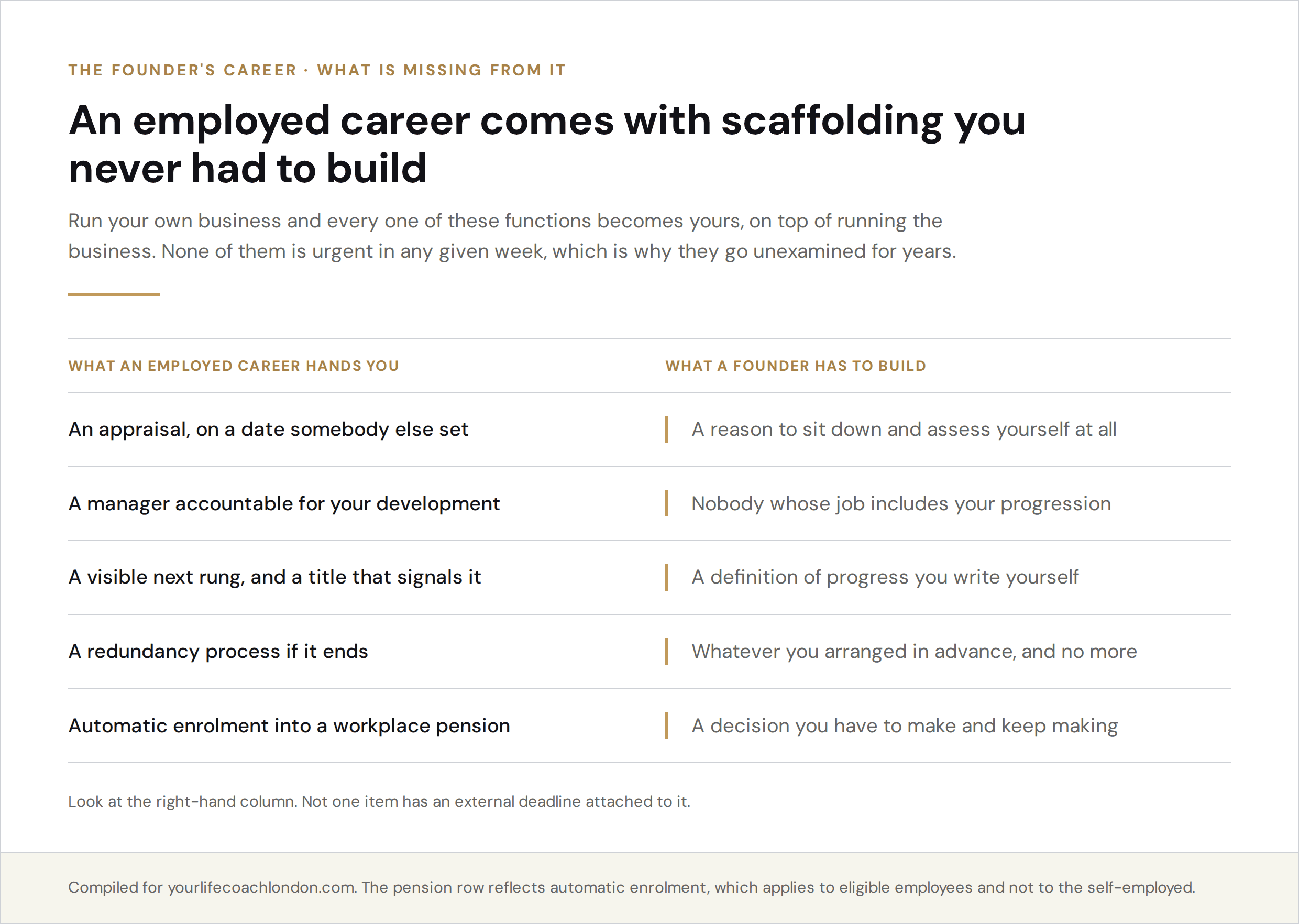
A founder’s career is the only one with no external clock on it. Nothing in your week will ever tell you that it is time to think about this, so it waits until something forces it.
You Are the Business, and the Statistics Say So
The scale of this is easy to underestimate, because the public picture of entrepreneurship is venture-backed teams with boards and investors. The actual UK picture is very different.
According to the Department for Business and Trade’s Business Population Estimates, published on 2 October 2025, there were 5.7 million private sector businesses in the UK at the start of 2025, and 5,681,930 of them were SMEs with 0 to 249 employees, 99.85 per cent of the entire business population.
Three quarters of UK businesses have nobody else in them
Within that total, roughly 4.3 million businesses, about 75 per cent, have no employees at all beyond the owners. Sole proprietorships and single-director companies make up three quarters of British business.
The Office for National Statistics Labour Force Survey put UK self-employment at about 4.5 million people in the four quarters to May 2026, in the series released on 18 August 2026.
Read those two together and the career point falls out. For most people running a UK business, the business has no independent existence to speak of. There is no bench, no succession plan and no deputy. If you stop, it stops.
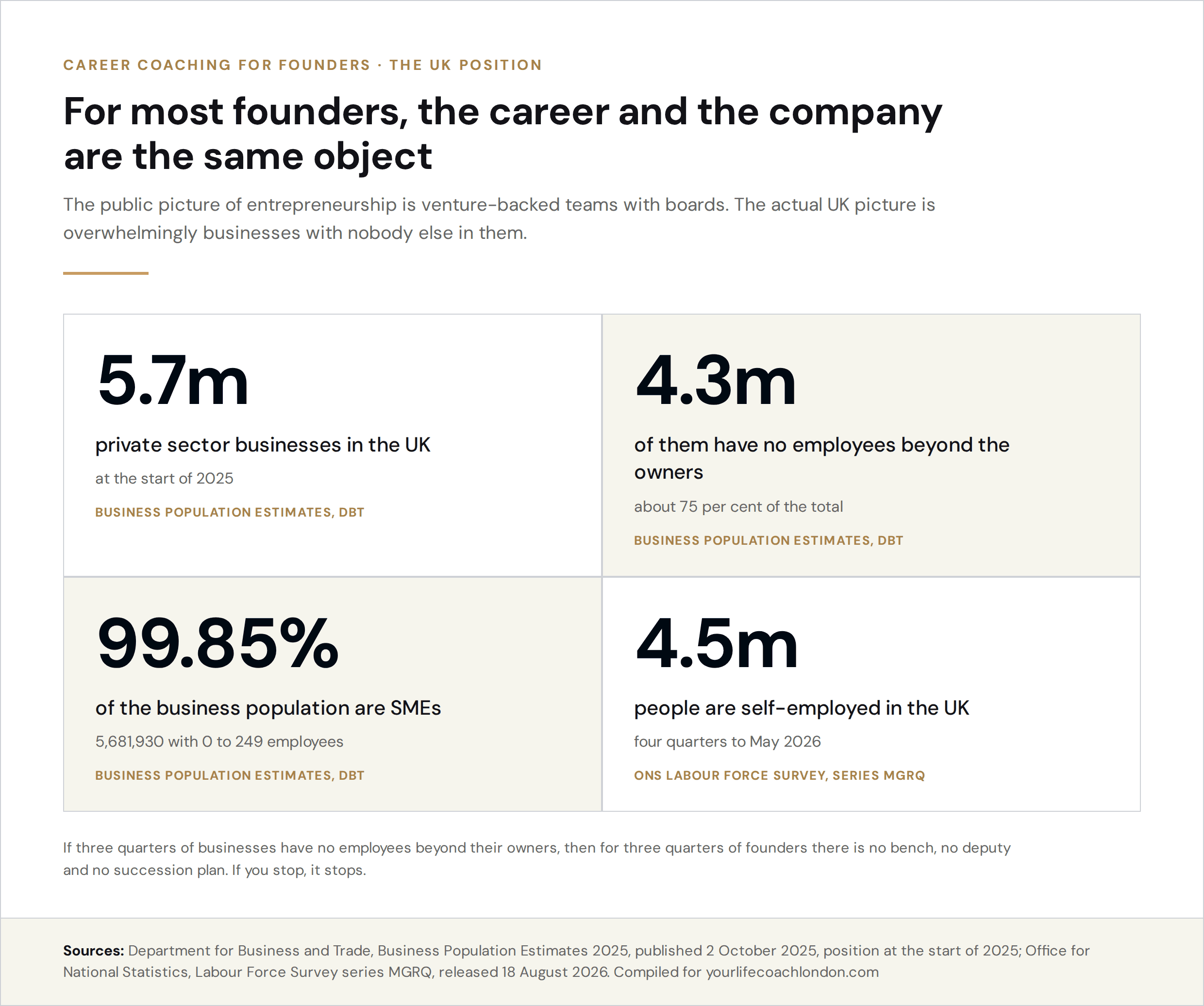
Three quarters of UK businesses have no employees beyond their owners. Whatever else that means commercially, it means your career and your company are the same object.
That is not an argument for hiring, which is a separate question with its own answer elsewhere on this site. It is an argument for noticing that you have no career outside this one.
The Ending Most Founders Have Not Scheduled
Every founder I work with can tell me what they want the business to do next year. Very few can tell me what they want to be doing in ten years, and fewer still have thought about how this particular chapter ends.
The ONS Business Demography release of 20 November 2025 is worth sitting with. In 2024 there were 317,000 UK business births and 280,000 business deaths, a birth rate of 11.1 per cent against a death rate of 9.8 per cent.
Fewer than four in ten reach five years
The same release reports that the five-year survival rate for UK businesses born in 2019 is 38.4 per cent.
Be careful how you read that, because the coaching industry routinely reads it wrongly. A business death in these statistics is not the same as insolvency. ONS identifies a death when an enterprise ceases to trade and is removed from the active population; the release does not classify every death by cause.
What it tells you is narrower than a failure rate. Of the UK businesses born in 2019, 61.6 per cent were not active in the fifth calendar year under the ONS definition. That cohort measure does not show what happens to all businesses in any arbitrary five-year period or how many founders personally experience an ending.
It is still the best public evidence that an ending is a normal part of a founder’s working life rather than an aberration. The question worth sitting with is not whether yours arrives. It is whether you have decided in advance what you want to happen next.
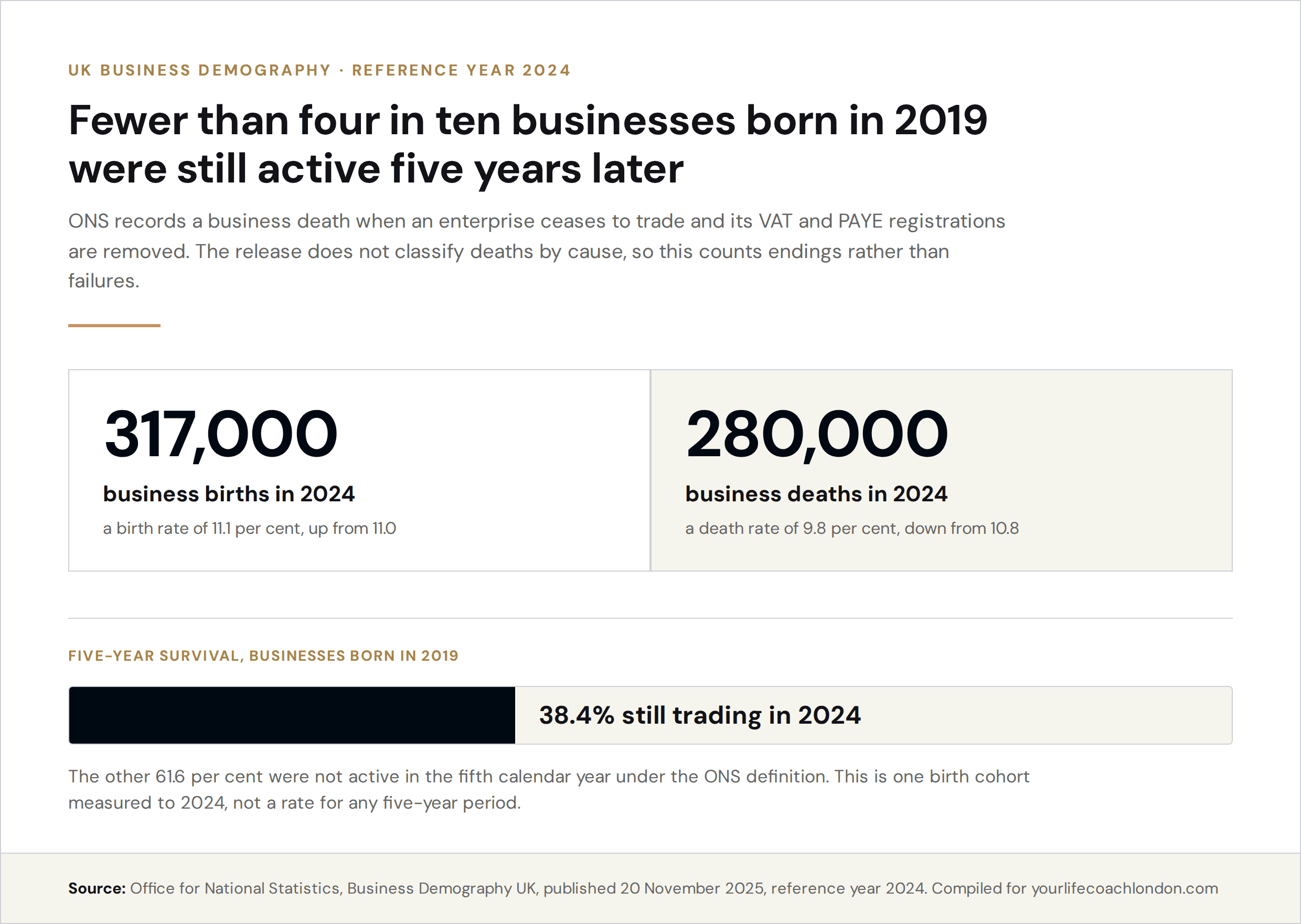
Of the ONS 2019 birth cohort, 61.6 per cent were not active five years later. That is one cohort rather than a law of nature, and it is still the clearest public reason to decide in advance what you want your own ending to be.
Why the business stopped is a different subject, and one I have written about separately. What matters here is the founder standing in the room afterwards.
What the System Quietly Does Not Give You
There is a second half to this, and it is structural rather than emotional. The support an employed career assumes in the background is simply absent.
GOV.UK states it plainly on its employment status guidance: “Employment law does not cover self-employed people in most cases because they are their own boss.” The rights it does list for self-employed people are protection of their health and safety, protection against discrimination in some cases, and whatever is written into the contract with the client.
The same page lists, as one of the indicators that somebody is self-employed, that they “do not get holiday or sick pay when they’re not working”.
The pension figures are the sharpest version of it
The clearest evidence I found is from the Institute for Fiscal Studies, in work by Jonathan Cribb and Laurence O’Brien published on 11 June 2026. It uses linked administrative data, COM100 pension records matched to HMRC PAYE and Self-Assessment records, covering 35,453 transitions from employee jobs into self-employment across the tax years 2009-10 to 2016-17.
Three findings from it, stated as the authors state them:
- Around 80 per cent of employees were saving into a private pension, against only 20 per cent among working-age self-employed workers in 2022-23
- In the first year after moving into self-employment, over 75 per cent had stopped contributing to a private pension altogether
- Across the whole sample, including people who stopped contributing, the mean contribution rate fell from around 8 per cent in the final year as an employee to just over 2 per cent in the year after the move, measured against earnings. Among those who continued saving, it rose to around 10 per cent
I am a coach and not a financial adviser, so I am not going to tell you what to do about that, and you should not take a number from an article as a plan. I include it because it is the most measurable example of the thing this whole piece is about: when you left employment, a set of default decisions stopped being made on your behalf, and nobody sent you a letter saying so.
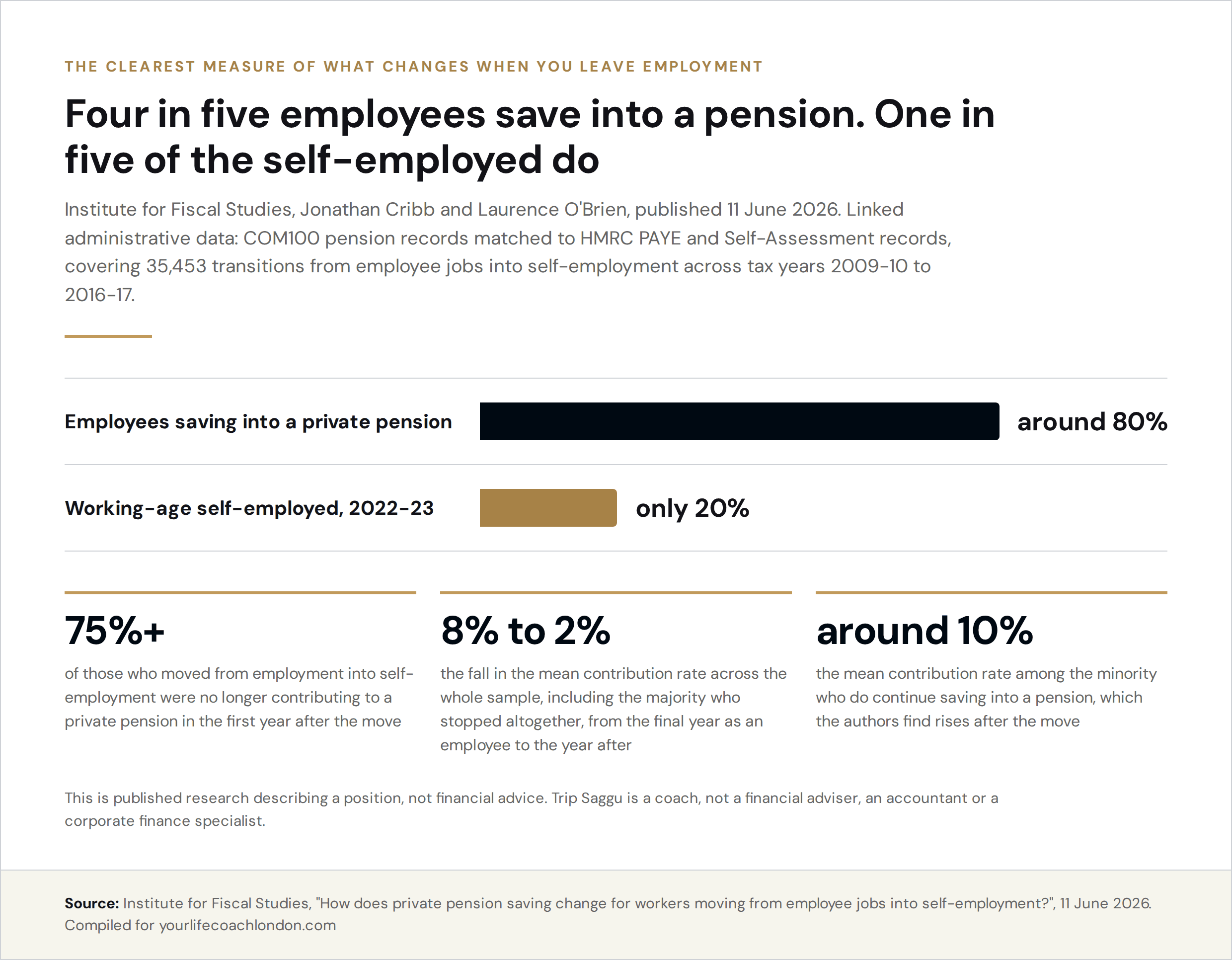
Four in five employees are saving into a pension. One in five of the self-employed are. The difference is not appetite. It is that one group had to choose and the other did not.
Career Coaching and Business Coaching Are Different Conversations
This distinction matters, because founders often book the wrong one and then conclude that coaching does not work.
Business coaching London work is about the company: the pricing, the pipeline, the hiring, the operating rhythm. Career work is about you: what you are building towards, what you would do instead, and what you want the next decade to contain.
The question I use to tell them apart
There is a simple test. Ask whether the answer would still matter if the business were sold tomorrow.
If it would not, it is a business question. Pricing, cash collection and the shape of the team all disappear the moment the company changes hands.
If it would, it is a career question. What you are good at, what you want to be known for and what you would do next all survive the sale, because they belong to you rather than to the entity.
Notice that the last row is deliberately not mine to answer here. The founder to chief executive transition belongs to the executive coaching material, and duplicating it would help nobody.
The Three Career Questions Founders Actually Bring
After a few hundred of these conversations, the same three arrive again and again. They rarely arrive in these words.
One: what am I actually building towards
Most founders can describe next year’s revenue target and cannot describe what the business is for in their own life. Those are different things, and the second one governs the first more than anyone admits.
The practical version is unglamorous. Are you building an asset you intend to sell, an income you intend to draw, or a job you happen to own? All three are legitimate. They point at completely different decisions about hiring, systems and how replaceable you make yourself.
A founder building to sell should be making themselves unnecessary. A founder building an income they enjoy drawing should not. I have watched people spend three expensive years pursuing the first while actually wanting the second.
Turning that into targets you can actually track is a separate craft, and I have written about it in how to define entrepreneurial goals. The question here comes before the goals: what are the goals in service of?
Two: what happens to me if this ends
Given the survival figures above, this is not a morbid question. It is a planning question that the employed version of your life would have answered for you through notice periods and redundancy terms.
- If you sold it tomorrow, what would you do on the Monday, and for how long would that be enough?
- If it closed instead, what does the following six months look like in practice?
- What in your current week is building something that would still be yours afterwards?
- What would you want on your record by the time this chapter finishes?
These are uncomfortable to sit with for about twenty minutes and then very clarifying. Most people discover they have an answer to none of them and strong opinions about all of them.
Three: is this still the work I want
This is the one people apologise for raising, usually with some version of “I know I should be grateful”. The apology is the tell.
A business can be performing perfectly well while the person running it has quietly stopped wanting to. That is a career problem wearing a business costume, and treating it as a strategy problem makes it worse, because it adds more of the thing that is draining you.
A business can be doing well while the person running it has stopped wanting to. Nothing in the management accounts will ever show you that, which is exactly why it goes unaddressed for years.
If that is closer to a life question than a work question, the honest place for it is life coach versus business coach, which sets out where the line falls.
What This Work Can Reach, and What It Cannot
I would rather be clear about the limits before the benefits, because this is a field where that rarely happens.
What genuinely shifts. Clarity about what you are building towards, a decision framework you can apply without me, and a plan that exists on paper rather than in your head. Those are decision problems, and decision problems respond to structured thinking with somebody who has run businesses.
What does not shift. I cannot make a market want your company, I cannot recover a year of runway, and I am not qualified to advise you on your pension, your tax position or the structure of a sale. Those need an accountant, a corporate finance adviser or an independent financial adviser, and a coach who pretends otherwise is doing you harm.
I also make no claim that coaching improves any business outcome. No randomised trial of this kind of work with UK founders exists that I could find, and anyone quoting you a percentage without naming the study, the sample size, the method and whether there was a control group is selling rather than informing.
- The evidence base for coaching specifically is thin, and I will not pretend otherwise
- What I bring is two decades of building businesses, not an accreditation
- The figures quoted here describe your position, not my results
- If your binding constraint is capital or legal structure, buy that expertise instead
The most useful thing a coach can tell you is which problem you have. Half the value in a first conversation is finding out that the thing you booked about is not the thing that needs solving.
Where This Sits Alongside the Rest of My Work
Several neighbouring questions have their own homes, and sending you there beats half-answering them here.
- On changing career in your forties as an employee rather than a founder, see career coaching for mid-career professionals
- On what to ask before you hire anyone in this field, see common mistakes when hiring a career coach
- If you lead inside a larger organisation, that is executive coaching, linked above
Complete Transformation is a six-month coaching programme, and every engagement I run carries a ninety-day checkpoint, with a pro rata refund for sessions you have not used if you stop there.
Frequently Asked Questions
Is founder career work different from business coaching?
Yes, and the test is simple. If the answer would still matter after the business was sold, it is a career question. If it would vanish with the sale, it is a business question. Most founders arrive wanting one and booking the other.
I am not planning to leave my business. Is this still relevant?
Probably more so. The founders who get most from this work are the ones doing it while nothing is wrong, because they still have options. Doing it after an exit or a closure is possible, it is just a narrower conversation.
What qualifications do you hold?
I hold a Diploma in Leadership and Management, a separate qualification in Coaching and Mentoring Skills, NLP to practitioner level, and Train the Trainer. I hold no ICF or EMCC accreditation and I do not claim one. Coaching is not a regulated profession in the UK, so nobody is checking, and you should ask this of anyone you consider.
Can you advise me on my pension or the structure of a sale?
No. I am not a financial adviser, an accountant or a corporate finance specialist, and career coaching is not financial advice. The pension figures quoted above are published research, included to describe the position founders are in, not as guidance about what you should do.
How long does this kind of work take?
Long enough for a decision to survive a normal quarter. Six months is a reasonable default for anything structural, with a genuine checkpoint at ninety days so that stopping is a real option rather than a theoretical one.
Does the evidence show career coaching works for founders?
Not in the form you should accept uncritically. No randomised trial of career coaching for UK founders exists that I could find, and I am not going to manufacture one out of general coaching research. What I can point to is the published data on the position founders occupy, which is what this article does.
Key Points
- About 4.3 million of the UK’s 5.7 million private sector businesses have no employees beyond their owners, according to the Department for Business and Trade. For most founders the career and the company are the same object.
- Of the ONS 2019 birth cohort, 61.6 per cent were not active in the fifth calendar year, on ONS figures for that cohort. ONS counts a death when a business ceases to trade and is de-registered, and does not classify deaths by cause, so this is not an insolvency rate.
- Employment law does not cover self-employed people in most cases, in GOV.UK’s own words, and holiday and sick pay are among the things it lists as absent.
- The Institute for Fiscal Studies found 80 per cent of employees saving into a private pension against 20 per cent among the working-age self-employed, with over three quarters stopping contributions within a year of going self-employed.
- The three questions worth booking time for are what you are building towards, what happens to you if it ends, and whether this is still the work you want.
- No randomised trial of this kind of work with UK founders exists. Treat any percentage you are quoted in this field with suspicion, including from me.
If you run a business and you have never once sat down to think about your own career rather than the company’s, that is the conversation to have. The first one is free and there is nothing to prepare.

Book a complimentary consultation about the 90-day business mentoring programme with Trip Saggu. No pressure, no obligation.
Last updated: 13 September 2026 by Trip Saggu