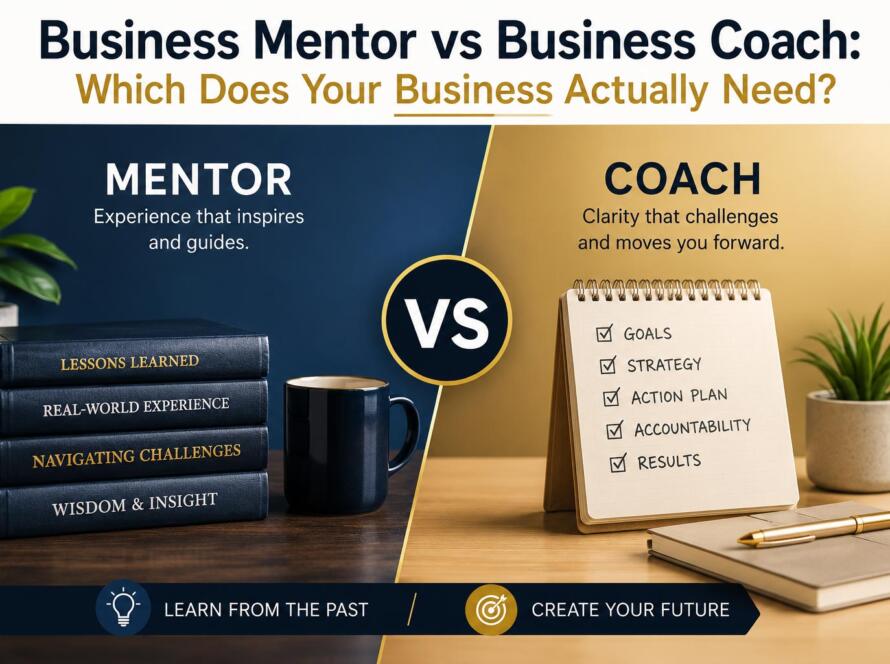

A good share of the people who contact me open with a business problem and spend the first twenty minutes describing something else. The pricing is wrong, they say, and then it emerges that it has been wrong for three years and the real difficulty is asking for the money. The hire is not working, and the real difficulty is letting go.
That is the question behind every life coach vs business coach search: not which label is correct, but where the problem actually lives. Business coaching works on the company through the owner. Life coaching works on the owner, and the company is one of the places the result shows up. For an owner, the two are rarely separable.
I am a business coach London owners tend to find when good advice has gone unused. If you are looking for a life coach for business owners as a service, that page describes it. This article answers the prior question: how to tell which kind of help you need, what the evidence supports, and how the two combine when the answer is both.
Every external figure below comes from the Office for National Statistics, the Department for Business and Trade, or a peer-reviewed study with a named sample. None comes from industry marketing.
The Short Answer, Before the Detail
A business coach is hired to change a business outcome and works on the owner only as far as that outcome requires. A life coach is hired to change something about the owner’s life and treats the company as one part of it. The useful test is not the label but a question: if the business were fixed tomorrow, would the thing bothering you be fixed with it?
If yes, start with the business side. If no, the company is probably where the trouble shows rather than where it started, and business advice alone tends to bounce off it. Most owners do not know which they are, and the four conversations on this site answer four questions.
The last row sits between two professions that would each rather you bought theirs.
Life Coach vs Business Coach: What Each Is Hired to Do
The industry’s own definition does not distinguish the two. The International Coaching Federation, a membership body for coaches, defines coaching as partnering with clients in a thought-provoking and creative process that inspires them to maximise their personal and professional potential. Personal and professional, in one sentence. The split into “life” and “business” is a marketing split, not a methodological one.
What differs is the brief. On the business side the coach is accountable for a result, so sessions open with the numbers, the pipeline and the diary, and the owner’s beliefs come in only where they block that result. On the life side the coach is accountable to the person, so sessions open with what the person wants their life to be, and the company is tested against that rather than the reverse.
One thing is worth knowing before you hire anyone. Coaching in the UK is not a regulated profession; there is no licence and no statutory register, as the Council on Licensure, Enforcement and Regulation set out in September 2024, and accreditation from bodies such as the ICF or the EMCC is voluntary. I hold neither.
That third column is the work I do most often, and the next section is about why.
Why the Line Blurs for a Business Owner
For an employee, work and life can be separated by a commute. For most UK business owners there is nobody to separate them from. The Department for Business and Trade’s Business Population Estimates, published on 2 October 2025, counted 5.7 million private sector businesses at the start of 2025. Of those, 1.4 million had employees and 4.3 million, 75 per cent, did not employ anyone aside from the owners. Three in four UK businesses employ nobody but the people who own them.
The hours agree. In the Labour Force Survey figures for July 2026, released by the Office for National Statistics on 20 October 2026, 21.0 per cent of self-employed people usually worked more than 45 hours a week, against 14.6 per cent of everyone in employment. The self-employed category is wider than owners with staff, but the direction is clear.
The research on owners goes further. In a systematic review of 144 empirical studies published in the Academy of Management Perspectives in 2018, Ute Stephan of Aston Business School found that entrepreneurs report being extremely happy in their work and highly satisfied with their life, while entrepreneurship is characterised as one of the most stressful jobs there is.
Her conclusion was that entrepreneurs’ work is uniquely enmeshed with their non-work life, and that models built for employees should not simply be applied to them.
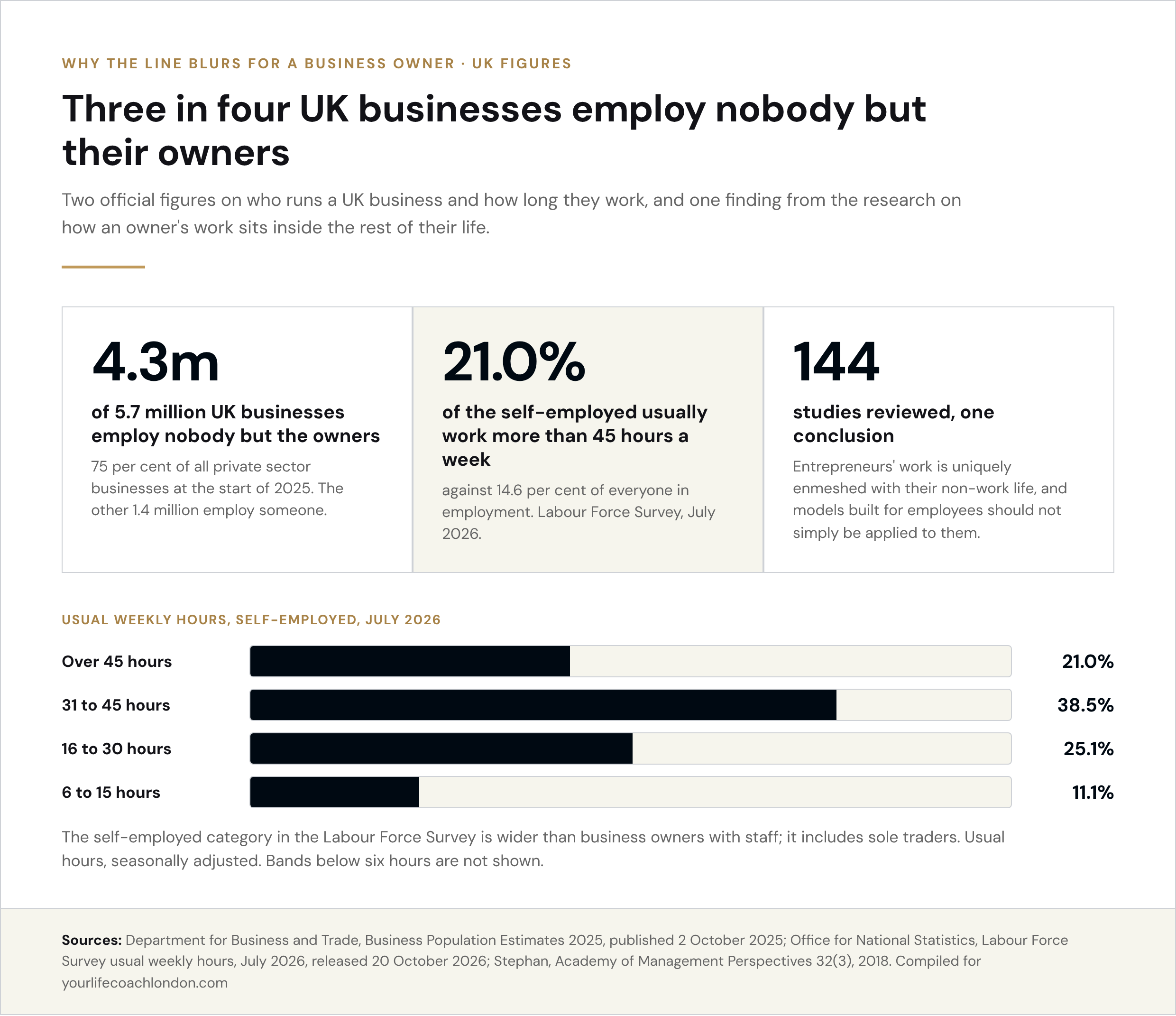
Three in four UK businesses employ nobody but their owners, and the research describes the owner’s work as uniquely enmeshed with the rest of their life. A coach who insists the two can be kept in separate sessions is describing a client who does not exist.
Stephan’s review also notes that the close entwinement of work and identity can tip into obsession and addiction to work. I see the milder version weekly: an owner who cannot say what they would do with a free Saturday, because there has not been one.
Five Business Problems That Are Usually Something Else
These are the five I meet most often. Each arrives looking operational and usually is not. They are patterns from my own practice, not published findings.
The pricing problem that is a worth problem
The owner knows the price is too low. They have the competitor data, the margin calculation and often a previous adviser’s written recommendation. They have not raised it. The block is not knowledge; it is the conversation in which a long-standing client is told the number has changed. Nobody can make that call for you, and until the reason you avoid it is on the table, the pricing model is decoration.
The hiring problem that is a control problem
The second hire is not working, or the first never happened. The plan says delegate; the diary says the owner checks everything. The question underneath is what it would mean about you if someone else could do the work. That is a life question wearing a recruitment problem’s clothes, and the delegation side of it is one of the three strands in my founder coaching article, linked in the table above.
The plateau that is a question of what you want
Revenue has been flat for two years and every growth tactic has been tried half-heartedly. Asked what the company would look like if it doubled, the owner describes a life they do not want. A plateau is often the honest answer to a goal the owner never chose, and no strategy fixes a goal inherited from a plan written at a different stage of life.
The hours problem that lives at home
The company is fine. The marriage, the health or the children are not, and someone at home has had enough. The business is the alibi. The work is on what the owner is avoiding by being at work, and the burnout side belongs to my article on entrepreneur burnout prevention, not here.
The decision you keep not making
A partnership to end, a product to kill, a premises to leave, analysed to exhaustion. When a decision has survived three rounds of analysis unmade, the missing input is rarely information. It is usually a fear about who the owner becomes once it is made, and the frameworks in my guide to decisions under pressure only start working once that is named.
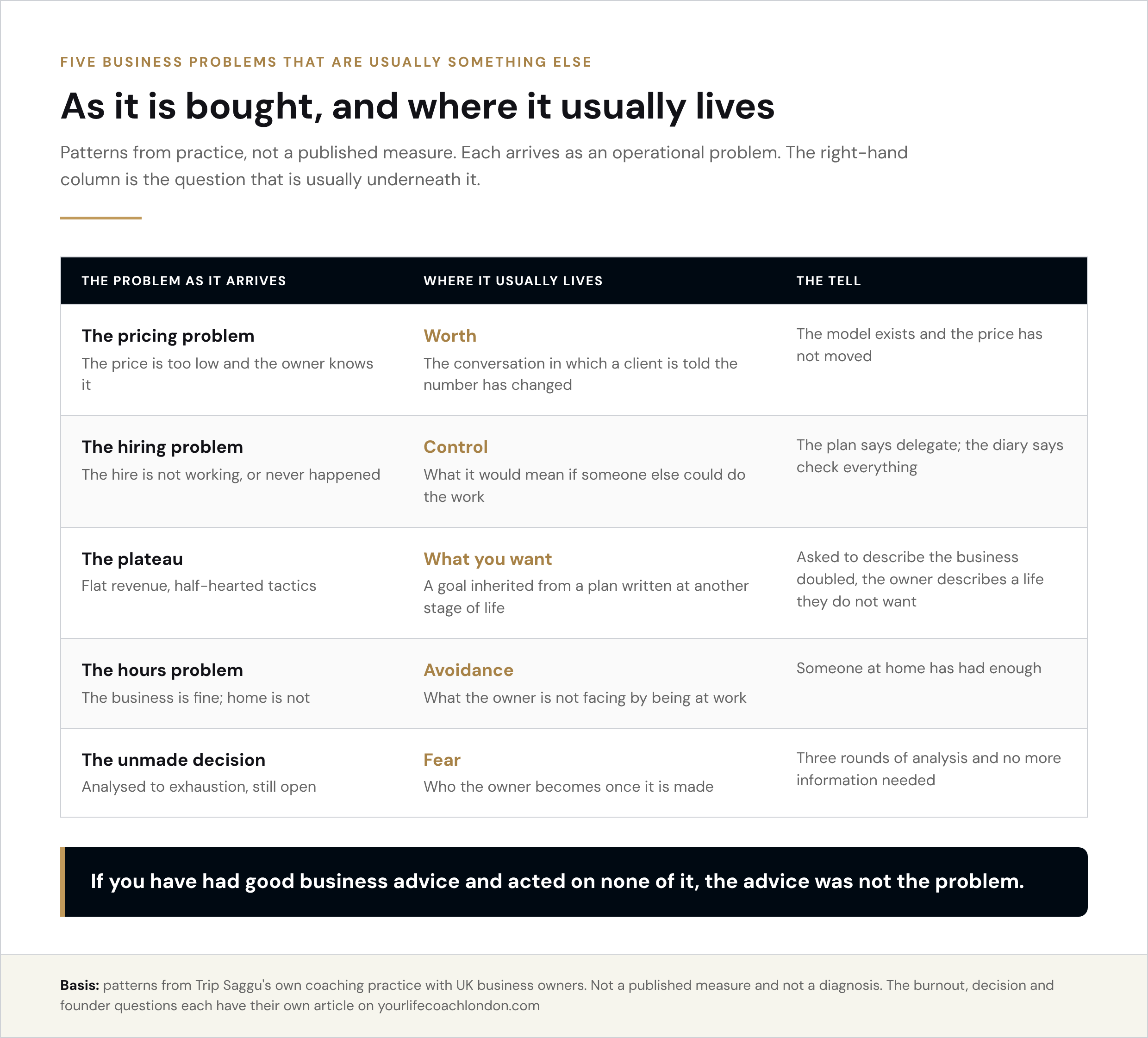
If you have had good business advice and acted on none of it, the advice was not the problem. That sentence does more diagnostic work than any questionnaire I have used.
Do any of the five sound like yours? The next section settles it.
The Test I Use in the First Session
I ask one question and then stop talking: if the business were fixed tomorrow, what would still be wrong? The first answer is usually “nothing”. The second, about a minute later, is the brief.
Four signals tell me the second answer is the real one.
- The owner has already bought the operational fix. Training, a consultant, software, a previous coach. The solution exists and has not been applied.
- The pattern predates the company. The same thing showed up in the last job, the last partnership or the last venture.
- The cost is being paid outside the company. Sleep, a relationship, a body. The metrics look fine and the owner does not.
- The owner can describe the company in three years and cannot describe themselves in it. The plan has a firm in it and no person.
Two or more of those signals make me test whether the issue extends beyond business coaching. They are prompts for the first conversation, not a validated diagnostic rule. If none applies, I test whether the issue is primarily operational rather than assume the answer. Selling six months of personal work to someone who needs a pricing model is the wrong thing to do. My article on when to hire a business coach is the right read if every signal is on the operational side.
What the Evidence Says About Coaching Beyond the Numbers
The evidence for coaching is real, moderate, and measured almost entirely on employees and managers rather than owners. Three meta-analyses carry most of the weight, each reported here with its limit.
Theeboom, Beersma and van Vianen, writing in the Journal of Positive Psychology in 2014, pooled 18 studies of coaching in organisational settings. They found effects on every outcome they measured, from g = 0.43 on coping to g = 0.74 on goal-directed self-regulation, with well-being at g = 0.46. Coaching aimed at work moved how people felt, not only how they performed. Not all 18 were randomised.
Jones, Woods and Guillaume, in the Journal of Occupational and Organizational Psychology in 2016, pooled 17 studies of workplace coaching and found an overall effect of 0.36, larger on affective outcomes at 0.51 than on skills at 0.28. They found no significant moderation of the effect by coaching format, whether face-to-face, blended or online, or by the number of sessions.
The strictest is Nicolau, Candel, Constantin and Kleingeld in Frontiers in Psychology, June 2023, which admitted only randomised controlled trials: 20 of them, from 2006 to 2023. The overall effect was g = 0.43, with resilience at 0.57. Their own test for publication bias was significant, and correcting for it brought the overall figure down to 0.27. Both numbers are theirs.
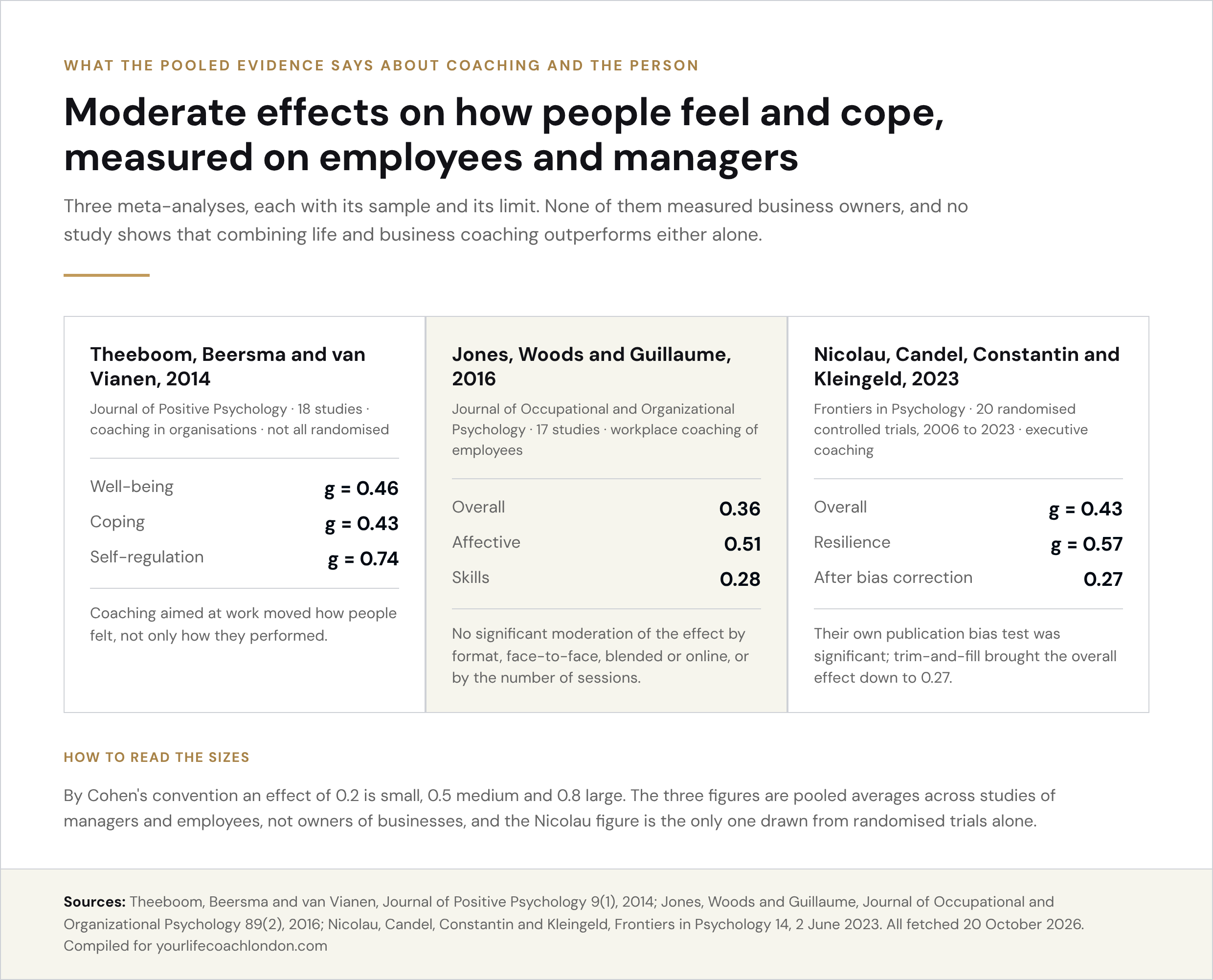
The pooled evidence shows coaching moving well-being, coping and resilience by moderate amounts, measured on employees and managers, with the effect shrinking once publication bias is corrected. No study shows that combining life and business coaching outperforms either on its own, and any coach who tells you otherwise is guessing.
Two gaps matter. None of the three measured business owners, and the UK trial evidence for support to small firms, which I set out in small business coaching London, measured business advice rather than coaching of the person.
What the research supports is narrower than a brochure: moderate average effects on how employees and managers coped and felt. Whether that transfers to an owner has not been measured, and none of the three says how long gains last.
How the Two Disciplines Combine in Practice
The question I am asked most is whether to do the personal work first or the business work first. It depends on which is blocking the other, and there are only two orders.
Business first, then the person
When the cost is being paid inside the company, we start with the numbers and stay there until a pattern shows up that the numbers cannot explain. A pricing model is built; the price is not raised; we move to why. The personal work earns its place by solving a business problem the business tools could not. Most of my ninety-day engagements run this way.
The person first, then the business
When the cost is being paid outside the company, starting with the numbers is a way of avoiding the subject. We start with what the owner wants their life to be, and the company is redesigned to fit it rather than the reverse. The business work earns its place by making the life the owner described possible. This is the order Complete Transformation is built around.
Whichever order applies, three rules keep the work honest.
1. Everything personal is tested against something observable. A belief we work on has to show up as a decision, a diary change or a number within a fortnight, or we are working on the wrong belief.
2. Neither side is an excuse for the other. If the company is losing money, that is a business fact and gets treated as one, whatever is going on at home.
3. The engagement has a stated end. Coaching that builds dependence rather than capability has failed, however pleasant it is for both of us.
What would change in your week if the thing you keep calling a business problem were treated as what it actually is?
Which Programme Fits Which Question
I run three programmes and an executive engagement, each built for a different answer to the test above. Every price is the figure on the programme page, and each page carries its own terms.
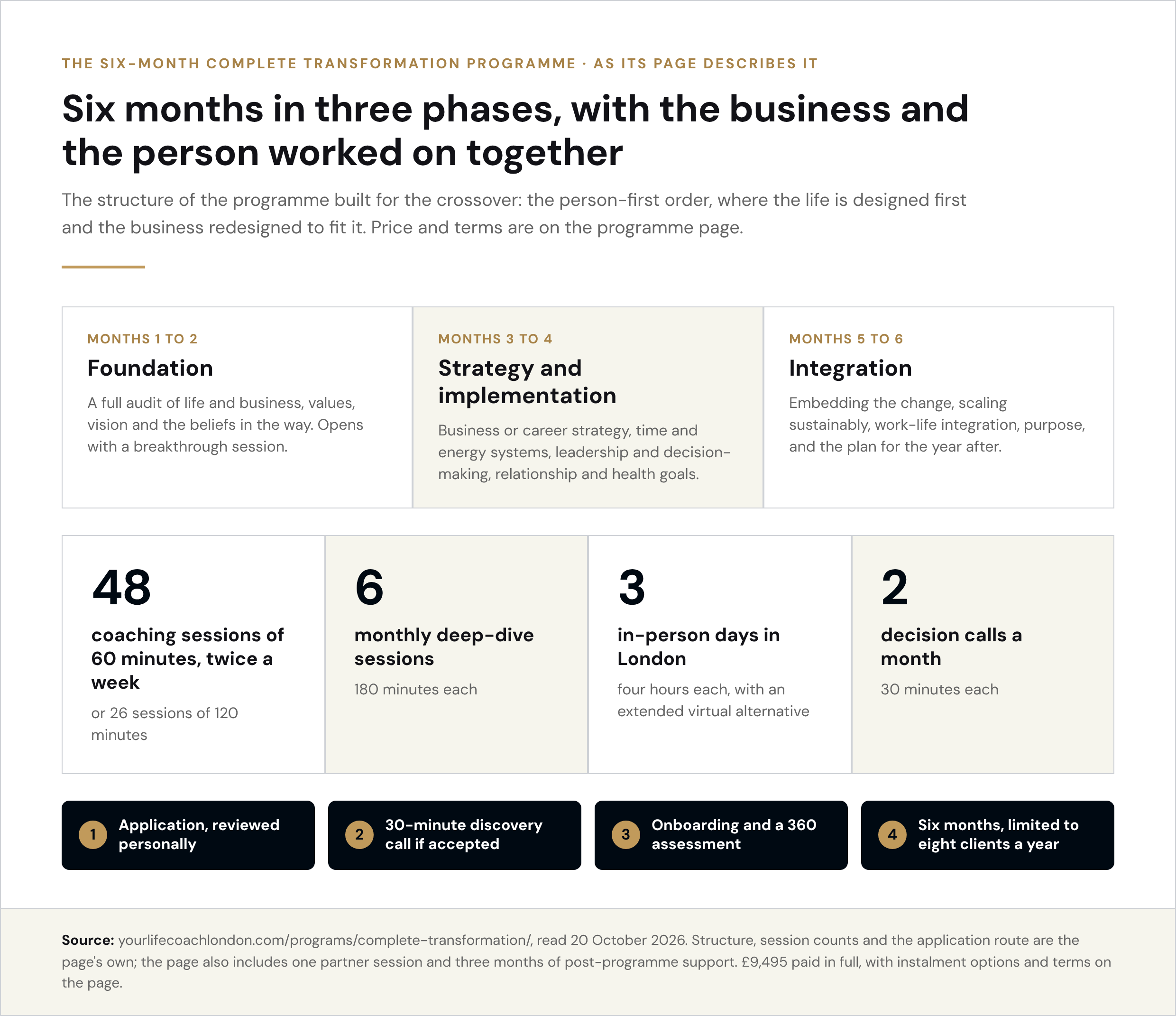
Complete Transformation is the one built for the crossover this article is about, so here is what its page says it contains. There are 48 coaching sessions of 60 minutes, twice a week, or 26 sessions of 120 minutes, plus six monthly deep-dive sessions of 180 minutes, three four-hour in-person sessions in London, and two 30-minute decision calls a month.
It runs in three phases: foundation in months one and two, strategy and implementation in months three and four, integration in months five and six. It is limited to eight clients a year and entered by application, with a 30-minute discovery call for applicants who are accepted.
If you are not sure which fits, start with the free call, or with the 90-day programme if the problem is primarily operational; the mentoring page states that an upgrade to the longer programme part-way through credits what you have already invested. How any of this compares with the wider market is covered in business coach cost UK and not repeated here.
Where This Work Stops
Coaching is not therapy and does not replace clinical or specialist support. The business coaching page linked above explains when coaching is the wrong purchase. What I can add is specific to the crossover: the hours problem that lives at home is the owner’s to work on, and although Complete Transformation includes one partner session, the client is the owner.
The crossover is not a licence to make everything about mindset. A company losing money has a business problem whatever else is true, and a coach who cannot read a cash flow statement is not the right person to tell you the real issue is your beliefs.
How I Work with Business Owners in London
I built businesses for two decades, and a property portfolio alongside them, before coaching the people who run them. My qualifications, in full, are these.
- A Diploma in Leadership and Management
- A separate qualification in Coaching and Mentoring Skills
- NLP to practitioner level, and Train the Trainer
- No accreditation from the ICF or the EMCC
I say so because there is no statutory coaching regulator or register checking practitioners’ credentials. The detail is on my about page.
Single sessions run over Zoom, with in-person sessions in London on request; the longer programme includes three in-person London days with a virtual alternative. The first conversation is a free call booked through the booking page, and its only purpose is to work out which of the four conversations in the table at the top you are in.
Frequently Asked Questions
Do I need a life coach or a business coach?
Ask whether the thing bothering you would be fixed if the company were fixed tomorrow. If yes, start with the business side. If no, look for someone who can work on both. Most owners I meet are in the second group and have been buying the first.
Can one coach do both?
Yes, provided they can do both well. The test is whether they can read your numbers and also sit with the question of what you want your life to be without rushing back to the numbers. A coach who does not understand how the company works will design a life it cannot support.
Does the evidence support coaching for wellbeing and not just performance?
By a moderate amount, yes. Theeboom and colleagues found an effect on well-being of g = 0.46 across 18 studies in 2014; Nicolau and colleagues found an effect on resilience of 0.57 across 20 randomised trials in 2023, with the overall effect falling to 0.27 once publication bias was corrected. Nearly all of it was measured on employees and managers.
What qualifications do you hold?
A Diploma in Leadership and Management, a qualification in Coaching and Mentoring Skills, NLP to practitioner level and Train the Trainer. No ICF or EMCC accreditation. Coaching is unregulated in the UK, so ask every coach on your shortlist the same question.
How does Complete Transformation differ from the ninety-day programme?
The ninety-day 1:1 Business Mentoring programme, at £4,995, focuses on the company and brings the personal work in only where it blocks a result. Complete Transformation, at £9,495 over six months, works on business, mindset, relationships, health and purpose together, by application. Each page carries its own terms.
Key Points
- The question is not which label is right but where the problem lives. If fixing the company would not fix it, the company is the symptom.
- Three in four UK businesses employ nobody but their owners, a fifth of the self-employed usually work over 45 hours, and the research describes an owner’s work as uniquely enmeshed with the rest of their life. The line blurs for a reason.
- The pooled evidence shows coaching moving well-being, coping and resilience by moderate amounts, measured mostly on employees. Nothing shows the combination beats either discipline alone.
- There are two orders of work, business first or person first, and the first session’s job is to tell which one you are in.
Ready to Find Out Where the Problem Lives?
Complete Transformation is built for owners whose business problem turned out to be something else. The first step is the application, which I review personally; accepted applicants then have a 30-minute discovery call.
Last updated: 21 October 2026 by Trip Saggu