

Most owners sell a business once. The buyer across the table may have done this several times. The broker, accountant and solicitor may each bring experience from many transactions. Every professional in the room owns a piece of the deal. Nobody in the room is responsible for the owner.
That gap is what a business exit coach, or a business buying coach on the other side of the table, exists to fill. Not the valuation, the tax or the contract, which belong to people qualified for them. The owner’s own decisions, pace and judgement from the day the thought arrives to completion.
I am a business coach London owners come to when the deal is already in motion and everyone else at the table has done this before. This article sets out what coaching through a sale or a purchase involves, what the UK actually knows about business sales, what a buyer looks at that no adviser can fix for you, and where this work stops.
Every external figure below comes from HMRC, the Office for National Statistics, GOV.UK or a peer-reviewed study with a named sample. None comes from a broker’s brochure.
The Short Answer, Before the Detail
Coaching through a business transaction is one-to-one work with the person buying or selling, on the decisions only that person can make: whether to do it at all, what they will and will not accept, who runs the company while they are distracted by the deal, and how they hold their nerve through due diligence. It runs alongside the broker, accountant and solicitor, never instead of them.
The sale of a business is the end of one story and the middle of three others, each dealt with in its own place.
Which row are you in? If the deal is a year or more away, start with the first row. If you have a buyer, an offer or a target in front of you, keep reading.
What the UK Does Not Know About Business Sales
Start with an uncomfortable fact: I could find no official UK count of how many businesses are sold each year. The two series that come closest both stop short, and it is worth knowing where.
The Office for National Statistics counted about 280,000 business deaths in 2024, a rate of 9.8 per cent, in its Business Demography release of 20 November 2025. A death is a business that has ceased to trade, identified through de-registration. The ONS does not record why. A company sold and folded into the buyer, a retirement, a collapse and a deliberate wind-down all count the same, so the figure says nothing about sales.
The nearest thing to a count comes from tax. In its Capital Gains Tax statistics published on 27 August 2026, HMRC reports that Business Asset Disposal Relief was claimed by 61,000 taxpayers on £18.5 billion of gains in the 2024 to 2025 tax year. The relief applies to qualifying disposals of a business or of shares in a personal trading company, so it is a proxy for owner disposals, not a count of companies changing hands.
One line in it matters for most readers. Seventy per cent of the tax paid at the relief rate came from the quarter of claimants with gains of £500,000 or more. The other 75 per cent had qualifying gains below £500,000. That does not reveal the sale price or show whether each claim represented a whole-business sale.
Then there is what there is to sell. The Department for Business and Trade counted 5.7 million private sector businesses at the start of 2025, and 4.3 million of them employ nobody but the people who own them. Three in four UK private sector businesses have no employees apart from their owners. That figure does not show whether those businesses have transferable assets, contracts, intellectual property or goodwill. Establishing what there is to sell, and how much of it is the owner, is the first thing a coach and an owner do together.
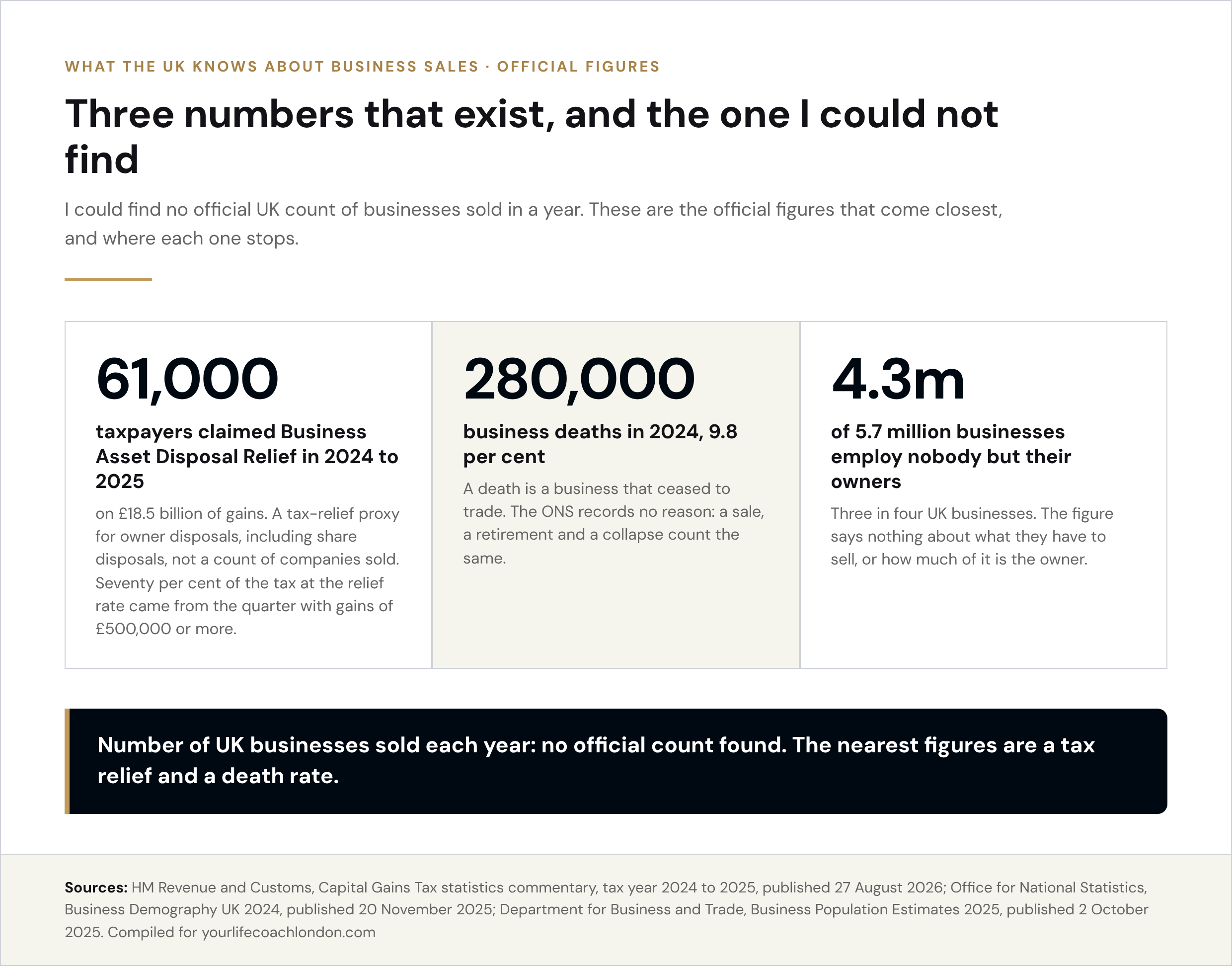
The UK publishes how many businesses die and how many owners claim a tax relief on a disposal. I could find no official figure for how many are sold. Anyone quoting you a share of owners who achieve a sale is working from a broker’s book, not from the state’s.
Owners Leave Healthy Businesses Too
The common picture of an exit is a tired owner selling a tired company. The research disagrees. In a study published in the Journal of Business Venturing in 2010, Wennberg, Wiklund, DeTienne and Cardon followed 1,735 new ventures and their founders in Sweden over eight years. They found that entrepreneurs exit from both firms in financial distress and firms performing well, and that the exit takes one of four routes.
The route decides what the coaching is for. From strength, the work is mostly patience and price. Under pressure, it is mostly not letting the deal become an escape from a situation a different decision would have fixed. The study is Swedish and was published in 2010, so it describes the shape of exits, not UK rates.
A sale from a healthy business and a sale from a struggling one feel identical from the inside, because both are exhausting. The first question in any engagement is which one this is, and owners are often wrong about their own answer.
Selling: Three Conversations Before the Broker
A broker will tell you what the business might fetch and who might buy it. Those are the right questions in the second month. In the first month there are three others, the owner’s to answer, which is why they land with a coach.
Why now, and is it the business or you?
Owners rarely decide to sell on a spreadsheet. Something happens: a competitor sells, a partner wants out, a health scare, a birthday with a zero in it. The job is to separate the reason from the trigger, because a sale is slow and the trigger will have passed by the time it completes. If the reason is the business, the deal goes ahead. If the reason is the owner, the better move is sometimes to make the company run without you first, and then decide.
What will you accept, written down before the first offer?
Not only price. Deferred payment, an earn-out that keeps you in the building for two years, a buyer who will close the site, a change of name. Every owner has a line, and almost none have written it down before the first offer arrives, which is exactly when a line is hardest to hold. The document is a page long and I ask for it in week one.
Who runs the business while you sell it?
A sale takes months and consumes the owner’s attention. Performance dips, the buyer notices, and the price follows. If the company cannot run for a quarter without you, that is a problem for the price, and it is the one my article on strategic business coaching says to fix years ahead. If there are no years, the first use of whatever time remains is to get you out of the daily running before the buyer’s accountant arrives.
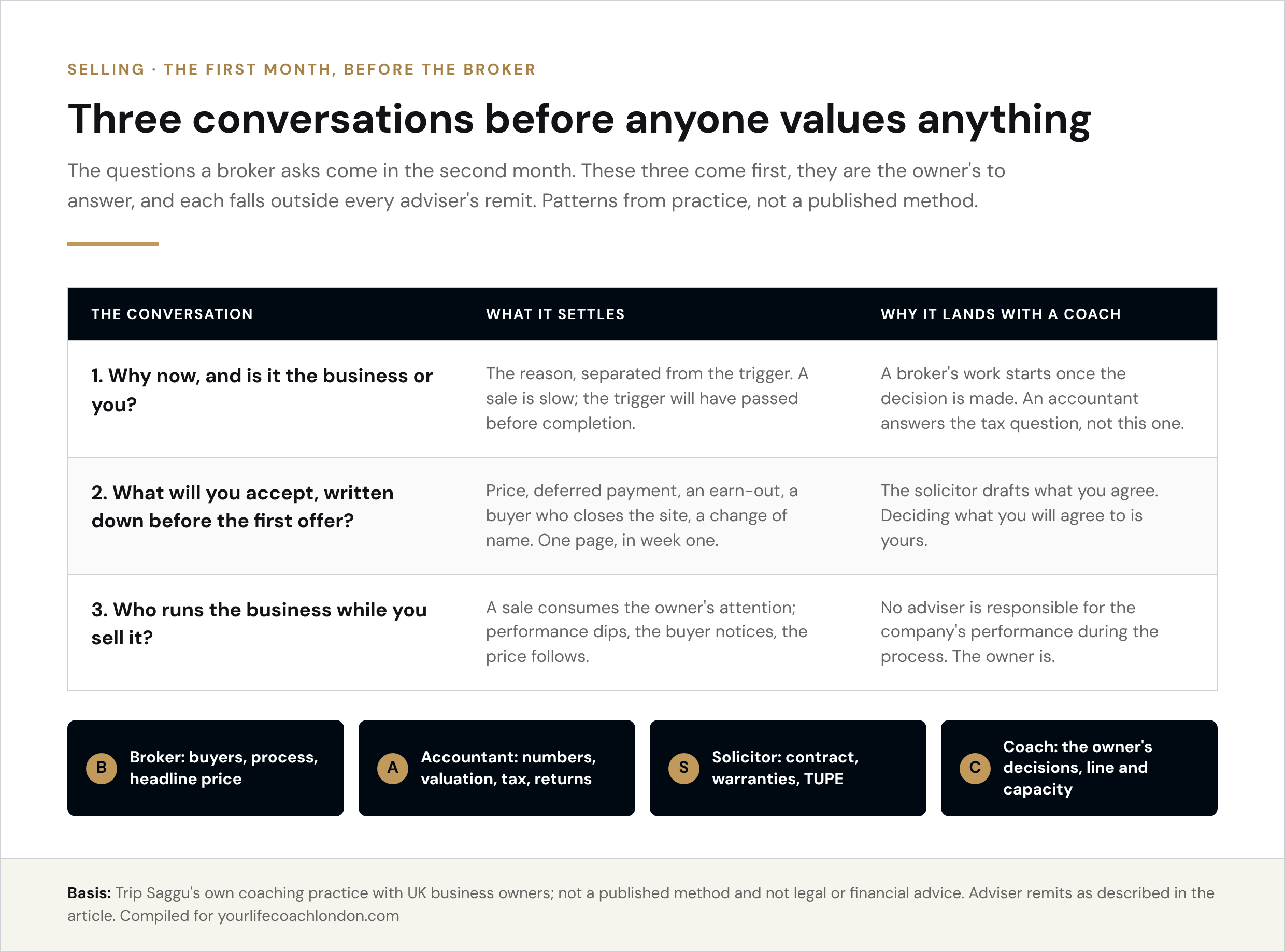
Have you answered all three? Most owners who come to me have answered the first and are improvising the rest.
What a Buyer Examines That No Adviser Can Fix
Due diligence has a reputation as an accounting exercise. It is partly that, and your accountant handles it. What catches sellers out is the rest, because what a serious buyer is trying to measure is how much of the business leaves with you. That is not in the accounts. It is in the diary, and nobody can tidy it up for you.
These are what I ask a seller to look at before the buyer does. Patterns from my own practice, not a published checklist.
- Who the top five customers call. If the answer is you, the buyer is buying your phone number, and the price reflects it.
- Who decided the last ten decisions that mattered. If every one came across your desk, the buyer is buying a job, not a company.
- What is written down. Processes, pricing rules, supplier terms. A business that lives in one person’s head is worth what that person is willing to stay for.
- Who the staff think they work for. The buyer will meet them, and the law on what happens to them is below.
- What you would be embarrassed by. The lapsed contract, the informal arrangement, the loan from a relative. Every one of them surfaces, and it is cheaper to surface them yourself.
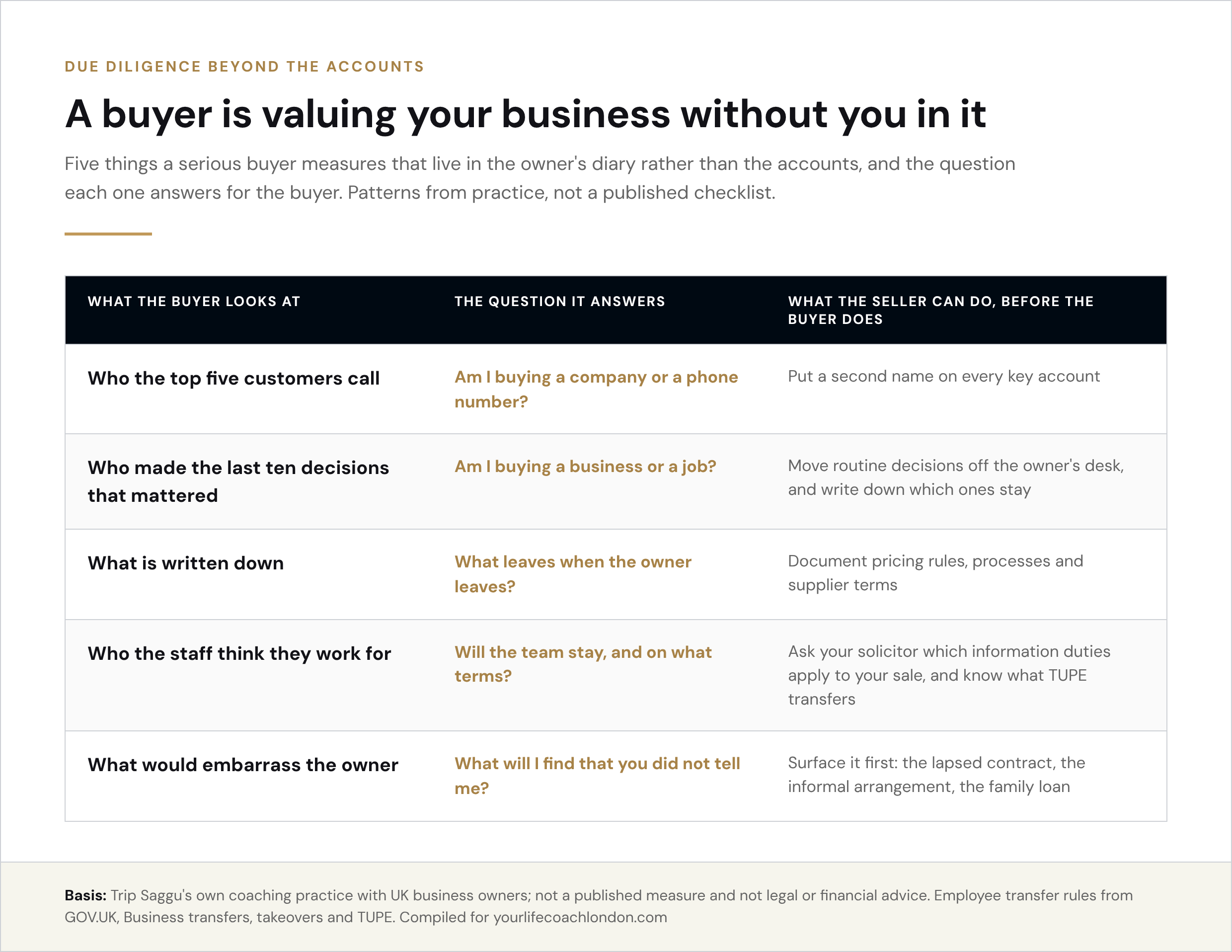
A buyer is not valuing your business. They are valuing your business without you in it. Reducing owner dependence before a sale may help a buyer understand what remains after you leave, but its effect on value depends on the business and belongs with the valuer and transaction advisers.
This is the point where selling and founder coaching overlap, and I do not pretend otherwise. The delegation and decision work in what a founder coach does is the same work a seller does against a deadline.
Buying: Coaching for the Person Acquiring a Business
Buying an existing business is the route into ownership nobody writes about, because the start-up story is better. Yet as many people arrive here looking to buy as to sell, and the coaching is different in kind, because a buyer may be making one of the most consequential decisions of their working life on information the seller controls.
The free check before any conversation
Before you speak to a broker, read the company at Companies House. The Get information about a company service is free and gives you the date of incorporation, current and resigned officers, document images, mortgage charge data, previous names and insolvency information. A string of resigned directors or a charge you were not told about is a question for the first meeting, not the last.
The question before the numbers
Why is this person selling? The answer the seller gives and the answer the business gives are often different, and the four routes above are the frame. A seller leaving a healthy business from strength is a different negotiation from one selling under pressure, and a buyer who cannot tell which they are talking to is negotiating blind. The coaching is on reading the seller, the discipline of walking away, which my guide to decisions under pressure treats at length, and whether you are buying this business or any business to escape your current job.
Your own hundred days
The deal completes and the previous owner leaves, or stays on an earn-out and second-guesses you. Either way the staff are watching. Under the GOV.UK guidance on business transfers, where TUPE applies, and the size of the business does not matter, employees’ jobs usually transfer to the new company, along with their employment terms and conditions and continuity of employment. Ask your solicitor what transfers in your acquisition. The coaching for a new owner in those months is the founder’s: decide what only you decide, and stop deciding the rest.
Who Does What: Broker, Accountant, Solicitor, Coach
Owners are not badly served through a sale because the advice is bad. Each adviser’s remit stops at a line, and the owner is beyond all of them.
The obligations themselves are set out plainly in the Selling your business guidance on GOV.UK, and they are the accountant’s and the solicitor’s to deliver, not mine.
- A sole trader must tell HMRC the business has been sold, send a final Self Assessment return with the date trading stopped, and may transfer the VAT registration to the new owner.
- An owner selling the whole shareholding of a limited company should appoint new directors before resigning, tell Companies House, and tell a lender within 21 days if company finance is secured on personal property.
- Employee information and consultation duties depend on the transaction. A sole trader must inform staff, while a company selling part of its business must inform affected employees. Ask your solicitor which duties apply to your sale.
None of that is coaching, and a coach who starts explaining the tax treatment of a share sale against an asset sale has stopped doing their job. I am not qualified to advise on your pension, your tax position or the structure of a sale, and I say so in every engagement.
The adviser whose remit is the owner is the one most sellers never appoint. That is not a criticism of the others. It is the gap this work exists for.
What the Evidence Says
I would rather you had the honest position than a reassuring one. There is no randomised trial of coaching owners through a business sale or purchase that I could find. What exists is the general evidence on coaching, and it has to be read for what it measures.
A deliberately narrow summary is a 2023 meta-analysis by de Haan and Nilsson in the Academy of Management Learning and Education, which admitted only randomised controlled trials: 37 of them, 39 samples, 2,528 participants. It found a moderate overall effect, g = 0.59, larger on outcomes people reported about themselves than on outcomes somebody else observed, with indications of significant publication bias. Nearly every participant was an employee or a manager, not an owner, and none was in the middle of selling a company.
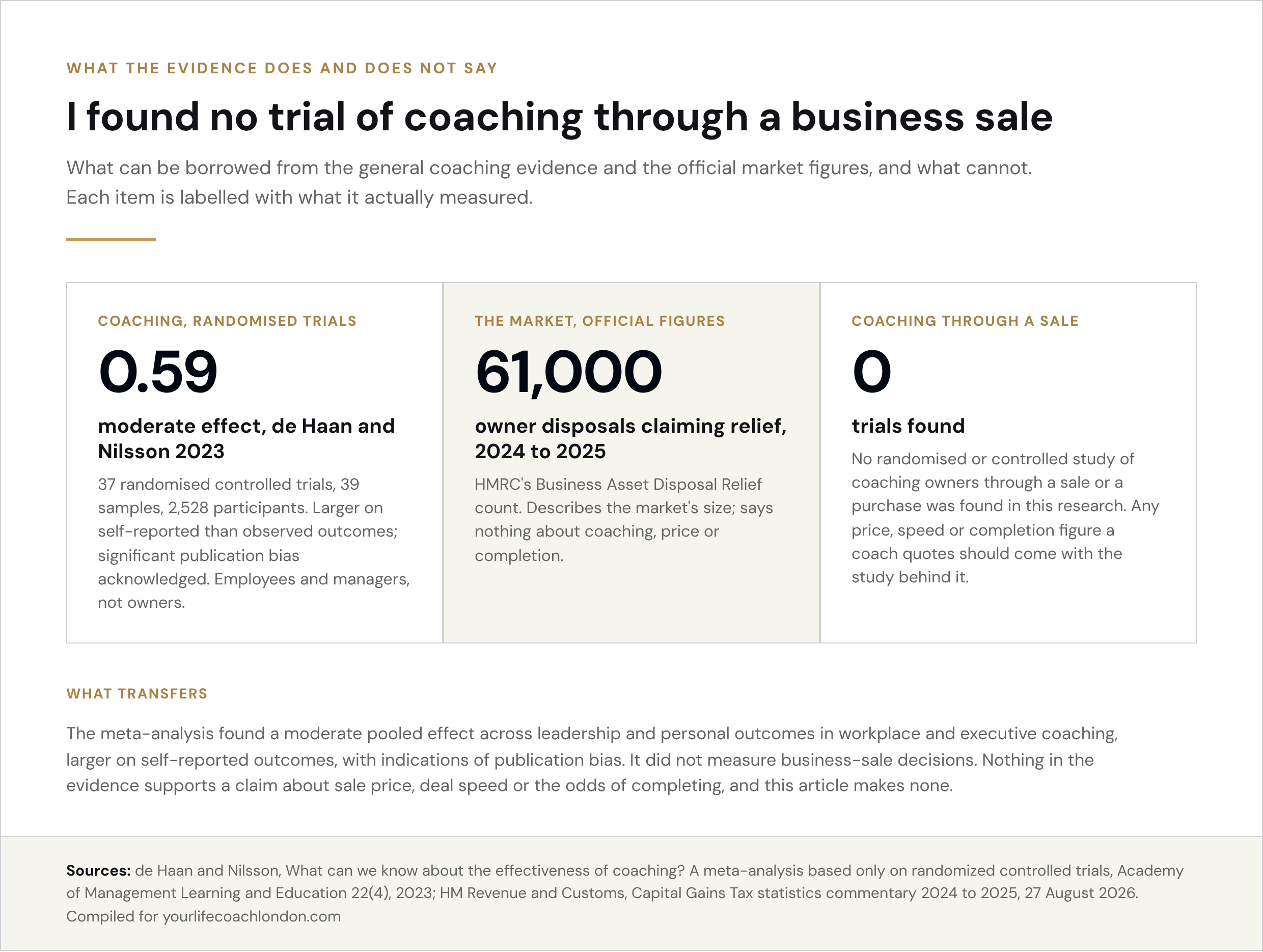
What transfers is limited: the meta-analysis found a moderate pooled effect across leadership and personal outcomes in workplace and executive coaching. It did not establish an effect on business-sale decisions or coping, and it reported larger self-reported effects and indications of publication bias. If a coach quotes you a figure for price, speed or the odds of completing, ask for the study.
The Programme, and What It Costs
The 1:1 Business Mentoring programme is £4,995 paid in full for ninety days. Its terms are on the programme page, including the statement that an upgrade to the six-month programme part-way through credits what you have already invested. Whether it is the right format for your sale or purchase is what the first conversation, which is free, establishes.
What would change in your negotiation if you had decided, in writing, what you will walk away from before anyone made you an offer?
Where This Work Stops
A coach is not a valuer, an accountant, a solicitor or a broker, and the moment a client asks me what the business is worth, the right answer is a name and a phone number. The business coaching London page sets out when coaching is the wrong purchase altogether.
The limit specific to a transaction is simpler: if the question has a number, a clause or a tax rate in it, it belongs to someone qualified in that number, clause or rate. What remains, the deciding and the holding of nerve, is the whole of this work.
How I Work with Owners Through a Sale or a Purchase
I built businesses for two decades, and a property portfolio alongside them, before coaching the people who run them. My qualifications in full:
- A Diploma in Leadership and Management
- A separate qualification in Coaching and Mentoring Skills
- NLP to practitioner level, and Train the Trainer
- No accreditation from the ICF or the EMCC
Coaching is not a regulated profession in the UK, so ask every coach you consider the same question, and read my about page for the detail.
The first conversation is a free call, booked through the booking page, and its purpose is to work out which of the four routes you are on and whether coaching is the help you need at this stage. For leaders of larger organisations in the middle of a transaction, the executive coaching engagement is the better fit, and the four-way table at the top says where the other conversations belong.
Frequently Asked Questions
What does a business exit coach do?
They work with the owner on the decisions only the owner can make through a sale: whether to sell, what to accept, who runs the business meanwhile, and how to hold a line under pressure. They do not value, advise on tax or draft the contract.
Is there such a thing as a business buying coach?
Yes, and the work is the mirror image: reading the seller, deciding what you are really buying, the discipline to walk away, and the first hundred days as the new owner. The free Companies House check comes before any of it.
How many UK businesses are sold each year?
I could find no official count. HMRC recorded 61,000 Business Asset Disposal Relief claimants in 2024 to 2025, which is a tax proxy, and the ONS recorded 280,000 business deaths in 2024 without a reason for any of them.
When should I start working with a coach before selling?
The moment the thought becomes serious, usually a year or more before a broker is appointed. The strategic preparation belongs years ahead.
Does the evidence show coaching helps with a business sale?
I found no study that measures that. The general coaching evidence, from 37 randomised trials of employees and managers, shows a moderate pooled effect across leadership and personal outcomes, with publication bias acknowledged. Nothing in it supports a claim about price or completion.
What does coaching through a sale cost?
The ninety-day 1:1 Business Mentoring programme is £4,995 paid in full, with its terms on the programme page. How that compares with the wider market is covered in business coach cost UK and not repeated here.
Key Points
- Every adviser in a business sale owns a piece of the deal. Coaching through it is the piece that is the owner: their decisions, their line, their capacity and the company’s performance meanwhile.
- No official UK count of businesses sold exists that I could find. HMRC’s 61,000 relief claimants and the ONS’s 280,000 deaths without a cause are the nearest figures, and 4.3 million businesses employ nobody but their owners.
- Owners exit healthy firms as well as failing ones, and the route decides what the coaching is for.
- A buyer values the business without you in it. The owner-dependence work is the same as founder coaching, with a deadline.
- I found no trial of coaching through a sale. The general evidence is moderate, measured on employees and managers, and supports nothing about price or completion.
Ready to Decide Before the Offer Arrives?
The first conversation is free, and its purpose is to work out which route you are on and what you need to have decided before anyone puts a number in front of you.

Last updated: 21 October 2026 by Trip Saggu