

Yes – but only after you have documented performance issues, provided clear feedback, established improvement targets, and followed UK employment law procedures. If performance hasn’t improved after proper support, a formal Performance Improvement Plan, and fair warnings, dismissal is usually the right and legally safe decision. However, many underperformance situations can be resolved through coaching, role realignment, or targeted development programmes before reaching termination.
Let me explain something crucial that many business owners struggle with: deciding whether to fire an underperforming employee is one of the most challenging decisions you’ll face as a leader.
Did you know that 89% of business owners admit they’ve kept underperforming staff longer than they should have?
That delay costs UK businesses an estimated £84 billion in lost productivity annually, according to research by the Chartered Management Institute.
I’m Trip Saggu, your business coach from London, and I’ve helped countless entrepreneurs navigate this exact dilemma over my two decades in business. Today, I’ll guide you through this difficult decision with clarity, legal compliance, and confidence.
Are you currently wrestling with an employee performance issue? Let’s tackle this together.
Understanding the Real Cost of Underperforming Employees
Before we dive into whether you should fire someone, let’s understand what’s really at stake here.
An underperforming employee doesn’t just affect their own output – they create a ripple effect throughout your entire business that compounds over time.
The Hidden Costs You’re Already Paying
Here’s what most business owners don’t realise about the actual cost of keeping underperforming staff:
- Team morale deteriorates rapidly as high performers watch poor performance go unaddressed
- Your management time is consumed with corrections, oversight, and damage control
- Customer satisfaction drops when service quality becomes inconsistent
- Revenue opportunities are missed due to delayed projects or substandard execution
- Top talent may leave when they feel their extra effort isn’t valued or recognised
- Your reputation suffers when clients experience poor service delivery
According to research by Harvard Business Review, a single underperforming employee can reduce overall team productivity by up to 30%.
That’s not just one person’s output – it’s your entire team’s effectiveness being compromised. When your star performers are picking up the slack, they’re not focusing on the high-value work that drives your business forward.
I’ve witnessed this firsthand with numerous clients. One entrepreneur I coached was spending 15 hours per week managing one underperforming team member – time he should have been investing in business development. The opportunity cost was staggering: over £50,000 in lost revenue that year alone.
Why Business Owners Hesitate to Fire Underperforming Staff
Let me ask you something: Are you avoiding this decision right now?
Most entrepreneurs delay firing decisions for these reasons:
- Fear of confrontation – Nobody enjoys difficult conversations or potential conflict
- Guilt and empathy – Worrying about the impact on someone’s livelihood and family
- Self-doubt – Questioning whether you’ve done enough to support their improvement
- Practical concerns – Wondering who’ll handle their workload or how quickly you can replace them
- Legal anxiety – Concerns about UK employment law and potential tribunal claims
- Hope – Believing they’ll eventually improve if you just give them more time
Sound familiar? You’re not alone. Through my business coaching work, I’ve seen that the average business owner waits 14 months too long before addressing serious performance issues.
But avoidance has its own cost, and often it’s far greater than the temporary discomfort of addressing the situation decisively.
Warning Signs an Employee Should Be Let Go
Let’s get practical. Here are the clear indicators that it might be time to part ways:
Performance Red Flags That Signal Dismissal May Be Necessary
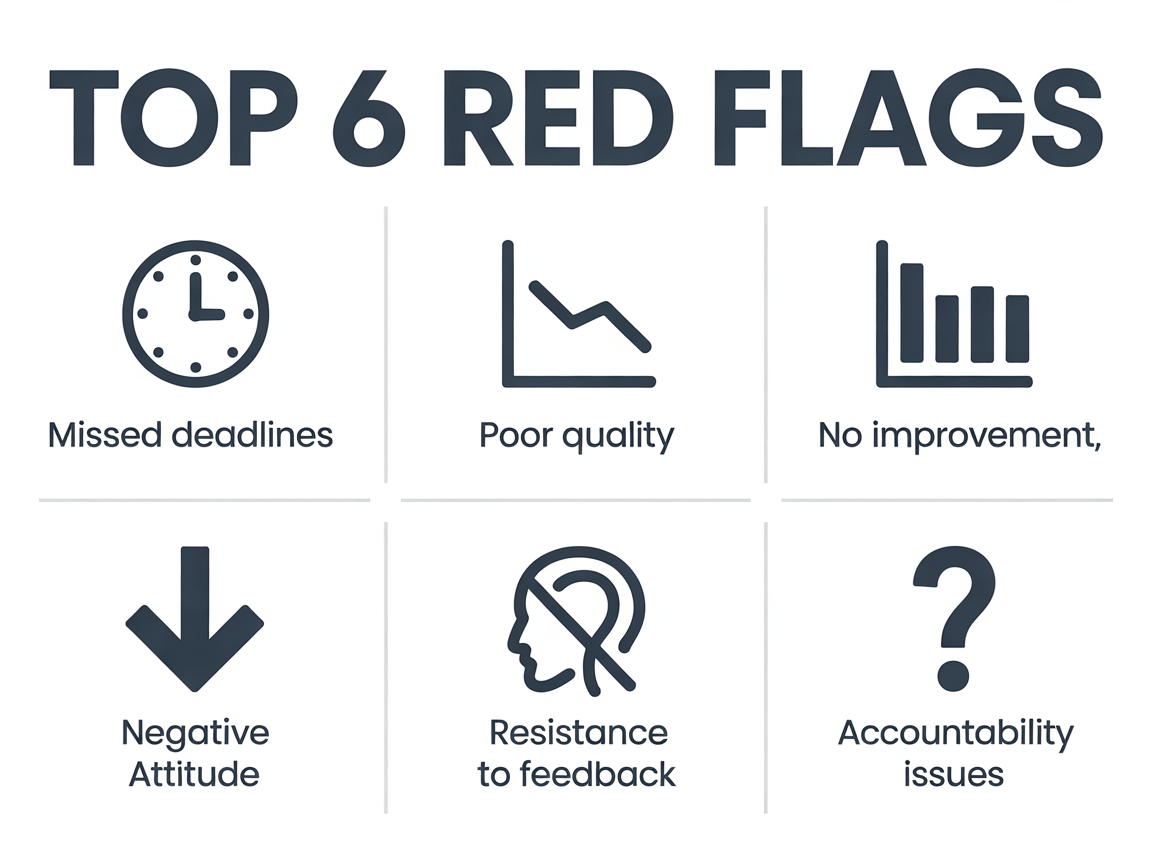
Consistent missed deadlines despite clear expectations
When someone repeatedly fails to deliver on time, it disrupts your entire operation. One or two instances? That’s human. A persistent pattern over several months? That’s a fundamental performance issue.
Quality of work consistently below acceptable standards
Are you constantly redoing their work? Do clients complain specifically about their output? If you’re spending more time fixing errors than they spent creating the work, something’s fundamentally wrong.
I had a coaching client whose marketing manager required 8-10 rounds of revisions on every piece of content. The client was writing everything herself while paying someone else to do it. That’s not management – that’s expensive frustration.
Lack of improvement despite feedback and support
This is crucial. Have you provided:
- Clear, written performance expectations?
- Specific, actionable feedback with examples?
- Resources, training, and development opportunities?
- Regular one-to-one meetings and guidance?
- A formal Performance Improvement Plan with measurable targets?
If the answer is yes to all of these and there’s still no meaningful improvement, the issue isn’t lack of support – it’s lack of capability or commitment.
Behavioural Warning Signs You Shouldn’t Ignore
- A persistently negative attitude that affects team dynamics and morale
- Active resistance to feedback or coaching, rather than receptiveness
- Consistent blame-shifting rather than accepting accountability
- Frequent unexplained absences or chronic tardiness
- Complete disengagement from team activities, meetings, and company goals
- Undermining behaviour that sabotages team cohesion or your leadership
According to ACAS (Advisory, Conciliation and Arbitration Service), behavioural issues combined with performance problems create the strongest case for fair dismissal when properly documented.
The Crucial Question Every Business Owner Must Ask
Ask yourself honestly: “If this person applied for their role today with their current track record, would I hire them?”
If your immediate, gut-level answer is “absolutely not,” that tells you something important about what you need to do.
When You Shouldn’t Fire an Employee (Critical Exceptions)
Before we proceed further, let’s be clear about situations where firing is NOT the correct answer – at least not immediately.
When the Problem Is Actually Your Leadership
Sometimes, underperformance reflects leadership gaps rather than employee deficiency:
- You haven’t provided clear role expectations or KPIs
- Training and onboarding were inadequate or rushed
- You’ve changed expectations without proper communication
- Resources or tools needed for success aren’t available
- Your feedback has been vague, inconsistent, or absent
If you’re recognising yourself here, the solution isn’t firing – it’s improving your management systems. This is precisely where many entrepreneurs benefit from professional business coaching to develop their leadership capabilities.
When External Factors Are Temporarily Affecting Performance
Consider postponing dismissal if:
- Personal circumstances (bereavement, divorce, health issues) are affecting performance temporarily
- The employee has a strong previous track record, and this is an anomaly
- They’re genuinely receptive to feedback and show effort to improve
- Recent organisational changes (restructuring, new systems) created confusion
- Reasonable adjustments under the Equality Act 2010 obligations haven’t been explored
UK employment law requires you to make reasonable adjustments for employees with disabilities. Failing to do so before dismissal could result in discrimination claims. Always consult ACAS guidance on disability discrimination when relevant.
When You Haven’t Followed the Proper Legal Process
Never fire someone without following correct UK employment law procedures, regardless of how clear-cut the performance issues seem. We have covered the complete legal framework in our legal steps guide on how to fire someone in the UK.
Alternatives to Firing an Underperforming Employee

Sometimes, firing isn’t the correct answer. Let me show you proven alternatives that often resolve performance issues without termination.
Performance Improvement Plans That Actually Work
A properly structured Performance Improvement Plan (PIP) can transform genuinely struggling employees into strong performers. But only if both parties are committed.
When a PIP makes strategic sense:
- The employee has demonstrated previous capability and success in the role
- External factors that temporarily affected performance have been resolved
- They show genuine receptiveness to feedback and a visible effort to improve
- The skills gap is specific and trainable with a reasonable time investment
- You have the capacity and resources to provide intensive support
A Performance Improvement Plan must include:
- Specific, measurable performance issues
Don’t write: “Needs to improve communication skills”
Write: “Must respond to all client emails within 4 working hours and provide comprehensive weekly project updates every Friday by 3pm” - Clear, quantifiable improvement targets
- Increase sales conversion rate from the current 12% to a minimum of 20%
- Reduce project delivery time from 6 weeks to 4 weeks
- Achieve a minimum 4.2/5 customer satisfaction rating (currently 3.1/5)
- Complete compliance training with 85%+ pass rate within 14 days
- Concrete support and resources provided
- Weekly one-to-one coaching sessions with a line manager
- Access to specific online training courses (list them)
- Shadowing a high-performing team member for one week
- Transparent written processes, templates, and quality standards
- Regular feedback sessions (minimum weekly)
- Defined timeline with review checkpoints
- Week 2: Initial progress check-in
- Week 4: Formal 30-day review meeting
- Week 8: Comprehensive 60-day assessment
- Week 12: Final evaluation and decision point
- Explicitly stated consequences
“If the performance standards outlined in this PIP are not achieved by [specific date], we will proceed to the next stage of our disciplinary procedure, which may result in dismissal.”
According to CIPD research, well-executed PIPs result in successful improvement in approximately 40% of cases – but only when both the employer and employee are genuinely invested in the outcome.
Role Realignment: Matching Talent to Different Positions

Sometimes you don’t have a “bad employee” – you have a talented person in the wrong role.
I worked with a technology business where a struggling salesperson was moved to the customer success team. The transformation was remarkable: from the bottom 20% in sales to a top performer in retention within three months: same person, proper role.
Consider whether:
- Their strengths align better with a different position in your business
- They have skills that are underutilised in their current role
- A lateral move could solve the performance issue
- Part-time or different working arrangements might improve output
This only works if you have genuine alternative opportunities and the employee shows transferable value.
When Coaching and Development Can Resolve Performance Issues
Sometimes underperformance stems from:
- Lack of confidence rather than lack of competence
- Unclear priorities in a demanding role
- Ineffective working methods that can be coached
- Personal organisation challenges that are trainable
External executive coaching or targeted skills training can address these issues effectively. The key question: Is the return on investment worth it?
For a mid-level manager earning £45,000 annually, investing £3,000 in professional development might be considerably more cost-effective than recruiting, hiring, and training a replacement at a cost of £15,000-£25,000.
This is where many entrepreneurs find value in working with a business coach who can provide that external perspective on whether development investment makes strategic sense.
Making the Right Decision: A Framework for Business Owners
Right, let’s get down to the actual decision-making process. Here’s the framework I use with my business coaching clients:
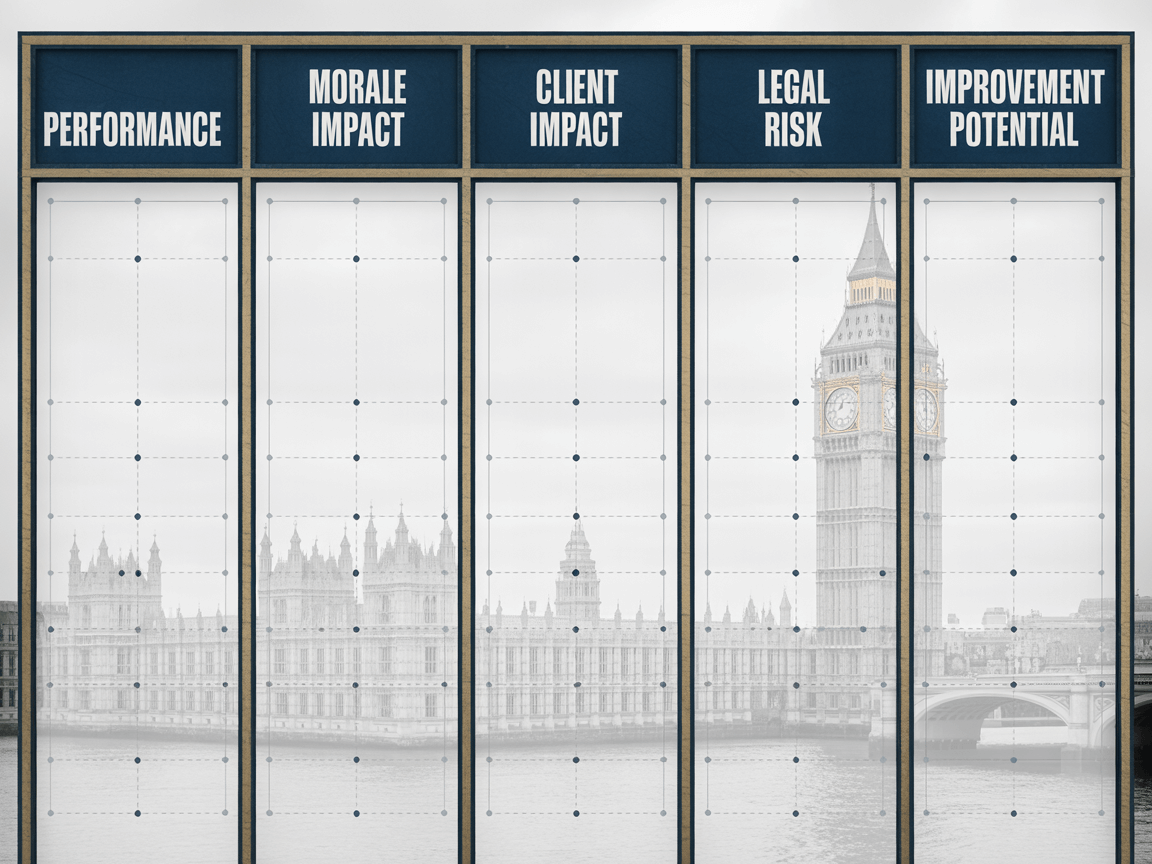
The Performance Decision Matrix
Create this table to evaluate your situation objectively:
| Factor | Score (1-5) | Weight | Your Notes |
|---|---|---|---|
| Performance vs. targets | High | Measurable results only | |
| Impact on team morale | High | Honest assessment | |
| Client/customer impact | High | External consequences | |
| Effort to replace | Medium | Recruitment difficulty | |
| Realistic improvement potential | High | Be honest, not hopeful | |
| Cultural fit and values | Medium | Alignment with company culture | |
| Legal risk if dismissed | High | Any protected characteristics? |
Scoring guide:
- 1 = Major concern/problem
- 3 = Neutral/mixed
- 5 = Excellent/no concern
If scores are consistently 1-2 despite documented support, the decision becomes clearer.
The “Sleep Test” for Difficult Decisions
Here’s a simple but remarkably effective technique I learned from a mentor years ago:
Ask yourself: “If I make this decision today, will I sleep better or worse tonight?”
Often, the sense of relief you feel at finally deciding tells you something important. Prolonged stress and anxiety about an employee situation usually indicates you already know what needs to happen – you’re just avoiding the discomfort of action.
Conversely, if imagining the dismissal fills you with genuine dread beyond normal discomfort, that might indicate you haven’t exhausted all alternatives or haven’t followed sufficient process yet.
Trust Your Gut – But Verify It With Evidence
As a business owner with years of experience, your instinct matters and deserves respect. But verify it against:
✓ Documented evidence of performance issues and support provided
✓ Objective performance metrics, not just subjective feelings
✓ Input from other managers or trusted advisors who know the situation
✓ Legal compliance checklist – have you followed proper procedure?
✓ Fair process audit – would an objective third party view this as fair?
When your experienced instinct aligns with documented evidence and legal compliance, you can act decisively and confidently.
This is precisely why many successful entrepreneurs invest in business coaching – having an experienced external perspective helps you make difficult decisions with confidence rather than doubt.
When to Get Professional Help With People Management
Let’s address this directly: knowing when you need support is a strength, not a weakness.
Signs You’d Benefit from Business Coaching or HR Support
Consider professional guidance if:
- You’re consistently avoiding performance conversations because they feel too difficult
- Employee issues are consuming excessive time that should go to business growth
- You feel out of your depth with employment law and HR procedures
- Team turnover is higher than your industry average
- You’re making people decisions based on emotion rather than strategic thinking
- Performance management feels reactive rather than proactive
- Your business growth is limited by people management challenges
Many entrepreneurs come to me initially struggling with precisely these issues. Through business coaching, we develop their people leadership capabilities alongside broader business strategy.
The ROI of Professional People Management Support
Consider the numbers:
Cost of keeping an underperformer for one year:
- Salary: £35,000
- Lost productivity (30%): £10,500
- Management time (10 hours/week): £15,000
- Team morale impact: £5,000
- Total cost: £65,500
Cost of professional HR/coaching support:
- Employment law advice: £800-£1,500
- Business coaching (3 months): £3,000-£5,000
- Total investment: £5,000 maximum
The return on investment is obvious. Professional support doesn’t just help you make better decisions – it enables you to build systems that prevent these issues from recurring.
This is why understanding business coaching investment in the context of the problems it solves makes the ROI clear.
Take Control of Your People Management Today
Here’s the truth: you already know what decision you need to make.
The fact that you’ve read this comprehensive guide means you’re taking your responsibilities as a business owner seriously. That’s precisely the kind of thoughtful leadership your business needs.
Whether you decide to let an underperforming employee go or invest in their improvement through a formal PIP, what matters most is that you take decisive action rather than remaining paralysed by indecision.
Your Action Plan for This Week
If you’re currently facing a performance decision:
Monday/Tuesday:
- Review all documentation of performance issues honestly
- Complete the Performance Decision Matrix with objective evidence
- Assess whether you’ve genuinely followed a fair process
- Review your employment contracts and disciplinary procedures
Wednesday/Thursday: 5. Consult an employment law advisor or HR specialist if any legal concerns exist 6. Make your decision based on evidence, not emotion 7. Prepare your action plan (either dismissal or formal PIP)
Friday: 8. Schedule necessary meetings for next week 9. Prepare all required documentation 10. Brief any relevant managers or HR support
Remember the core principles:
- Document everything thoroughly and contemporaneously
- Follow fair process consistently and demonstrably
- Make decisions based on evidence, not emotion or guilt
- Seek professional advice when legal concerns exist
- Learn from every experience to strengthen your systems
Your business deserves a team of people who contribute positively to its success and share your commitment to excellence. You deserve to lead without the constant drain of managing persistent underperformance.
Work With Me: Transform Your People Management
If you’re struggling with performance management decisions or want to develop your leadership capabilities systematically, let’s have a conversation about how I can help.
As a business coach in London with over two decades of entrepreneurial experience across multiple successful businesses, I’ve guided countless business owners through these exact challenges.
Book a complimentary strategy session where we’ll:
- Discuss your specific people management situation confidentially
- Identify the key leadership capabilities you need to develop
- Explore how coaching can help you become the confident, decisive leader your business needs
- Create a clear action plan for resolving your current challenges
Because great businesses aren’t built on avoiding difficult decisions – they’re built on making the right ones at the right time with confidence and clarity.
Are you ready to take control of your people management challenges and build a high-performing team?
Contact me today to book your complimentary strategy session.
Key Takeaways: Should You Fire an Underperforming Employee?
| Key Principle | Why It Matters |
|---|---|
| Underperforming employees cost far more than their salary | Impacts morale, productivity, customer satisfaction, and revenue – hidden costs accumulate fast. |
| Always follow UK employment law fair process | Protects you legally – document issues, provide support, issue warnings, and use Performance Improvement Plans. |
| Make decisions based on documented evidence, not emotion | Prevents reactive decisions and ensures fairness, clarity, and legal safety. |
| Know your obligations under UK law | Compliance with the Equality Act 2010, notice periods, and fair dismissal procedures protects your business. |
| Explore genuine alternatives before dismissal | PIPs, role realignment, training, and coaching may resolve performance issues without termination. |
| Prevention is more cost-effective than cure | Strong hiring, onboarding, and performance systems stop issues before they become costly problems. |
| Seek professional support when needed | Employment law advisors ensure compliance; business coaches strengthen leadership skills. |
| Act decisively once you’ve followed a fair process | Delaying decisions harms productivity, morale, and business outcomes more than taking action. |
Frequently Asked Questions About Firing Underperforming Employees
How long should I give an underperforming employee to improve?
- A typical Performance Improvement Plan runs 30-90 days, depending on the severity of performance issues and complexity of the role. For straightforward performance gaps, 30-60 days is usually sufficient. More complex improvements may warrant 90 days. However, if there’s no improvement within the first 30 days despite intensive support, continuing further often yields minimal benefit.
Can I fire someone during their probation period for underperformance?
- Yes – this is precisely what probation periods are for. Employees with under 2 years’ service have very limited rights, making dismissal during probation much simpler legally. You still need to follow your stated probation review process and provide clear feedback, but the bar for dismissal is much lower. Don’t waste this opportunity by avoiding difficult decisions during probation.
What should I include in a Performance Improvement Plan?
- A legally sound PIP must include: (1) Specific, measurable performance issues with examples; (2) Clear improvement targets and success criteria; (3) Support and resources you’ll provide; (4) Timeline with review checkpoints (typically 30, 60, 90 days); (5) Explicit consequences if improvement isn’t achieved. All expectations must be realistic and achievable within the timeframe.
Do I need to give written warnings before firing someone in the UK?
- Generally, yes, unless it’s gross misconduct. UK employment law and
ACAS guidelines require a fair disciplinary process for capability dismissals, which typically includes a first written warning, then a final written warning, before dismissal. Each warning should clearly state the consequences if performance doesn’t improve. Document everything meticulously.
Can an employee sue me for unfair dismissal if I follow the correct process?
- They can file a tribunal claim, but if you’ve followed fair process correctly, documented everything, and have legitimate performance grounds, you should successfully defend it. Employees need 2+ years’ service to claim ordinary unfair dismissal. However, discrimination claims can be brought from day one, which is why you must never dismiss someone due to protected characteristics. When in doubt, seek employment law advice.
What’s the difference between firing for performance vs. conduct?
- Performance (capability) dismissal addresses the inability to meet job requirements despite support – they can’t do the job. Conduct dismissal addresses behavioural issues or misconduct – they won’t do the job correctly. Both require fair process, but conduct issues may escalate to dismissal more quickly, especially for gross misconduct (theft, violence, serious policy breaches), which can result in immediate dismissal.
Should I offer a settlement agreement instead of a formal dismissal?
- Settlement agreements (formerly “compromise agreements”) can be beneficial for both parties. You offer a financial settlement (typically 1-3 months’ salary plus notice pay) in exchange for the employee leaving without claims. This avoids lengthy procedures and potential tribunal risk. However, they must receive independent legal advice (which you typically pay £300-£500 for). Consider this option when you want a clean, quick resolution and are willing to pay for it.
How do I handle the situation if other employees ask why someone was fired?
- Maintain professional confidentiality while being transparent about standards. Simply say: “I can’t discuss the details of individual employment situations due to confidentiality. What I can tell you is that we have clear performance standards and fair processes, and we apply them consistently across the business. Everyone here is expected to meet those standards.” Never gossip or share details about the dismissed employee.
Can I fire someone who’s off sick or on maternity leave?
- You can, but it’s hazardous legally and requires specialist advice. Dismissing someone on sick leave could constitute disability discrimination if their illness is long-term. Dismissing during maternity leave is usually automatically unfair unless for gross misconduct or genuine redundancy. If you’re considering dismissal in either situation, you must consult an employment law specialist first – the legal risks are substantial.